Category: Zoho finance workflows
Author: AorBorC Technologies
Published: July 15, 2026
Source URLs: Zoho Books July 2026 product updates, Zoho Books May 2026 product updates, Zoho Books June 2026 product updates.
Zoho Books' July 2026 product update is easy to read as a list of finance features. That would understate the operational signal.
Zoho added Terminal Payments support for India, the US, and Canada editions, CMP-08 filing support for India composition taxpayers, SEPA Credit Transfer support for Germany, a cash-based Receipts and Payments Report for non-profit organizations, and self-billed credit and debit notes for buyer-generated billing scenarios. Zoho also notes Inventory add-on enhancements in the same update.
AorBorC's view: this is not just a payment collection update. It is a reminder that finance workflows now sit closer to the point of sale, procurement, compliance, and reporting layer. If teams enable new payment or filing features without checking the handoffs around them, the accounting system gets faster at recording messy data.
What changed
Zoho says Terminal Payments now lets teams accept in-person customer payments from Zoho Books through connected payment terminals and dynamic QR codes. India edition support is listed for Paytm Dynamic QR and PhonePe Dynamic QR. US and Canada editions can connect Stripe Terminal and Square Terminal.
The same July update also adds direct CMP-08 preparation, push, payment, and filing from Zoho Books for India composition taxpayers. For Germany, Zoho Books can generate a SEPA Credit Transfer XML file for multiple vendor payments. The update also introduces receipts and payments reporting for non-profits and self-billed credit or debit notes for vendor billing scenarios.
Those are different features, but they point to the same operating question: when money moves, does the rest of the system know what happened?
Why operational leaders should care
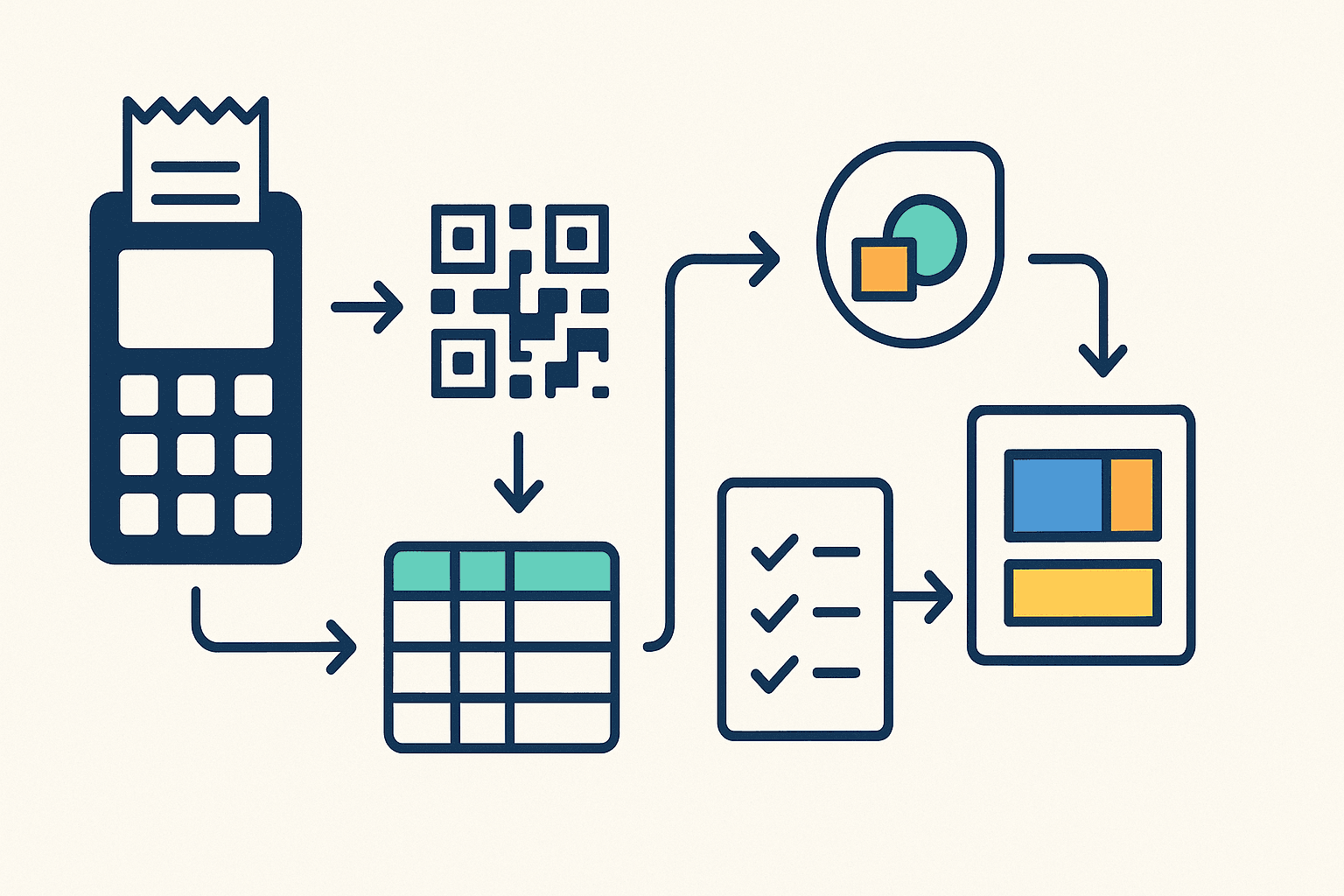
In-person payment collection can look like a front-office convenience. In practice, it touches finance controls, inventory movement, order status, branch reporting, customer records, and reconciliation. A payment received at a counter or field location may need to update the invoice, customer balance, receipt record, cash account, tax treatment, sales report, and inventory commitment.
That is where small businesses usually get into trouble. The payment succeeds, but the handoff around it is loose. Staff create duplicate receipts. Inventory remains separate. A manager exports data to clean up branch totals. Finance does not know whether a QR payment, terminal payment, bank transfer, or cash receipt should reconcile to the same account path.
For e-commerce and ERP teams, the impact is broader. Shopify, custom storefront, Odoo, Zoho Inventory, Zoho CRM, Zoho Books, and reporting tools all need consistent transaction meaning. If a sale starts online and finishes offline, or if an order is created in one system and paid in another, the integration should make the order, payment, tax, stock, and reporting state explicit.
AorBorC's practical take
The useful work is not to switch on every new finance feature. The useful work is to map the payment-to-ledger path and decide where each system is the source of truth.
For a Zoho-led operating stack, Zoho Books may own accounting, tax, receipts, vendor payments, and finance reports. Zoho CRM may own customer and deal context. Zoho Inventory or an ERP module may own product, stock, warehouse, and fulfillment state. Odoo may own deeper ERP modules for procurement, warehouse, manufacturing, or accounting in businesses that need a broader suite. Shopify may own storefront, checkout, catalog, and order capture.
A good implementation makes those boundaries boring. Payment status should not depend on someone remembering to update three screens. Inventory should not be adjusted from a spreadsheet after the finance team closes the day. Reports should not require manual stitching between terminal records, invoices, and order exports.
Implementation checklist
Use this before enabling or expanding terminal payments, bulk vendor transfers, or self-billing flows in Zoho Books:
- List every payment route: terminal, QR, bank transfer, online checkout, payment link, cash, and manual adjustment.
- Define the source of truth for customers, items, tax rates, invoice numbers, payment status, stock movement, and reporting dimensions.
- Confirm whether in-person payments should create, update, or only settle invoices already in Zoho Books.
- Check how refunds, partial payments, failed payments, and duplicate attempts are recorded.
- Map inventory impact for product sales: committed stock, fulfilled stock, returned items, damaged goods, and branch/location movement.
- Decide whether Shopify, Odoo, Zoho Inventory, or a custom app needs payment events from Zoho Books.
- Review user permissions so counter staff, finance users, and managers can only perform the right actions.
- Test daily reconciliation with real scenarios: split payments, QR payments, terminal payments, tax adjustments, refunds, and end-of-day settlement.
- Build reports around operational questions, not only accounting fields: branch, channel, salesperson, product category, customer segment, and payment method.
- Document the exception path for finance review before automation hides the problem.
Risks and limits
There are a few places where the hype is not useful.
First, terminal support does not automatically fix finance operations. If products, tax rules, branches, accounts, and receipt workflows are inconsistent, faster payment capture only moves the inconsistency downstream.
Second, region-specific features need region-specific review. Zoho's July update names editions and countries for several features. Do not assume every workflow is available in every organization, edition, payment provider, or tax setup.
Third, integrations need failure handling. A payment workflow is not complete until the team knows what happens when a payment succeeds but an inventory update, invoice sync, or ERP posting fails.
Fourth, AI fields and finance automation should remain human-reviewed where judgment matters. Zoho Books' May 2026 update introduced AI custom fields in premium and above plans, but finance records still need clear ownership, permission controls, and review paths before teams rely on generated classification or summaries.
Where AorBorC fits
AorBorC helps teams turn these platform updates into working operating systems. That can mean a Zoho Books and CRM handoff audit, a Zoho Inventory integration, a Shopify-to-finance reconciliation path, an Odoo implementation for broader ERP modules, a custom approval app, or a reporting layer that leaders can trust.
Relevant next reading:
If your payment, order, inventory, and finance records do not agree without manual cleanup, start with the handoff map before adding another feature. Plan the system review and bring the real payment paths, edge cases, and reports your team depends on.