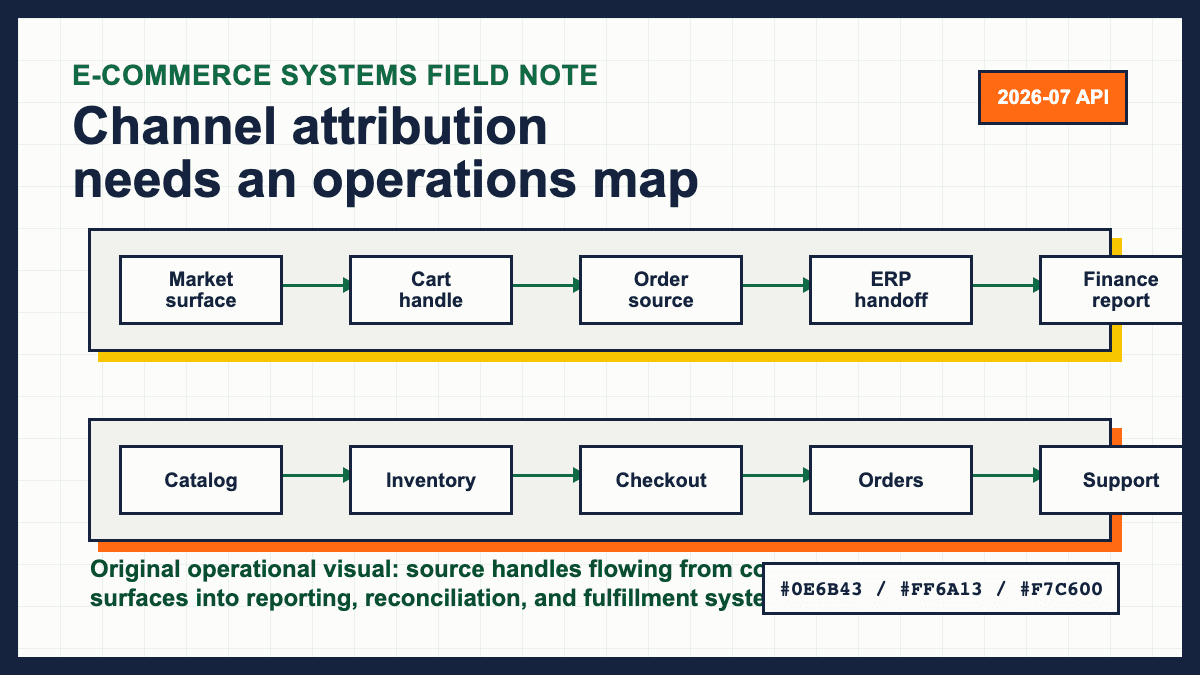
Shopify Order Attribution Is an ERP Reporting Test
Category: E-commerce systems
Author: AorBorC Technologies
Published: July 13, 2026
Source URLs: Shopify Developer Changelog, Shopify sales channel order attribution docs, Shopify GraphQL Admin Order docs, Shopify cart permalink docs.
Shopify's 2026-07 API update for sales channel order attribution is easy to treat as a developer-only change. That would miss the point.
The useful signal is operational: Shopify is giving sales channel apps a cleaner way to identify the more specific source that created an order, such as a marketplace, region, account, or commerce surface. That source can then flow through carts, orders, admin reporting, analytics, and the GraphQL Admin API.
For leaders running multi-channel commerce, this is not just attribution polish. It is a data contract decision. Once channel handles start moving through order creation, they can affect revenue reporting, ERP imports, finance reconciliation, inventory allocation, customer support routing, and management dashboards.
What changed
Shopify's official guidance says sales channel apps can now create order attribution definitions, pass attribution handles when creating carts or orders, and read the resolved details from Order.attribution. Shopify also notes that default app-level attribution is still enough when a business only needs to know that a channel app drove the order.
That distinction matters. A retailer selling through one online store may not need anything new. A business selling through multiple marketplaces, regional storefronts, B2B surfaces, social commerce paths, or partner accounts probably does.
The practical question is not "can the app pass the handle?" It is "does the business know what the handle should mean after the order leaves Shopify?"
The AorBorC view
AorBorC's position is simple: attribution data should be designed like operational data, not like campaign copy.
A channel label that looks harmless in Shopify can become messy downstream if it is not mapped before launch. Finance may want revenue by marketplace. Operations may want fulfillment by warehouse or catalog source. Support may need to know whether a customer came from a marketplace, direct store, regional surface, or wholesale path. Leadership may want clean reporting without asking a developer to explain five similar channel names.
This is where implementation discipline matters more than the API announcement. A founder-led systems partner should ask the boring questions early: which source names are approved, who owns them, where they sync, how exceptions are handled, and what reports will use them.
For AorBorC clients, this sits directly inside e-commerce operations and Shopify implementation, ERP module and reporting design, and long-lived integration work. If a stakeholder needs the short version of who is reviewing the system, the AorBorC company profile is the better link than a sales deck.
Where this affects the operating system
The first impact is reporting. If orders arrive from multiple surfaces but land under a single generic source, channel profitability becomes guesswork. Better attribution can help teams separate marketplace revenue, regional commerce, partner channels, and experimental sales paths without building fragile spreadsheet fixes.
The second impact is ERP and finance. Odoo, Zoho Books, custom ERP modules, and finance dashboards need stable source fields if they are going to reconcile orders, payments, refunds, taxes, discounts, and commissions. The attribution handle should not be renamed casually after accounting workflows depend on it.
The third impact is fulfillment. If a channel source implies different inventory rules, shipping promises, marketplace service levels, or warehouse handling, that source needs to be available before the order is routed.
The fourth impact is support. A support team looking at a customer order should know whether the order came from the main storefront, a marketplace connection, a B2B surface, or a regional channel. That context changes refund handling, customer communication, and escalation.
Implementation checklist
Use this before switching on more specific attribution:
- List every order source the business wants to distinguish: marketplace, region, account, B2B surface, social commerce path, app surface, or partner channel.
- Decide the approved handle, display name, owner, and retirement rule for each source.
- Map each handle into downstream systems: ERP, finance, warehouse, CRM, support desk, analytics, and board reporting.
- Confirm whether each source affects catalog rules, price lists, tax treatment, inventory allocation, fulfillment location, commission logic, or refund policy.
- Test cart creation, cart permalinks, order creation, ERP import, refund flow, partial cancellation, and reporting exports with sample orders.
- Add monitoring for unknown, missing, or fallback attribution so bad source data is caught before month-end reporting.
- Document who can create or change attribution definitions and how those changes are reviewed.
Risks and limits
Do not confuse order attribution with marketing attribution. Shopify's own order attribution docs distinguish source attribution from campaign, ad, email, referral, UTM, and Marketing Events data. Use each field for its job.
Do not over-segment just because the API allows it. If every campaign, promotion, or landing page becomes a source handle, operations will inherit noisy data that does not help fulfillment or finance.
Do not let channel labels become accounting policy. The label can help route and report orders, but tax, revenue recognition, commissions, and settlement rules still need explicit finance logic.
Do not skip permissions and data access review. Shopify's Order object documentation is clear that order data access should be tied to legitimate app functionality. If an integration only needs summarized reporting, it should not casually pull broad order records.
Business takeaway
The hype version says better attribution means better analytics. The useful version says better attribution gives operations a chance to stop guessing where orders came from before that guess reaches ERP, finance, warehouse, and support workflows.
If your Shopify store is becoming a multi-channel operating layer, treat order attribution as part of the system design. Map it before it becomes historical data.