Category: Odoo 20, ERP Controls & E-commerce Operations
Author: AorBorC Technologies
Published: September 24, 2026
Odoo connects eCommerce, sales, inventory, purchasing, and accounting in one ERP. Operational leaders should ask whether their team can prove who owns the defaults, exceptions, and evidence after extra steps disappear—not whether Odoo 20 looks faster. Treat the September 24 launch as a reason to test three flows, not as automatic approval to upgrade.
What Odoo 20 changed on September 24
Odoo's September 24 launch post presents version 20 around plain-language AI automation, more automated purchasing and inventory work, eCommerce changes, and direct bill payment. Its examples include confirming a sales order from a matching email, drafting purchases from stock needs, matching bills to purchase orders, and paying bills from Odoo.
The release notes make the operational shift clearer. An online store can use simplified inventory without the Inventory app; stock availability can control product publishing; eCommerce orders can use a selected default accounting journal, the accounting book used to group those entries; intercompany routes and inventory-cost transfers have been improved; and supplier-bill matching, payment initiation, and bank reconciliation contain new automation and checks.
The launch post also says Odoo can calculate minimum and maximum stock levels from the previous 30 days of sales and draft a purchase order, while vendor quality, bill matching, and discrepancies surface earlier. A proposed action still needs a policy, approval boundary, and exception owner.
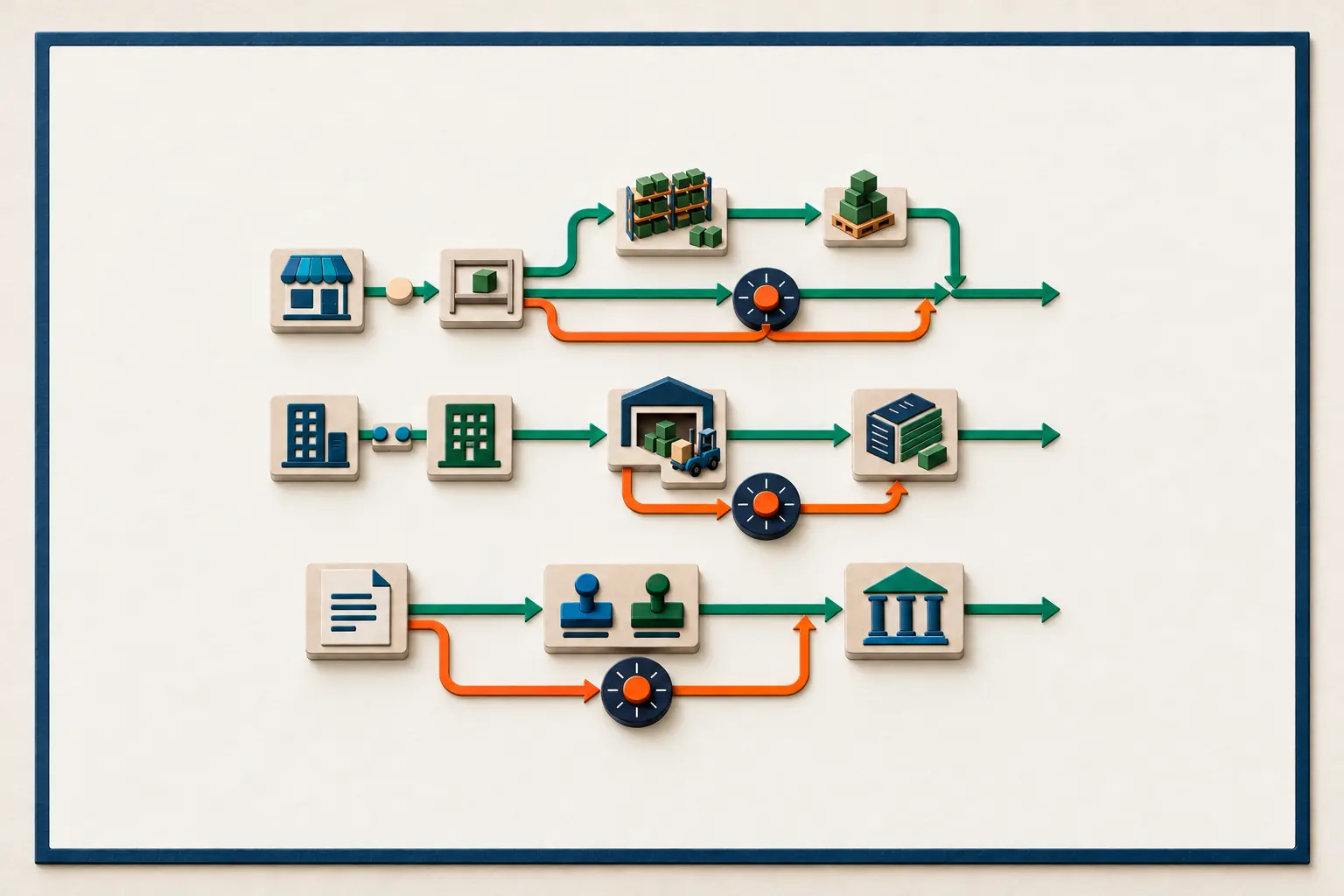
Selected Odoo 20 changes shorten paths across three transaction boundaries: online sale to available stock, fulfilled order to the right company accounts, and supplier bill to bank settlement. They connect demand, stock, and finance more tightly, but do not prove every configuration, localization, bank connection, or custom module is ready for your business.
Fewer steps move the control
The control moves; it does not disappear. Removing a click moves it upstream to whoever configures the default, sideways to whoever handles the exception, and downstream to whoever reviews the evidence.
For every shortcut, define an eligibility rule, configuration approver, exception queue, and evidence report. Without those four, automation can make a wrong decision more consistent without making it more visible.
AorBorC inference: Odoo 20's most important management question is therefore not “How much can we automate?” It is “Which artifact proves that the automated outcome was correct, and which named owner acts when it is not?” That is an AorBorC inference, not product wording from Odoo. The distinction matters most where a storefront changes stock, one company fulfills another company's sale, or a supplier bill proceeds through approval, payment initiation, and reconciliation.
Online sale to available stock
Odoo 20's release notes say eCommerce can run with simplified inventory without installing the Inventory app. In that mode, each product has a single on-hand quantity and required transfers are removed. The notes also describe automatic unpublishing and republishing based on stock availability.
That combination can suit a straightforward catalog with one meaningful stock balance. It should not be selected merely because it is shorter. Before using it, define how returns, damaged goods, pending receipts, backorders, and concurrent checkouts affect what the store may sell. Then test the exact configured behavior rather than assuming what “available” means.
If a retailer relies on multiple location movements, reservations, lots or serials, or detailed warehouse transfers today, the published description does not establish how those controls will be preserved. In practical terms, simplified inventory is not full warehouse operations. Treat the shorter model as a scope option, not a maturity level.
AorBorC inference: The control has moved from a warehouse transfer step to the saleability rule and its exception queue. The owner needs a stock policy, an oversell test, and evidence that republishing happens correctly. That is part of sound e-commerce store development, not a theme setting.
Fulfilled order to the right company accounts
Odoo 20 lets a business select a default accounting journal for eCommerce orders. Its improved intercompany flows can resupply one company from another, fulfill a sales order from another company's warehouse or pickup point, transfer the recorded inventory cost between companies, and communicate updates across linked sales and purchase orders. Synchronized intercompany vendor bills can also be matched with synchronized purchase orders.
The same convenience increases the impact of a wrong company, warehouse, route, or journal default. A successful delivery is not enough. The test must show the selling company, fulfilling company, customer invoice, intercompany documents, taxes, revenue, stock valuation, and cost of goods sold landing where finance expects. When a later cost changes, the release notes say the delivery's value can be updated retroactively and, with perpetual accounting, the invoice cost can also update. That needs a close-period policy: a rule for handling late cost changes after finance has closed a reporting period.
AorBorC inference: The control is an approved order-to-company mapping plus a finance-reviewed exception report—not a user choosing values on every order.
Supplier bill to bank settlement
The procurement-to-payment flow gains several linked changes. Bill-line prediction can suggest product, account, tax, analytic distribution, and vehicle from prior bills and labels while preserving manually entered values. Improved purchase-order matching checks existing lines before creating new ones, summarizes matches, warns about unexpected price or quantity differences, and allows unmatching.
Odoo's release notes also say individual or batch bills can be paid with one signature through the new payment-initiation-service-provider interface. The payment wizard detects pending payments and deducts them from the amount due. The notes say journal entries affecting bank accounts must originate from bank transactions, and the status language now distinguishes a payment marked Paid from one Reconciled to a real bank entry.
AorBorC inference: That status distinction matters: a payment instruction does not by itself prove bank settlement. Management reporting should not treat Paid and Reconciled as interchangeable. Maker-checker means one person prepares a payment and another approves it. Maker-checker controls and reconciliation are AorBorC recommendations, not claims that Odoo automatically provides your required approval policy.
This is not one control; it is a chain. Accounts payable owns the match and discrepancy. A budget or department owner approves the commercial exception. Treasury owns the payment batch and signature. The controller owns reconciliation and period evidence. If one person silently inherits all four jobs, the workflow is shorter but the operating risk is larger.
A ten-output Odoo 20 readiness checklist
The role beside each output is the accountable function. Before go-live, replace every role with one named person and a deputy.
Release-to-process map. Artifact: A list of each Odoo 20 feature proposed for use, the current step it replaces, and the control that must remain, with evaluated-only features marked. Owner: Operations lead.
App and dependency register. Artifact: A record of installed apps, extra modules, dependencies, custom code, hosting model, subscription impact, and each required module's target-version path. Owner: Odoo administrator.
Stock saleability policy. Artifact: A rule for which products may use simplified inventory, what stock state permits publishing, and how returns, damage, backorders, and oversell exceptions are handled. Owner: eCommerce operations lead.
Order-to-company mapping. Artifact: A map of each website, legal company, warehouse, route, journal, tax treatment, revenue path, and expected document at every intercompany handoff. Owner: Group financial controller.
Intercompany transaction pack. Artifact: Expected and actual outputs for one resupply and one cross-company fulfillment from order through delivery, linked purchase documents, valuation, and accounting. Owner: Supply-chain lead.
Bill-match exception matrix. Artifact: Price and quantity tolerances, receipt requirements, duplicate handling, approvers, and evidence rules for unmatched or deliberately unmatched bills. Owner: Accounts-payable manager.
Payment authorization matrix. Artifact: Named preparers, reviewers, and signers for individual and batch payments, with limits, provider and bank coverage, failed-payment handling, and duplicate-payment review. Owner: Treasury lead.
Reconciliation evidence report. Artifact: A report separating Paid, Reconciled, pending, and unreconciled items, with aging thresholds, investigation owners, and month-end sign-off. Owner: Financial controller.
Upgrade regression pack. Artifact: Results for online checkout, purchasing, receipt, delivery, invoicing, credit notes, reports, integrations, automated actions, and permissions in the upgraded test database. Owner: UAT lead.
Go-live decision record. Artifact: Accepted custom-module readiness, open exceptions, downtime, cut-off rules, support contacts, and named approval. Do not schedule production until this evidence is accepted. Owner: Executive sponsor.
Where the automation hype is not useful
The launch post's broad promise of describing a process and letting an AI agent run it is useful for discovering possibilities. It is not a control design. Likewise, the 30-day sales history does not establish AI-assisted replenishment; the cited example says Odoo calculates stock levels and drafts a purchase order.
Auto-confirming a sales order from an email, for example, still leaves questions about sender identity, duplicates, customer status, agreed pricing, credit, tax, stock, and exceptions. Predicting an account on a bill does not make that account correct. An AI-generated action should enter the same approval, access-control, logging, and exception structure as any other action. Human review is most valuable at the irreversible or financially material boundary, not as a ceremonial click afterward.
Risks and limits
The release notes are a catalog, not a deployment guarantee. Availability still depends on edition, localization, bank, provider, and tenant, as well as country, hosting, and configuration. Odoo's apps documentation warns that adding or removing apps can affect other apps and subscription costs; dependencies can install more modules; and uninstalling can delete records. Test those changes on a duplicate database.
Odoo's upgrade documentation calls for an upgraded test database and end-to-end business-flow testing. Custom modules must be compatible with the target version. External integrations may need separate sandbox evidence because an upgraded test database does not by itself prove live-provider behavior. Production downtime must be planned. For Odoo Online specifically, Odoo warns that after the production upgrade completes, reverting to the previous version is impossible.
Where AorBorC fits
AorBorC approaches Odoo 20 as an operational-system change, not a feature tour. Our Odoo implementation work maps the order-to-cash, inventory, intercompany, and procure-to-pay paths before configuration. Where standard behavior is insufficient, ERP module development is tied to a named requirement, test, and owner rather than custom code for its own sake.
That approach reflects the wider AorBorC position: founder-led Zoho, Odoo, eCommerce, and AI delivery; rescue and audit discipline; practical integrations; and human-reviewed automation built to last. The goal is a maintainable operating system whose controls survive staff changes, upgrades, and exceptions.
Business takeaway
Odoo 20 can remove steps, but it cannot assign accountability. Every automated default needs an owner, every exception needs a route, and every material outcome needs evidence.
The upgrade is ready when operations and finance can trace a real transaction together without filling gaps with assumptions.
What to do this week
Choose one real example for each flow: online order to stock, cross-company fulfillment to accounts, and supplier bill to bank reconciliation. Run all three in an upgraded test database. Collect the ten artifacts above, log every exception, and hold one joint operations-and-finance review.
If the mappings or ownership are unclear, plan an Odoo implementation review before setting a production date.