Category: EU Customs, E-commerce & ERP Operations
Author: AorBorC Technologies
Published: September 22, 2026
Regulation (EU) 2026/2108 entered into force on 20 September 2026. The Commission announced progressive implementation the next day. Implementation is staged. This is not a signal to rush out and buy a connector for a future customs portal.
The useful response is more basic: make the data behind every imported order traceable now.
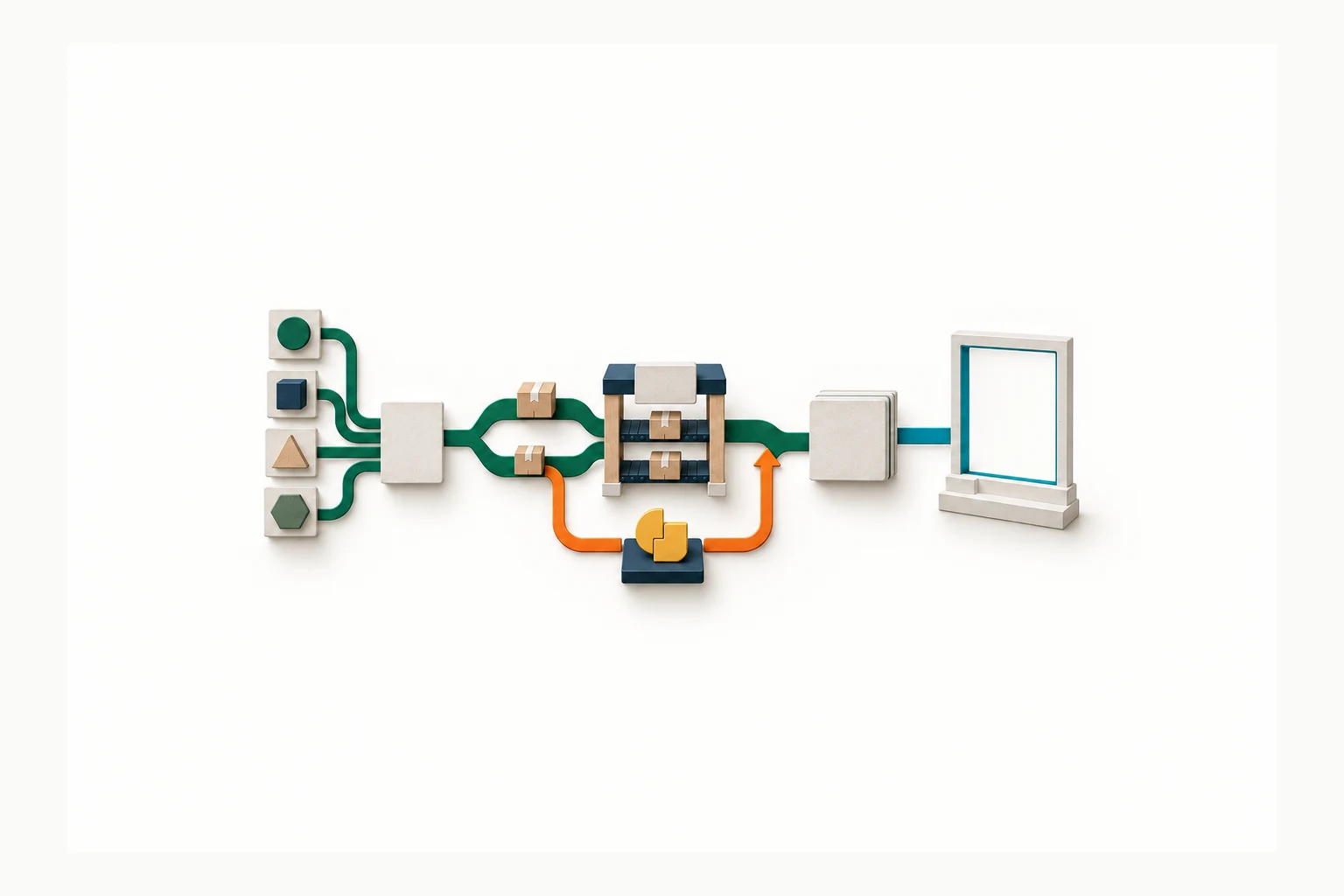
At AorBorC, we call that an e-commerce customs data contract. It is an operating method, not a term in the legislation. For every material data element, it names the source, owner, consumer, evidence, and exception path so a broker export does not become the only version of truth.
This article concerns goods entering the EU from outside it. It does not claim that every EU merchant, domestic-only flow, or services business has the same obligations. Qualified customs, tax, and legal advisers must determine roles, classifications, values, and jurisdiction-specific requirements. AorBorC's role is the data, workflow, integration, evidence, and reconciliation layer around those decisions.
What the Commission announced on 21 September
The regulation was published on 19 September. Article 287 puts entry into force on 20 September and general application on 21 September 2027, with listed provisions applying earlier. In plain language, the law exists, but most provisions apply later. The Commission said progressive implementation began on 21 September and Member States had 12 months to implement the rules fully.
The modernised Union Customs Code, or UCC, provides the legal framework. The EU Customs Authority, or EUCA, was legally established on 20 September and is expected to begin operations in 2027.
The reform also establishes the basis for an EU Customs Data Hub: a future single interface through which businesses will provide customs information and authorities will work from a common data environment. For e-commerce, use of that Hub is planned to become mandatory from 1 July 2028.
Four clocks, not one go-live
- Already live — 1 July 2026: a temporary €3 customs duty per item applies under the published low-value-import regime. The Commission says “per item” is based on tariff classification, not physical quantity, and sets detailed scheme and declaration conditions. This predates the September milestone and needs transaction-specific advice.
- In force/implementing — 20–21 September 2026: the regulation entered into force on 20 September; the Commission announced progressive implementation from 21 September. Most provisions apply from 21 September 2027, with listed exceptions applying earlier. The Commission's 12-month statement is not permission to invent a national deadline or assume every component is available at once.
- Expected — November 2026, then 2027: a small-parcel handling fee is expected by 1 November 2026, but its amount is to be established through a delegated act. EUCA is expected to start operating in 2027. Keep both as unresolved milestones rather than hard-coding a number or capability.
- Future mandatory — 1 July 2028: the EU Customs Data Hub is planned to become mandatory for e-commerce. The date is published; a finished integration contract for each business is not. Build clean source data and a stable integration boundary now, rather than pretending a live government API already exists.
Does this affect your operation?
Ask five questions. Do you sell goods from outside the EU? Who submits information for those movements? Can one order split across warehouses or parcels? How are returns, replacements, and corrections handled? Can finance reconcile amounts charged, declared, refunded, and settled?
If the answers expose goods imported into the EU from outside it, the reform belongs on the operating roadmap. The accountable legal role may sit with a seller, marketplace, importer, representative, or another party depending on the transaction. That determination belongs with qualified advisers. The systems question is whether the business can supply and trace the facts that role requires.
Why the EU Customs Data Hub will not repair upstream data
A future customs interface can accept data. It cannot repair a product variant with no stable identity, an origin copied from a supplier email, a parcel that cannot be tied back to order lines, or a refund that never reaches the ledger.
Customs may be filed at the border, but the evidence is created across the product, order, parcel, return, and finance workflow.
A customs connector should be the last mile of a governed chain. Brokers and carriers remain important, but their export should not be the sole record for facts originating in the catalog, checkout, warehouse, or finance platform. Retain their declarations, acknowledgements, rejections, and corrections as evidence.
A split shipment exposes the missing contract
Take two product variants whose goods sit under different adviser-approved tariff subheadings. One order splits between two warehouses and becomes two parcels. The broker receives separate declaration records and returns an acknowledgement, then a correction changes the contents of one parcel. That parcel is later returned and replaced.
A defensible customs trail connects each approved tariff-item identity and accepted transaction fact to parcel composition, the retained declaration request, broker or authority response, correction, return, replacement, and finance entry. It also shows who approved an override and why.
If the team needs four spreadsheets and a broker email to reconstruct that one order, the immediate issue is not a 2028 connector. It is a missing data contract.
A ten-part commerce data contract
Use these entries as operational questions. Fields such as commodity classification, origin, value, and responsible operator apply only where advisers determine they are required. The system should record approved decisions and evidence; it should not manufacture customs advice.
Applicability and accountability. Object: the cross-border sales flow. Source: approved legal and customs-role assessment. Owner: a named operations or compliance lead. Consumer: commerce, finance, fulfilment, and integration teams. Evidence: the approved scope, assumptions, and review date. Exception: route an unclassified route, product, or party to a qualified adviser before automation.
Tariff-item identity. Object: each sellable variant and its adviser-approved tariff-category relationship. Source: the governed product master. Owner: catalog operations. Consumer: checkout, ERP, warehouse, carrier, and declaration processes. Evidence: version history plus approved classification and origin records where applicable. Exception: review a line whose identity, description, classification, or origin evidence is incomplete.
Accepted transaction facts. Object: the order line as accepted by the customer. Source: the commerce platform. Owner: e-commerce operations. Consumer: ERP, finance, fulfilment, refunds, and downstream customs processes. Evidence: a protected snapshot of quantity, price, discount, currency, destination, and relevant party details under approved minimisation, access, and retention rules. Exception: preserve a correction as a new event rather than silently rewriting the original order.
Order-to-parcel lineage. Object: the mapping between order lines and parcels. Source: the warehouse or fulfilment system. Owner: fulfilment operations. Consumer: carriers, customer service, ERP, and reconciliation. Evidence: parcel identifiers with included lines and quantities. Exception: quarantine a split, merge, short pick, or substitute that cannot be traced to the accepted order.
Warehouse transformations. Object: bundles, kits, relabelling, substitutions, and consolidation. Source: approved warehouse transactions. Owner: warehouse control. Consumer: inventory, product, carrier, and finance teams. Evidence: before-and-after item and quantity records. Exception: require approval when a physical change breaks the expected product-to-parcel relationship.
Declaration exchange. Object: every carrier or broker request and response. Source: the carrier or broker exchange. Owner: integration operations. Consumer: logistics, customer service, and evidence review. Evidence: access-controlled request and response records with correlation IDs, timestamps, acknowledgements, rejections, and corrections; hashes support integrity but cannot reconstruct a submission. Exception: send failed, duplicated, or materially changed submissions to a human-owned queue with safe retry rules.
Duty and fee scenarios. Object: date-controlled calculation inputs and outputs. Source: adviser-approved rules and published decisions. Owner: finance or commercial operations. Consumer: pricing, checkout, margin reporting, and reconciliation. Evidence: rule version, effective date, assumptions, and calculation trace. Exception: keep the November handling-fee amount unresolved until the delegated act establishes it; do not insert a guessed value.
Returns and replacements. Object: cancellation, return, refund, reshipment, and replacement events. Source: commerce, service, warehouse, and payment systems. Owner: customer operations. Consumer: inventory, finance, carrier, and downstream customs processes. Evidence: links to the original order line and parcel. Exception: investigate any reversal that cannot be matched to the original movement and settlement.
Financial reconciliation. Object: amounts charged, declared, paid, refunded, and settled. Source: commerce, payment, broker, carrier, and general-ledger records. Owner: finance. Consumer: financial control, operations, and management reporting. Evidence: an order- and parcel-level reconciliation with tolerances. Exception: assign differences outside tolerance to a named owner instead of clearing them through an unexplained journal.
Change and control evidence. Object: configuration, mapping, approval, and override history. Source: controlled workflow and deployment records. Owner: the system owner. Consumer: operations, internal review, and implementation partners. Evidence: tests, approver, timestamp, version, and rollback path. Exception: stop an unreviewed mapping or emergency override from becoming the new silent default.
Risks and limits
The biggest risk is false certainty. The reform is in force, but the programme remains staged. The handling-fee amount is unresolved. July 2028 is a mandatory-use milestone, not permission to claim a finished technical interface today. A 12-month Commission statement should not be converted into a made-up national deadline without local confirmation.
There is also no universal field list for every merchant in this article. Required data depends on goods, route, value, parties, and legal roles. Classification, origin, valuation, importer responsibility, and filing decisions need qualified advice. System designers should encode approved decisions, lineage, access, retries, reconciliation, and change control—not make those decisions by inference.
Where AorBorC fits
AorBorC can turn the approved operating scope into working systems: product-master cleanup, variant and order lineage, warehouse and parcel mapping, finance reconciliation, evidence retention, exception queues, and integration boundaries.
That can begin in a Shopify or other e-commerce implementation, continue through an Odoo implementation, or repair the seams between an existing storefront, ERP, warehouse, carrier, broker, and finance stack. Odoo is one ERP example, not a compliance shortcut.
Our company profile explains the founder-led, human-reviewed delivery model behind this work. The useful output is not a generic “customs ready” badge. It is a traceable workflow that keeps business ownership visible and leaves legal determinations with the right advisers.
Business takeaway
The reform is not a reason to buy a customs connector today. It is a reason to stop treating customs data as a broker-side export.
Use the time before mandatory e-commerce use of the Data Hub to make product, order, parcel, return, and finance facts coherent. Then a future connector has a controlled source to read from, a clear exception process, and evidence the business can actually inspect.
Your next move
Choose a high-volume imported variant and real split shipment. Build a six-column data-contract table for its objects, sources, owners, consumers, evidence, and exceptions. If none is available, use a representative imported order. Then sample the actual order, parcel, carrier or broker response, return, and finance records to find every broken link.
If that trace breaks, plan the operating and integration work with AorBorC before treating a future interface as the solution.
Sources checked
- European Commission press release: EU Customs Reform marks a new era for customs in Europe
- Regulation (EU) 2026/2108 establishing the Union Customs Code and EU Customs Authority (official PDF)
- European Commission: EU Customs Reform overview
- European Commission questions and answers on the EU Customs Reform
- European Commission guidance on the temporary flat-rate duty for low-value imports