
Technology leaders rarely struggle to find another tool. The harder problem is turning a business process into a system that people can trust, govern, and improve.
A request may begin simply: replace a spreadsheet, remove an approval bottleneck, give customers a portal, or connect information that is scattered across email and departmental applications. But once that workflow becomes operational, the CIO inherits a wider set of responsibilities. Who can see each record? Which actions require approval? How will exceptions be handled? What happens when an integration fails? Can the next team understand why the application was designed this way?
That is why a Zoho Creator initiative should not be treated as a collection of forms. It should be led as a business-system programme: small enough to move quickly, but governed from the beginning.
Where Zoho Creator fits in a CIO's application portfolio
Zoho Creator is a low-code application platform for building forms, workflows, reports, pages, portals, and integrations around a specific operating process. It is useful when an organisation needs more control than a spreadsheet or disconnected SaaS tools provide, but does not need to begin with a fully custom software stack.
Typical use cases include service requests, procurement approvals, field operations, project controls, vendor onboarding, compliance evidence, scheduling, inventory movements, and customer or partner portals. The common thread is not industry. It is the need for one controlled place where records, decisions, responsibilities, and status can move together.
The platform, however, is only part of the solution. A dependable application still needs a coherent data model, clear permission boundaries, integration ownership, testable business rules, and an operating model after launch. Those decisions are where CIO sponsorship and experienced implementation matter most.
Start with the outcome, not the interface
The first design question should not be, "Which forms do we need?" It should be, "What must become measurably easier, faster, safer, or more visible?"
A useful outcome statement is concrete enough to guide trade-offs. For example: every purchase request should have an accountable owner, the correct approval path, visible supporting documents, and a status that finance can trust. This is stronger than a requirement to "digitise procurement" because it defines what the system must make true.
Before building, agree on:
- the business result and process owner;
- the user groups, including external users;
- the records that form the system of record;
- the decisions, approvals, and exceptions;
- the integrations and the owner of each endpoint;
- the evidence needed for audit, support, or management review; and
- the acceptance criteria for the first release.
This keeps the project anchored when new requests appear. A feature belongs in the release when it supports the agreed outcome, reduces a known risk, or is necessary for adoption. Everything else can be prioritised explicitly instead of entering the build through informal conversations.
Map the workflow before configuring the application
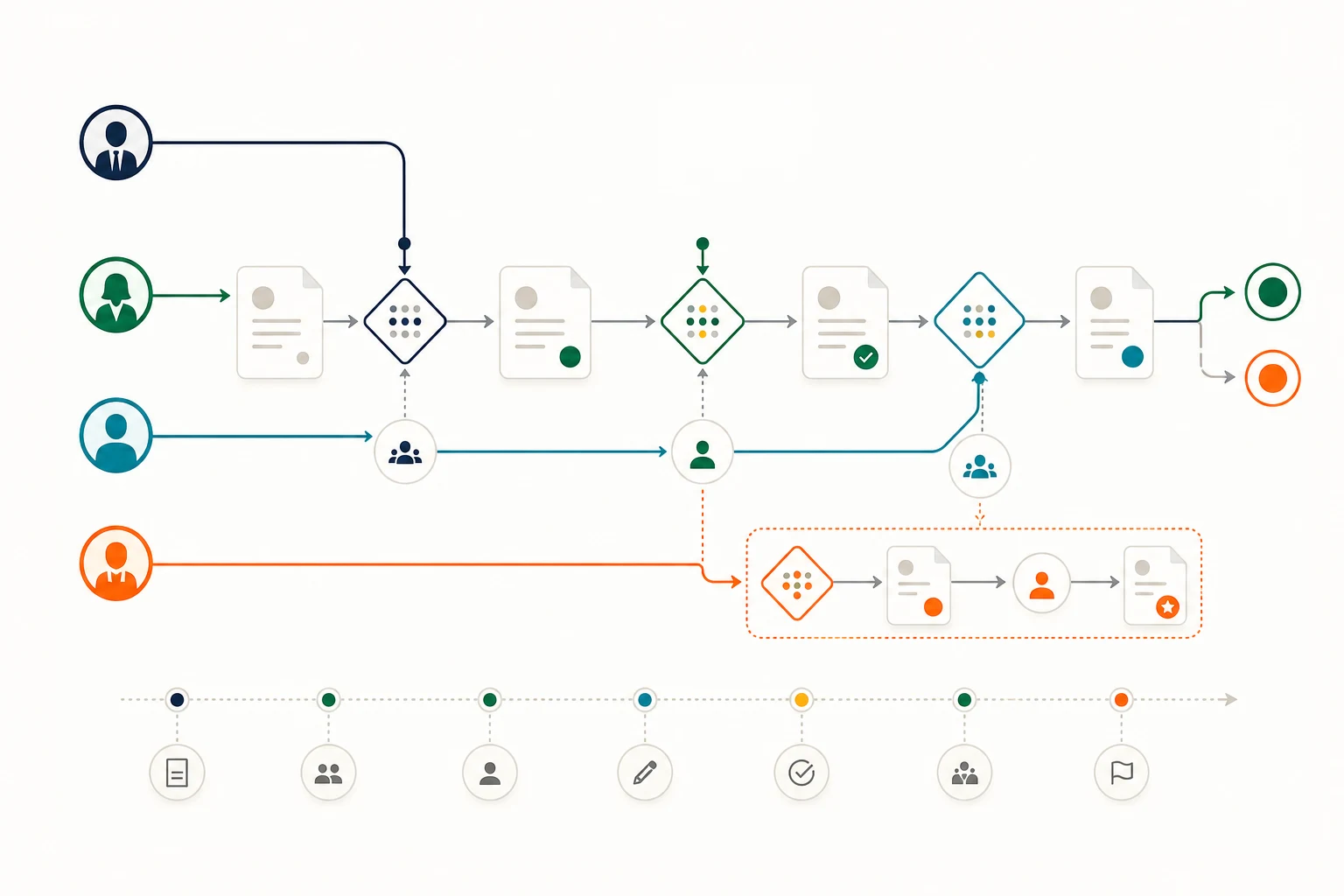
Operational work is rarely a clean sequence. It contains loops, missing information, delegated decisions, urgent exceptions, and different rules for different teams. A workshop that captures only the happy path produces a tidy diagram and an unreliable application.
The workflow map should show how a record begins, who enriches it, which rules route it, what approvals apply, what other systems exchange information, and how it closes. It should also identify what happens when data is incomplete, an approver is unavailable, a threshold is exceeded, or an external service does not respond.
From that map, the implementation team can define the application architecture: forms and related records, roles and permission sets, reports and dashboards, automations, portal access, integration points, and a phased release boundary. The result should be understandable to the business owner and precise enough for the builders to test.
Treat governance as application design
Governance is not a document added before go-live. It is expressed in the structure of the application.
Zoho Creator provides permissions, roles, data-sharing controls, and portal permission sets that can restrict access to application components, records, and fields. Creator also provides audit-trail capabilities for tracking activity. These platform controls are useful, but they still have to be designed around the organisation's responsibilities.
For each role, decide what the user can view, create, change, approve, export, or administer. Test those decisions with representative accounts. Pay particular attention to sensitive fields, bulk actions, portal users, and reports that combine data from several processes.
Auditability also requires operational clarity. Important automations should have an observable result, failures should create an actionable signal, and integrations should have an owner and a recovery path. A workflow that fails silently is not controlled simply because it was automated.
Build through controlled milestones
Low-code speed is most valuable when it shortens feedback cycles. It should not be used to postpone architecture or compress all validation into the final week.
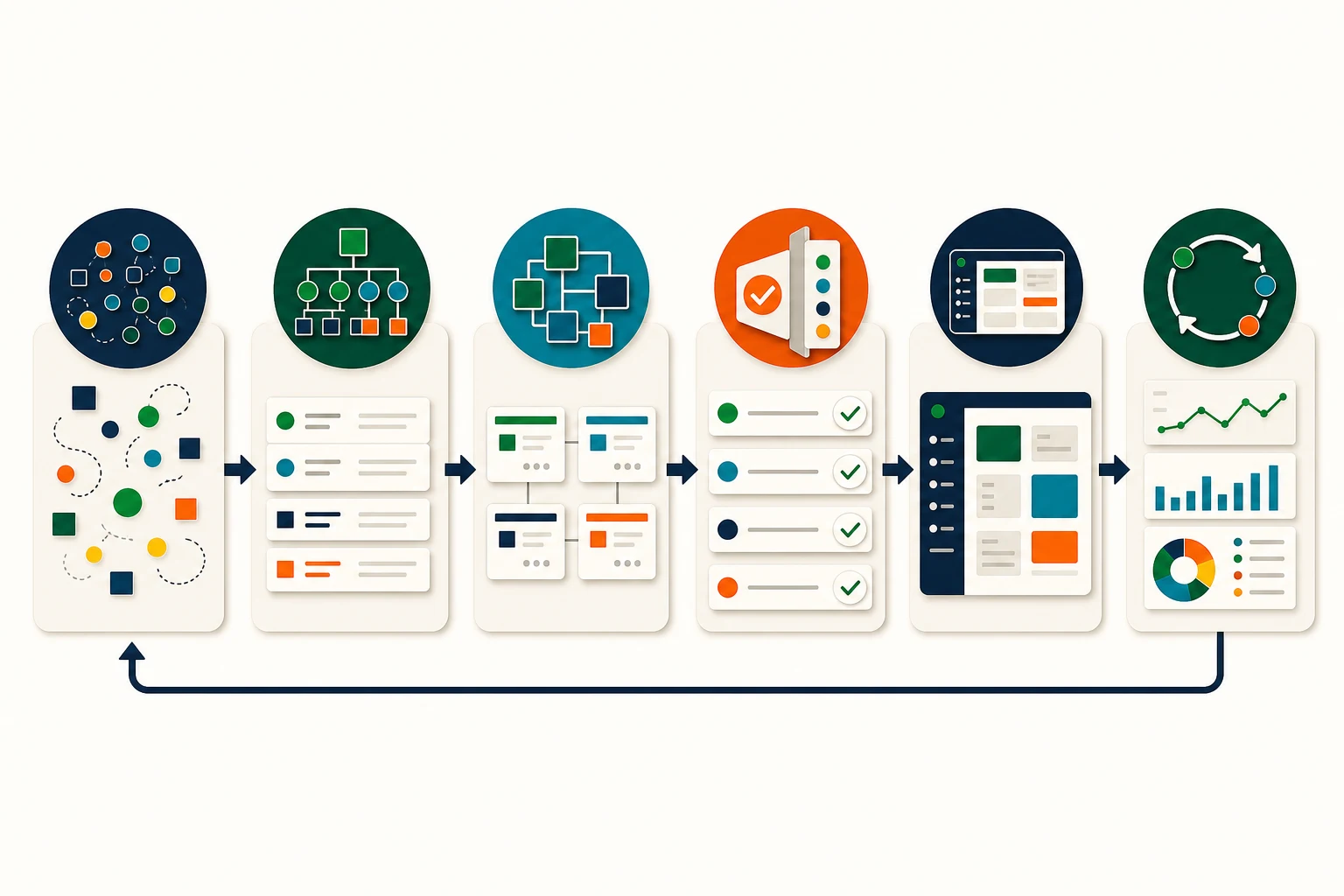
A milestone should produce something that stakeholders can inspect: a working workflow slice, a role-specific view, a portal journey, an integration result, or a management report. The demonstration should compare the application against the agreed scenario and record what has been accepted, changed, or deferred.
Written change control is equally important. When a new requirement affects the data model, permissions, timeline, or cost, the effect should be visible before the team starts building it. This protects both the sponsor and the implementation team from a release that expands without a corresponding decision.
Creator environments can support development, testing, and controlled publication of changes. CIOs should still review the platform's current environment limitations for the features in scope. Some capabilities, including aspects of portals and audit trails, have environment-specific constraints, so the test plan must reflect what can be validated before production and what needs a controlled production check.
Make UAT role-based and evidence-led
User acceptance testing is not a tour of screens. It is evidence that each role can complete its real work and that restricted actions remain restricted.
Create test scenarios from the workflow map. Include routine transactions, boundary values, rejected approvals, incomplete data, duplicate submissions, integration delays, permission checks, and recovery from failure. Ask users to verify the resulting records, notifications, reports, and audit evidence—not only the action they performed.
For an externally facing portal, test what each portal profile can see and change. For internal users, verify role hierarchy, field visibility, exports, administrative actions, and access to combined reports. Record defects and decisions in one place, retest the affected scenarios, and link release acceptance to agreed evidence.
Training and handover should use the same role model. Users need concise instructions for their tasks; administrators need configuration and support guidance; future developers need the workflow, data, integration, and design decisions. Documentation is part of operational resilience, not an optional project souvenir.
Plan for the first month after launch
Go-live changes the quality of information available to the team. Real volumes, edge cases, user behaviour, and integration timing become visible. A short stabilisation period should therefore be part of the delivery plan.
During this period, review failed automations, incomplete records, permission questions, support requests, and differences between expected and actual cycle time. Separate genuine defects from training needs and enhancement ideas. Fix urgent reliability issues first, then prioritise improvements against the original business outcome.
After stabilisation, establish an application owner, a request path, a release rhythm, and a simple decision log. The goal is not to freeze the application. It is to let it evolve without losing the controls that made it dependable.
Where AorBorC fits
AorBorC works with CIOs, fractional CIOs, and operational leaders to turn workflow requirements into maintainable Zoho Creator systems. The work begins with process and solution mapping, then moves through architecture, configuration, scripting, permissions, integrations, milestone demonstrations, testing, documentation, launch, and support.
This approach keeps platform speed connected to implementation discipline. The CIO retains a clear view of scope, ownership, risk, and acceptance, while users receive an application shaped around how the work actually moves.
Explore AorBorC's Zoho Creator implementation approach or plan a business system around your workflow.
A CIO's implementation-partner checklist
Before selecting a delivery partner, ask for clear answers to the following:
- Scope: Are deliverables, assumptions, exclusions, and dependencies written in comparable terms?
- Architecture: Will the partner document the workflow, data model, roles, portals, and integrations before the full build?
- Timeline: Are milestones tied to inspectable outcomes rather than broad percentages of completion?
- Commercial model: Is it clear what is fixed, what can vary, and how changes affect cost and schedule?
- Security: Who designs and tests permissions, sensitive fields, exports, portal access, and administrative privileges?
- Integrations: Who owns credentials, mapping, retries, monitoring, failure handling, and third-party coordination?
- Migration: How will source data be profiled, cleaned, reconciled, and accepted?
- Testing: Does the plan include role-based scenarios, exceptions, integration failures, regression checks, and retesting?
- Acceptance: What evidence is required before each milestone and production release is approved?
- Handover: Which user, administrator, solution, and support documents will be delivered?
- After launch: Is there a defined stabilisation period, support path, and method for prioritising improvements?
A strong proposal makes these answers easy to find. A strong implementation keeps them visible throughout delivery.