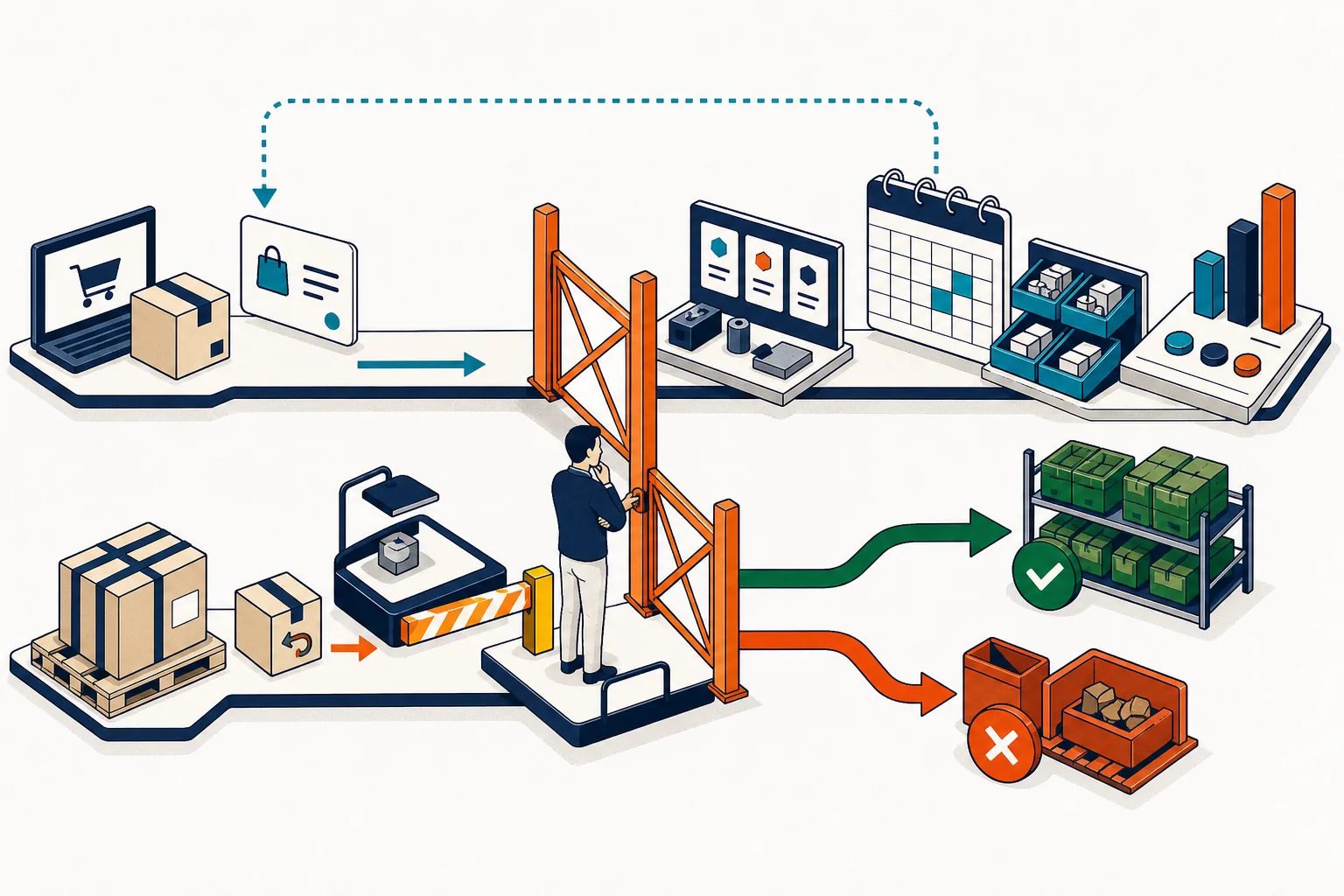
A faster ERP handoff without a named release owner is a faster way to move an unreviewed assumption downstream. Zoho ERP can now shorten the path from a confirmed sales order to a manufacturing order, while new receipt-quality controls can hold incoming and returned stock away from sale. The implementation work is deciding who may release each flow, what evidence they need, and how exceptions get recovered.
Category: Zoho ERP, manufacturing, e-commerce, and integrations
Zoho's July 2026 ERP update brings three changes that operational leaders should read together—but not collapse into one automated story.
First, a user can create a manufacturing order from a confirmed sales order when an ordered item has a bill of material and available stock is insufficient. Second, a new Work Center Calendar shows job cards, upcoming work, conflicts, utilisation, and dependencies. Third, the Quality module now supports Purchase Receives and Sales Return Receives. Configured quality rules automatically generate inspections when those goods are received; pending or in-progress inspections keep the received quantities unavailable for sale.
This is Zoho ERP for India, which Zoho announced in January 2026. This article covers that India product; it is not a blanket Zoho One, Zoho Books, or Zoho Inventory update. Availability, configuration, roles, and transaction behaviour should be verified in the organisation that will actually use it.
The product news is useful. The operating question is more important: when the system makes a handoff easier, has the business also moved the approval, exception, inventory, and reconciliation controls that make the handoff safe?
What changed—and what did not
1. A confirmed order can become a manufacturing order more directly
Zoho says a confirmed sales order can display a manufacturing-required alert when an ordered item has a bill of material and insufficient stock. The user clicks Create Manufacturing Order, selects the relevant items and bill of material, and creates the manufacturing order.
A bill of material, or BOM, is the production recipe: the components and operations needed to make an item. A manufacturing order, or MO, is the controlled production record for a planned quantity, location, owner, components, operations, and status.
That is a shorter operator path. It is not evidence of a hands-off planning engine. The release note still describes a person reviewing the alert, choosing items and the appropriate BOM, and creating the order.
For a business taking orders through Shopify, another e-commerce channel, a CRM, or a customer portal, the real boundary begins earlier. The team must define which upstream status becomes a confirmed ERP order, how changed or cancelled orders are handled, and how an integration prevents the same demand from creating two production records.
2. The Work Center Calendar adds visibility, not an automatic scheduling policy
In Zoho ERP, a work center is a physical location where a manufacturing operation is performed, with configured capacity, timing, and cost treatment. Zoho's new calendar places job cards across work centers in day, week, and month views so teams can review upcoming work, conflicts, utilisation, and dependencies.
That can make a scheduling problem visible. The July announcement does not say the calendar ranks competing jobs by customer, margin, due date, material constraint, maintenance window, or changeover cost.
The business still needs a named scheduling owner, a prioritisation rule, a response time for conflicts, and an escalation path when the calendar shows more demand than the work center can absorb.
When a capacity conflict changes the feasible completion date, define how that revised promise returns to sales, customer support, and the originating store or portal. Otherwise, visibility stops at the factory wall.
3. Receipt quality can hold stock away from sale
The July update extends Quality module support to Purchase Receives and Sales Return Receives. When an applicable quality rule exists, Zoho says an inspection is generated as goods are received. While that inspection is pending or in progress, the received quantity remains unavailable for sale and its serial or batch numbers remain inactive.
This is a separate operational lane from sales-order-driven manufacturing. One lane turns confirmed demand into a production decision. The other controls whether vendor receipts and customer returns may re-enter sellable inventory.
That distinction matters. Inside Zoho ERP, the software hold keeps the received quantity unavailable for sale. Whether a connected Shopify storefront, sales desk, or allocation process honours that state without stale data is an integration test. The hold does not physically move a pallet into quarantine, label a returned item, collect a test certificate, or decide whether failed goods should be reworked, scrapped, returned to a vendor, or accepted under concession.
AorBorC recommends reporting dispositions by item, vendor, batch, return reason, and failure type, whether that reporting lives in Zoho ERP or a governed external layer. That is where inspection evidence can become useful input for supplier review, purchasing decisions, warranty handling, and recurring-defect analysis—even when those follow-up actions are managed outside the inspection record.
Why operational leaders should care
The update reduces distance between signals that are often owned by different teams:
- Sales and e-commerce own customer demand and order changes.
- Planning and production own BOM selection, capacity, material readiness, and job execution.
- Procurement and warehouse teams own receipts, locations, batches, serial numbers, and physical custody.
- Quality owns inspection criteria, sampling, evidence, pass or fail decisions, and disposition.
- Finance owns component and operation cost treatment, inventory valuation, variance review, and close.
- Integration owners keep Shopify, custom applications, Zoho systems, the ERP, and reporting from disagreeing.
When those ownership boundaries are implicit, a faster click can move a bad assumption downstream sooner. The wrong BOM can load the wrong component and operation requirements into the MO. A changed web order can leave stale production demand. A return can be physically restocked while the ERP still blocks it—or its software status can change before physical custody catches up. A completed MO can surface a cost variance after finance has no owner left to investigate it.
AorBorC's view is that ERP implementation is control design expressed in software. Configure the screen, but also define the owner, release condition, evidence, exception queue, recovery action, integration contract, and report that keep the workflow operable after go-live.
Map two lanes before configuration
Draw these paths separately before trying to connect them.
Demand-to-production lane
Shopify, portal, or CRM order → ERP sales order → confirmed status → stock/BOM condition → user selects items and BOM and creates MO → MO confirmation and job-card release → Work Center Calendar review → completed MO → estimated-versus-actual cost review
Receipt-to-availability lane
Purchase receive or sales return receive → active quality rule → automatically generated inspection → pending/in-progress availability hold → inspection completion and result → verify resulting quantity and serial/batch status
Physical quarantine and disposition are parallel warehouse controls; the July note does not say Zoho performs those physical actions. A pass, fail, or partial-fail result needs its own verified software and warehouse path.
Then mark the shared records: item ID, selected BOM ID, unit of measure, location, batch or serial number, source-order and line references, owner, and status timestamps. Add reporting dimensions only where the tenant schema supports them. Those shared identifiers are what make integration, analytics, support investigation, and reconciliation possible.
An implementation checklist
Verify the live scope. Confirm that the target India organisation or account is using Zoho ERP, then verify the required sales, manufacturing, inventory, quality, and role behaviour there. Do not infer availability from a release-note headline.
Define the order-release contract. Document which Shopify, e-commerce, CRM, portal, or custom-app event creates or updates the ERP sales order; which ERP status counts as confirmed; and who can change it. Include partial confirmation, edited quantity, cancellation, refund, fraud hold, payment failure, and duplicate-event cases.
Govern items and BOMs. Assign owners for item IDs, units of measure, BOM records, components, and operations, plus any organisation-specific revision, effectivity, substitution, or scrap controls. Verify which controls Zoho ERP supports natively and document the remainder separately. State how a user chooses the appropriate BOM and what evidence is required when more than one record could apply.
Protect material and location readiness. Check components in the selected production location before release. Zoho documents that components are consumed when an MO changes to In Progress, and its creation guide warns that missing components can make accounting stock negative unless the relevant negative-stock transaction lock is enabled. Decide whether the response is a transfer order, purchase order, revised schedule, or an approved exception.
Give calendar conflicts an owner. Define the priority rule and escalation time for overlapping job cards, unavailable work centers, maintenance, material delays, labour gaps, and operation dependencies. Treat the calendar as decision evidence, not the decision-maker.
Make integrations idempotent and reversible. Preserve the source-order ID and line ID on every handoff. Test retries, out-of-order updates, changed quantities, cancellations after MO creation, and recovery after a failed write. One commercial demand signal should not create duplicate production demand.
Design the quality rule deliberately. For each eligible received item, configure the transaction type, criteria or template, sample rate, allowed failures, and inspection guide. Decide separately who may inspect or approve and whether evidence attachments are mandatory. Keep a controlled link between the ERP inspection and any physical quarantine label or warehouse location.
Define every disposition. Map pass, fail, partial fail, damaged return, supplier dispute, rework, scrap, vendor return, restock, and concession outcomes. Verify which Zoho ERP supports natively, what stock, serial, or batch status follows each result in the tenant, and which outcomes require another transaction or external control.
Close the cost loop. Zoho says estimated manufacturing cost is available before production and actual cost appears after the MO reaches Completed status. Assign a finance or operations owner for component and operation variances, a review threshold, an accounting treatment, and a reporting cadence. End each review in a governed action: correct an assumption, investigate supplier or usage variance, revise future estimates, or document a one-off deviation. The cited sources describe Cost Overview and drill-down; they do not say a variance automatically posts an accounting adjustment, so validate journal and valuation effects separately.
Run end-to-end acceptance tests. Cover a clean make-to-order path, insufficient components, a competing work-center job, an order change after MO creation, a failed integration retry, a passing purchase receipt, a failing receipt, a returned serialised item, and the first completed-MO cost review. Capture the record IDs and expected stock, inspection, MO, Cost Overview, and reporting outcomes—and ledger outcomes only where the configured transaction is documented to create them.
Risks and limits
Zoho's launch announcement places Zoho ERP in India. The July update does not publish a complete tenant, plan, role, or rollout matrix, so the live organisation remains the source of truth for availability.
The sales-order action is user-triggered assisted creation: the operator selects the items and BOM, then Zoho creates the MO. It is not autonomous planning. A shorter creation path should not be described as automatic material planning, automatic BOM governance, or automatic production scheduling.
The Work Center Calendar shows schedule information and conflicts. It does not replace the business policy for capacity, priority, maintenance, changeovers, or escalation.
Actual cost becomes available after a manufacturing order is completed. It is retrospective evidence unless the team gives the variance a threshold, owner, and corrective workflow.
An ERP stock hold is not a physical quarantine process. Warehouse layout, labels, custody, sampling tools, safety controls, and disposition procedures still need to match the configured status.
Zoho's general quality documentation also covers inspections for manufactured items. The specific July release claim discussed here is narrower: new Quality module support for Purchase Receives and Sales Return Receives. These lanes can share governance and reporting, but they should not be presented as one newly automated chain.
Where the hype is not useful
“Order to production in one click” is a weak operating target.
The click is not the hard part. The hard part is knowing whether the order is stable, the BOM is approved, components exist in the correct location, capacity is real, the integration will not replay demand, and the resulting cost will be reviewed.
“Quality is automated” is equally incomplete. For the July receipt scenarios, the system can trigger an inspection and restrict software availability. People still need to inspect, capture evidence, control physical stock, decide disposition, and resolve the commercial or supplier consequence.
The useful outcome is a faster handoff that remains explainable, reversible, and reconcilable.
Related AorBorC service paths
AorBorC works across the operating boundaries behind this release:
- ERP and Zoho solutions for process discovery, module fit, finance and inventory controls, reporting, and long-lived operating ownership.
- ERP module development when manufacturing, quality, exception handling, approvals, or reporting need business-specific behaviour.
- Zoho integrations for reliable order, catalog, inventory, status, finance, and analytics handoffs across Zoho, Shopify, and custom systems.
- Plan my project to map one changed customer order, one receipt that failed inspection, and one completed manufacturing order with a cost variance before configuring the release gates.
Our approach is founder-led and implementation-first: use the product release as a prompt to inspect the workflow, not as permission to skip operational design. We build and rescue Zoho, ERP, e-commerce, and integration systems with human review at consequential release points.
Business takeaway
Zoho ERP's July update can remove useful friction within several separate controls: confirmed-demand release, production visibility, manufacturing cost review, and receipt quality. It also makes hidden ownership gaps easier to expose.
Start with two maps, not one feature demo. Prove who releases production, who controls received stock, who owns the system handoffs, and who closes the cost variance. When those answers are testable, the new controls can shorten work without shortening judgment.