Category: Odoo, ERP Audit & Integration Operations
Author: AorBorC Technologies
Published: September 9, 2026
An upcoming admin-log retrieval endpoint could make evidence easier to collect. It cannot decide what your business should review, which activity deserves investigation, who owns the response, or when an issue is closed.
That distinction matters because Odoo's documentation repository now describes an upcoming way to retrieve Odoo Online admin activity logs. It is a useful signal for teams planning controls around an ERP estate. It is not a reason to connect production code today or claim that an audit program has arrived.
A retrieved log is source evidence. An audit process defines who reviews it, what counts as an exception, and what happens next.
What Odoo documented
On September 9, Odoo's official documentation repository received a commit that adds an “Audit logs” section for Odoo Online. The commit message calls the capability upcoming. The proposed contract uses the external JSON-2 API and the get_audit_logs method on the odoo.database model to retrieve admin activity logs.
The documentation draft shows two ways to select scope. A request can provide a db_uuid for one database, or a subscription_code for the databases and projects belonging to a subscription. If both are provided, the documented parameter notes say the database UUID takes precedence.
The same draft describes an optional opaque cursor. A later request can send a cursor returned by an earlier response to ask for logs more recent than that cursor. Retrieval must not be performed more than once every five minutes.
The documented response example includes logs and a next_cursor. Each example log contains a UTC date, user, database, subscription, ip, action, details, and an authorized Boolean.
Those details describe a proposed retrieval contract. They do not describe a complete control environment.
Upcoming means prepare, not connect
The word “upcoming” is the most important release detail. When checked on September 9, the live Odoo 19.0 Online documentation did not yet show the new Audit logs section. Odoo had not announced a launch date in the sources reviewed for this article.
Operational leaders can still use the signal. Inventory the Odoo Online databases and subscriptions that matter. Write down the control questions the organization needs to answer. Name the people who would review evidence and the records they would need beside it. Define an availability gate that requires live documentation, successful testing in the intended environment, and approval before a production dependency is introduced.
Do not schedule a rollout, promise coverage, or build a monitoring service around an unconfirmed production assumption. Preparation is useful precisely because it separates durable process design from one vendor endpoint.
Translate the proposed retrieval contract
The method, selector, cursor, interval, and returned fields are implementation inputs, not business controls.
The selector determines the retrieval boundary. One database may suit a focused investigation. Subscription scope may suit a team responsible for several databases and projects. Neither choice defines which activity is risky or which business owner is accountable.
The cursor suggests an incremental collection pattern. It does not, by itself, establish retention, ordering, completeness, uniqueness, replay behavior, or backfill. The five-minute minimum interval constrains collection frequency, but it does not create a response target. A team could retrieve evidence on schedule and still leave it unread.
The returned fields can help frame useful questions: who performed an action, when it was recorded, which database or subscription was involved, which IP was reported, what action and details were supplied, and what value appeared in authorized. The documentation reviewed does not define the complete action vocabulary or the business meaning of that Boolean. Treat both as source data until Odoo publishes and observed behavior confirms their semantics.
Admin activity is not business transaction history
Odoo describes admin activity logs. That scope is narrower than the transactions an operating team may need to investigate.
An admin event does not prove that a sales order was approved correctly, inventory reached the right location, a purchase receipt matched its bill, a journal entry reconciled, or a source-channel order arrived in Odoo once and only once. The sample “Connect as” action is an example, not evidence of every action that will be available.
In this article, an audit process means an operational control loop: collect evidence, compare it with policy and related records, route exceptions to a named owner, investigate, decide, remediate, retain the outcome, and test that the loop works. It does not mean a statutory audit, a legal opinion, or a claim of regulatory compliance.
That plain definition prevents a common systems mistake: buying visibility and assuming accountability came with it.
Build the evidence-to-response loop
Start with a control question, not a dashboard. The draft's concrete example is a Connect as event, so a first scenario could ask whether that activity matched an approved support request. Other scenarios should wait until Odoo publishes—and testing confirms—the event vocabulary and the meaning of authorized. The organization must still decide which supported questions matter and what evidence answers them.
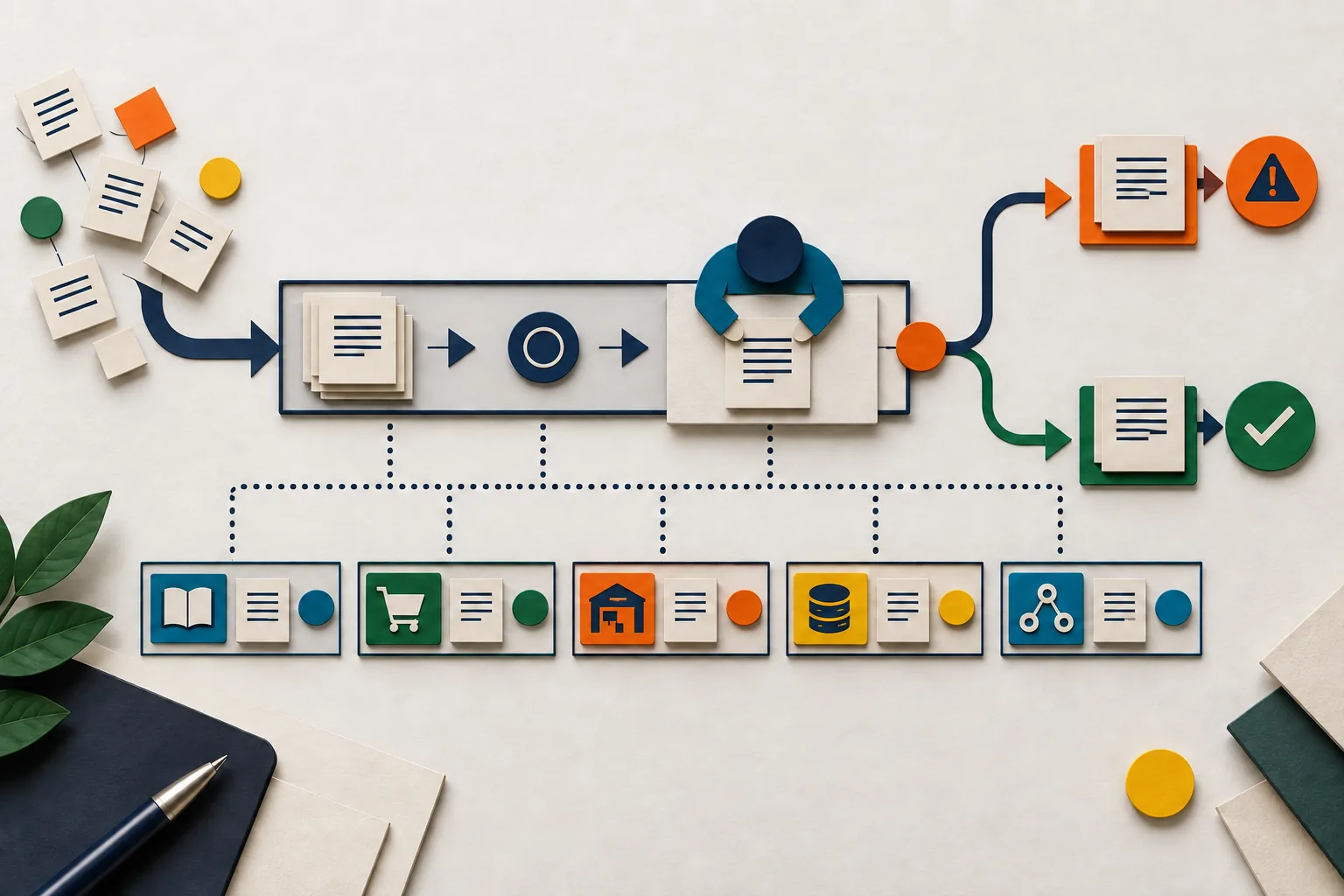
Then assign the loop. A collector obtains the source data. A deterministic rule can route a clear exception. A reviewer checks context and related records. An owner decides whether remediation is required. A support or change record holds the finding, action, and closure evidence. A periodic test proves that the path still works.
If AI is later used to summarize or group a review queue, keep it as optional triage support. A person should review consequential findings and own every decision, remediation, and closure.
Records to correlate separately
The upcoming admin-log contract should be one evidence source among several. Keep the boundaries visible:
- Identity and access: user lifecycle records, role assignments, API-key ownership, access requests, and approvals.
- Finance: source documents, posted entries, lock controls, approval evidence, payment records, and reconciliations.
- ERP operations: product, purchase, inventory, manufacturing, warehouse, fulfillment, and return records.
- E-commerce handoffs: source-channel catalog and order identifiers, connector runs, inventory acknowledgements, refunds, fulfillment updates, and failed-message queues.
- Support and change: incident timelines, approved admin access, deployments, rollback decisions, investigation notes, and closure evidence.
These records are not promised by the documented admin activity method. Correlation is the team's design responsibility. It is especially important where one business event crosses several systems and no single platform holds the whole story.
A ten-step implementation checklist
Phase: Define the control
Name the control question. State the decision the evidence must support, the risk it addresses, and what a reviewer must be able to conclude.
Mark the documented boundary. Record that the repository describes upcoming Odoo Online admin activity retrieval, not general ERP transaction history or confirmed production availability.
Create an availability gate. Require a live documentation update, confirmation for the intended environment, an approved isolated or test-database connection, a successful test, security review, and rollback plan before introducing a production dependency or collection job.
Phase: Design the evidence path
Inventory the retrieval scopes. Map every relevant database UUID and subscription relationship, then decide which control owner needs which boundary.
Design least-privilege access. Assign the future credential to a named owner, document storage and rotation, and limit downstream access to people with an operational need.
Protect the evidence lifecycle. Minimize collected personal data, encrypt transport and storage, restrict and log access, set retention and deletion rules, control exports, and assign a privacy owner.
Plan cursor handling and cadence. Store cursor state safely, respect the five-minute minimum interval, surface collection failures, and test observed behavior before assuming ordering or replay guarantees.
Map the separate records. Identify the access request, finance record, ERP transaction, connector run, source-channel object, support case, or change record needed to interpret each control scenario.
Phase: Operate and verify
Assign review and escalation. Name the reviewer, response owner, review cadence, exception rule, escalation path, and evidence required for closure.
Test the complete loop after scope is known. Once Odoo publishes and observed testing confirms the event catalogue and
authorizedsemantics, run supported normal, exception, missing-context, collection-failure, and handoff scenarios; verify routing, investigation, remediation, retention, and recovery before expansion.
Risks, limits, and unanswered questions
The reviewed sources do not state a launch date, eligibility rules, retention period, ordering guarantee, completeness guarantee, uniqueness rule, replay behavior, backfill window, access scope, or formal meaning for authorized. They also do not say that every administrative action will appear or that the response is immutable.
Those are not minor blanks to fill with assumptions. They affect data architecture, alert design, investigation quality, storage, privacy, and recovery. IP addresses and user details also deserve controlled handling even when they are operationally useful.
Cursor loss, credential failure, unavailable dependencies, or a misunderstood selector could create an evidence gap. The process therefore needs visible collection health and a documented response to missing data. Confirm behavior through supported documentation and testing when the capability becomes available.
Where the hype is not useful
An endpoint does not provide “continuous compliance.” A five-minute collection constraint does not promise real-time detection. A field named authorized does not replace a policy decision. A central dashboard does not prove that anyone reviewed an exception.
It is also unhelpful to sell this as an automatic audit of finance, inventory, commerce, or integrations. Those workflows require their own transaction evidence and reconciliation. Adding AI does not remove that need; it adds another output that must be checked.
The useful work is quieter: define the question, preserve the source boundary, correlate the right records, assign ownership, handle gaps, and prove the response path.
The AorBorC view
AorBorC treats audit readiness as a workflow and systems problem. Our Odoo implementation work begins with roles, approvals, system boundaries, integrations, exceptions, and reporting—not an isolated endpoint.
For controls that native modules do not express cleanly, ERP module development can shape the operating record around approvals, reconciliation, and accountable handoffs. Rescue and audit work then tests what the deployed system actually records and what operators actually review.
That approach matters wherever Odoo sits inside an integrated ERP operation. Our company profile explains the founder-led, human-reviewed way we build long-lived business systems: automation handles repeatable work, while people own consequential decisions.
Business takeaway and your next move
Retrievable evidence becomes valuable only when it enters an owned review-and-response loop.
Choose one meaningful scenario now, such as privileged support access during an order-integration incident. Map the policy, expected admin evidence, source-channel and Odoo transaction records, reviewer, escalation, corrective action, and retained closure record. Mark the upcoming API as a future source, not a current dependency.
That exercise will expose missing ownership and correlation rules before code makes them harder to see. If you need help defining the control loop, system boundaries, and safe availability gate, plan an Odoo implementation review.
Sources checked
- Odoo documentation commit 0e7e5a6: add documentation for upcoming audit log retrieval, committed September 9, 2026.
- Odoo 19.0 documentation: Odoo Online, checked September 9, 2026; the live page did not yet show the Audit logs section.
- Odoo 19.0 developer documentation: External JSON-2 API, checked September 9, 2026 for transport and authentication background; it does not document
get_audit_logs. - Odoo 19.0 documentation: Access rights, checked September 9, 2026 for general role context; it does not prove caller eligibility for the upcoming method.