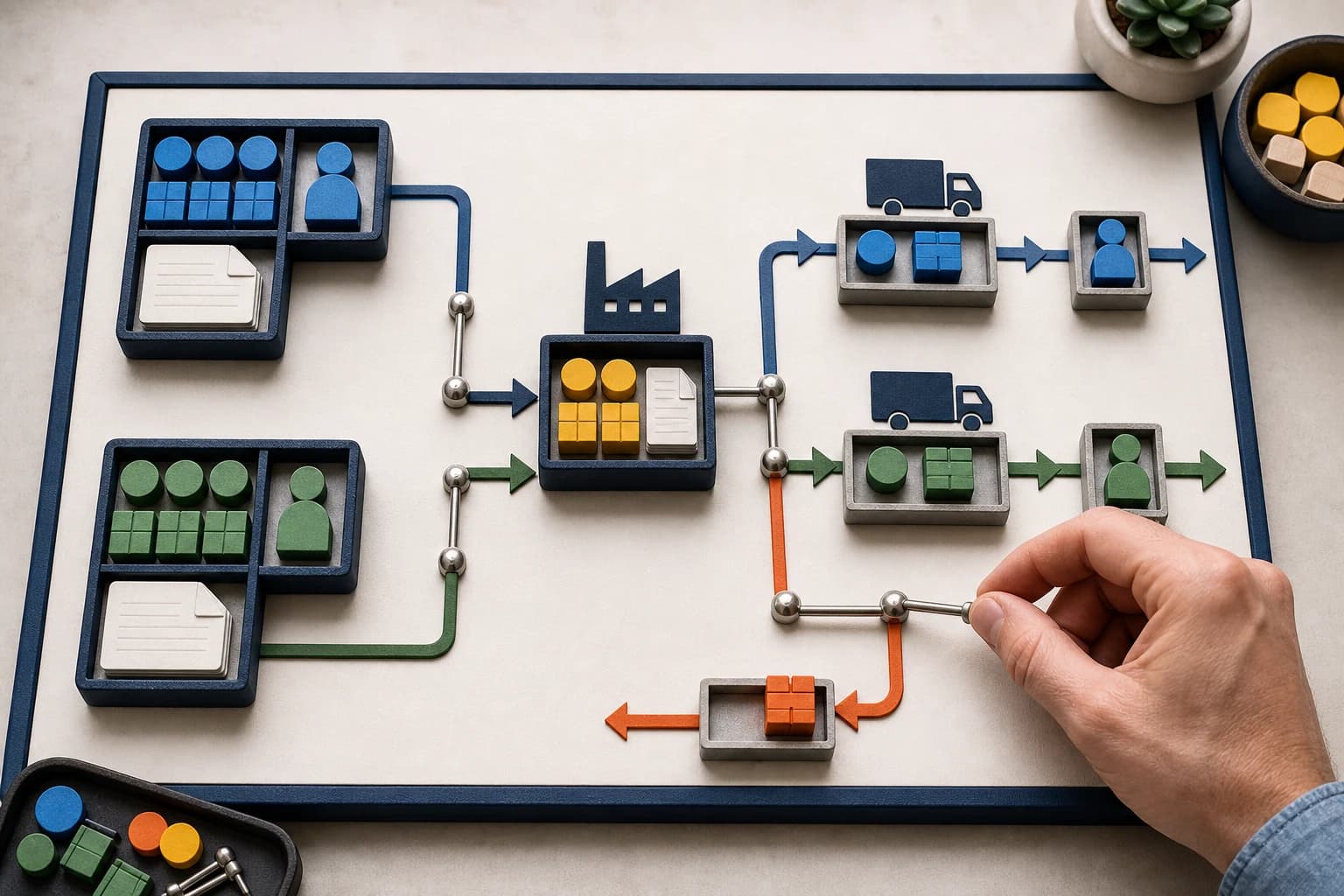
A green ERP status is a conclusion, not evidence. Two fixes merged into Odoo's public 19.0 branch on August 3 and August 1 had different technical causes but the same operational symptom: a visible fulfilment state could be wrong when status logic failed to preserve or account for origin across less-common transaction paths. The practical response is to test the transaction chain, not just the label.
Category: ERP
One fix covers merged dropship purchase orders spanning more than one sales order. The other covers a valid customer return created after an order quantity was reduced. In both cases, the operational state shown on a sales order could disagree with the stock activity underneath it.
These are upstream code commits, not a blanket service notice. They do not prove that every Odoo 19 environment had the defects or that every Odoo Online, Odoo.sh, Enterprise, Community, or self-hosted instance already contains the fixes. Version, hosting, update state, installed modules, configuration, and custom code all matter.
They are still useful evidence for any team running Odoo across sales, procurement, inventory, e-commerce, finance, integrations, or reporting. A status is reliable only when the records that produce it remain connected and reconcilable.
What changed
A merged dropship purchase order could lose sales-order context
Dropshipping lets a supplier deliver directly to the customer. Odoo's documented chain starts with a sales order, creates vendor demand, and uses a dropship receipt—technically a stock picking or transfer—to record the supplier-to-customer movement.
The August 3 fix covers a more complex version of that flow. The official test starts with two sales orders containing dropship products from the same vendor. Their purchase orders are merged and confirmed, and the supplier-to-customer movements are validated.
Before the fix, moves originating from more than one sales order could be grouped into one picking. That picking could resolve to only one sales order, leaving the other order marked as not fully delivered even though its movement was validated. The corrected result for the official two-order scenario is two pickings: one for each originating sales-order group.
The lesson is not that purchase-order consolidation is inherently unsafe. It is that consolidation must preserve the customer-order identity used by fulfilment, support, reporting, and integrations.
A valid return could leave delivered quantity unchanged
The August 1 fix addresses a separate path. Odoo's official reproduction confirms a sales order for 10 units, delivers all 10, cancels the order and resets it to draft, reduces the ordered quantity to 4, reconfirms it, and validates the generated return of 6.
The inbound return was valid, but it lacked the usual link to the original delivery move and the usual return reference on its picking. Before the fix, the line still showed 10 delivered. After the fix, it shows 4.
That matters because Odoo can base invoicing on ordered quantity or delivered quantity. An incorrect delivered quantity does not prove that an invoice or ledger entry was wrong; configuration, timing, automation, and human action determine the downstream result. It does mean the value used by invoice review, customer support, integrations, and operational reporting can be wrong.
Why operational leaders should care
ERP screens compress a chain of records into a few labels. That makes work manageable, but it also makes a status easy to over-trust.
A dropship flow can cross a source storefront or integrated sales channel, an Odoo sales order, procurement rules, a vendor purchase order, stock movements, delivered quantity, invoice eligibility, and customer support. A quantity change or return can continue through inventory, credit review, finance reconciliation, analytics, and an external order-status update.
The records can be valid while the status calculation either resolves to the wrong origin or fails to account for a valid unlinked path. That is the difficult middle ground: nothing looks obviously corrupt, yet the operational conclusion is wrong.
The impact is practical:
- Catalog and sales teams own the product, vendor, route, unit of measure, variant mapping, and invoicing policy that shape the transaction.
- Procurement may combine vendor demand, while warehouse and inventory teams depend on the correct picking, movement direction, quantity, and validation state.
- Finance needs delivered quantities, invoices, credits, and reconciliation to agree with the configured policy.
- Integration owners may publish the state to Shopify, a customer portal, a 3PL, a CRM, or a reporting warehouse.
- Support needs to distinguish "the supplier shipped" from "this customer's order is correctly linked and complete."
If an integration permits post-fulfilment changes—cancellation, quantity reduction, return, exchange, or support correction—the test must follow the revised transaction through inventory and finance. A webhook returning 200 proves message delivery, not business correctness.
The AorBorC view: turn status into testable assertions
An ERP status is an assertion the system makes. Release evidence should prove the facts that make the assertion true.
For these Odoo paths, useful assertions include:
- Every originating sales order retains the correct fulfilment record after purchase orders are merged.
- Each dropship picking contains the intended moves and updates the correct order.
- A completed quantity-change return reduces delivered quantity even when it was not created through the standard return action.
- Invoice or credit review follows the configured policy and the final delivered quantity.
- External systems receive the corrected state once, with stable source IDs and a recoverable error path.
- Reports can reconcile the sales order, purchase order, stock moves, return, invoice, and credit where those records apply.
A screen test checks whether a label changed. A workflow test checks whether the right records changed, for the right reason, with the right downstream consequence.
Automation is good at checking IDs, counts, quantities, statuses, API responses, and reconciliation rules. Human review remains necessary when the correct commercial outcome depends on a refund policy, vendor agreement, customer promise, approval threshold, or accounting treatment. That is what human-reviewed AI and long-lived operational systems should look like: automation for repeatable evidence, accountable people for exceptions.
An eight-step transaction-integrity checklist
Identify the deployed environment. Record the exact Odoo version, edition, hosting model, installed applications, relevant custom modules, and current revision. Check whether the public fixes are actually present; the public 19.0 branch is not proof of a production deployment.
Map the record chain and stable IDs. For dropshipping, capture the source order, sales order and lines, procurement group, purchase order and lines, pickings, stock moves, products, quantities, vendor, customer, and company. For a return, include the original order and delivery, incoming move, reason, quantity, refund intent, and final delivered quantity.
Reproduce the two-order dropship case. In an approved staging copy, create two sales orders for dropship products from one vendor, merge the vendor purchase orders, and validate the movements. For the official scenario, assert two pickings—one per sales-order group—plus the correct moves, origins, and final state on both orders.
Reproduce the quantity-change return. Deliver a known quantity, cancel and reset the order to draft, reduce its quantity, reconfirm it, and validate the generated return. Assert the final delivered quantity. Also test a standard linked return as a control.
Verify configuration and ordinary paths. Check routes, vendors, companies, units of measure, product or variant mappings, and invoicing policies. Re-run a single-order dropship, unmerged multi-order flow, partial delivery, partial return, cancellation before fulfilment, and failed vendor delivery. Edge-case coverage is useful only when common paths still pass.
Reconcile finance and every handoff. Compare ordered, delivered, invoiceable, invoiced, returned, and credited quantities according to policy. Then trace the e-commerce connector, vendor or 3PL feed, customer portal, support tool, and analytics pipeline. Exercise duplicate, delayed, out-of-order, failed, and retried events. One business event must not create two stock or finance consequences.
Separate code release from historical review. Confirm the supported update path, backup, recovery plan, approval owner, and release evidence. The commits add code changes and regression tests; they do not document a general data-repair procedure. Review representative historical merged dropship orders and quantity-change returns before deciding whether any controlled correction is needed.
Keep the assertions in the release suite. Run them after Odoo updates, custom-module changes, catalog or route changes, and connector releases. Flag combinations that are unexpected for the tested scenario, such as a validated dropship movement with an incomplete originating order when no partial delivery or backorder is planned, or a completed return with unchanged delivered quantity.
Risks, limits, and where hype is not useful
The evidence is precise but narrow. It covers two confirmed defects and their regression tests. It is not evidence that every Odoo 19 database, order, dropship process, or return is unreliable.
Availability in a live environment depends on the service, build, deployment cadence, packaging, hosting model, and maintenance process. Custom modules may alter the same models and workflows. The supported action may be to confirm an automatic cloud update or install the latest supported 19.0 revision through Odoo's documented update route. A separately maintained backport should be considered only by the environment maintainer after dependency, backup, and regression testing.
A code update also does not prove that historical records are reconciled. If a team runs matching workflows, it should inspect representative history and define any correction with its Odoo maintainer, operations owner, and finance owner.
These fixes are not proof that Odoo is uniquely fragile. Public, specific fixes with regression tests show a maintained system doing maintenance work. Nor do they make ERP statuses meaningless. Statuses are valuable summaries; they simply should not be the only acceptance criterion for a workflow crossing sales, procurement, inventory, finance, e-commerce, analytics, and support.
Related AorBorC service paths
AorBorC implements and stabilises these transaction chains through Odoo implementation, including inventory, procurement, finance, e-commerce operations, integrations, migration, and post-launch support.
For maintained web and API journey tests, release evidence, and regression coverage, see Zoho QEngine implementation. Our company profile summarises the broader Odoo, ERP, e-commerce, QA, Zoho, and rescue scope.
Business takeaway
Trust the transaction chain before you trust the status. For every critical order flow, prove the originating record, linked stock movement, final quantity, configured finance result, external handoff, and exception owner. That evidence turns an ERP label into a reliable business state.
Your next move
Take one merged dropship purchase order and one quantity-change return from a staging copy. Trace both from source order through stock, delivery status, invoicing logic, integrations, and reporting. If the relationships or expected outcomes are unclear, plan an Odoo workflow audit with AorBorC before the next update or custom-module release.
Sources checked
Checked August 4, 2026.