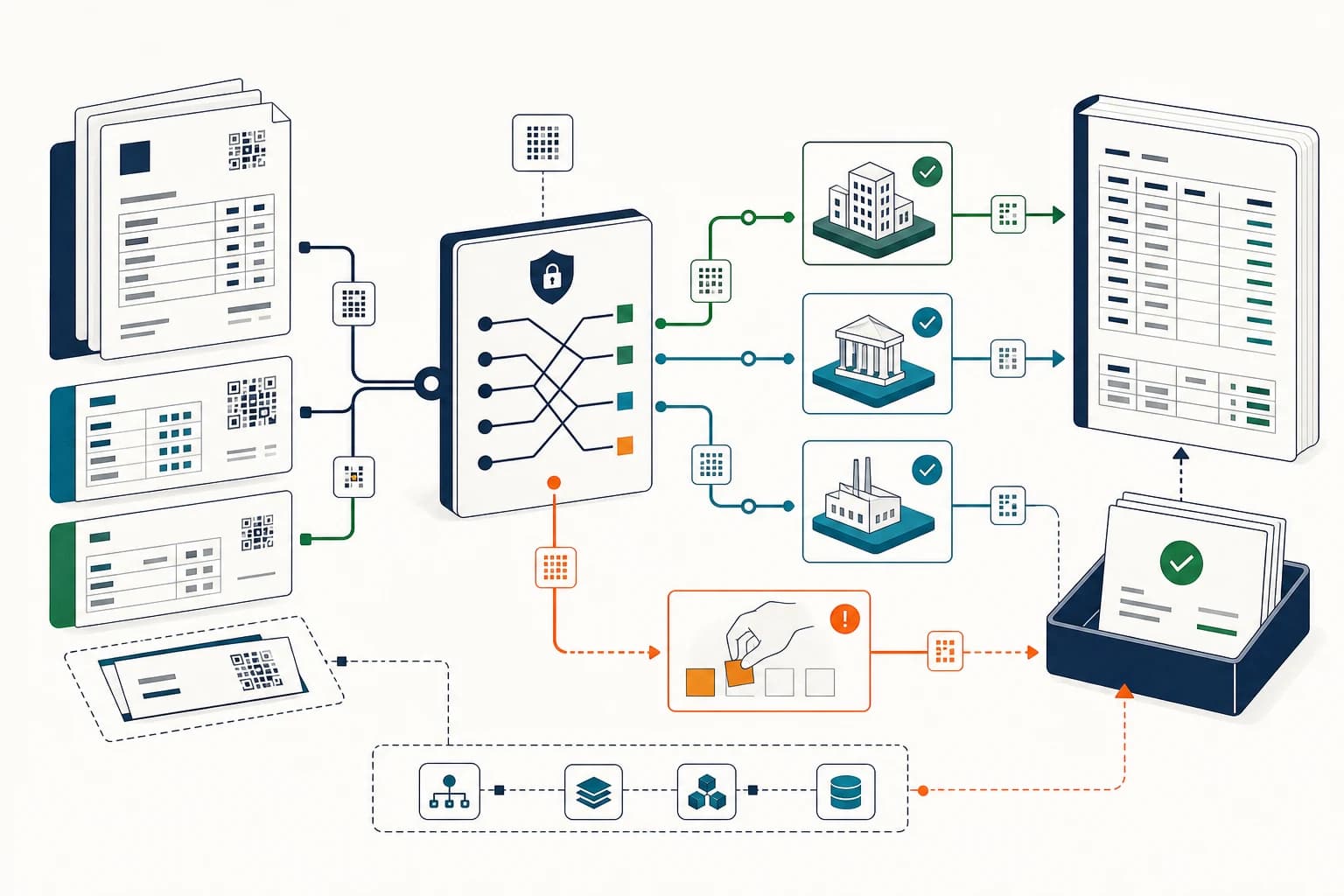
France has softened the launch posture, not the system work. Regulatory tolerance will not repair weak invoice data, unclear routing, or unreconciled finance workflows.
Category: ERP, Odoo, finance, and e-invoicing operations
France has kept its September 1, 2026 electronic-invoicing launch while promising a tolerant, supportive approach for businesses that encounter genuine difficulties and are actively working to correct them.
That distinction matters. The date has not moved, and the announcement is not a blanket waiver.
From September 1, businesses established in France and subject to VAT must be able to receive electronic invoices. Large enterprises and mid-sized companies must also issue covered domestic B2B invoices electronically and perform the applicable e-reporting. Small and medium-sized businesses and micro-enterprises move into the issuing and e-reporting phase on September 1, 2027.
The operational lesson is simple: enforcement tone does not create ERP readiness.
What changed—and what did not
On July 10, France's Ministry of Public Action and Accounts met with business federations, approved platforms, software providers, and accounting professionals. The ministry then confirmed the launch timetable and a tolerant implementation posture.
The useful part of that message is not “there will be no consequences.” It is that a good-faith business facing a real implementation problem, and taking steps to regularize it, should not be treated like a business that has ignored the reform.
The underlying requirements remain. The French government's implementation overview describes a normalized electronic document exchanged through an approved platform. Emailing a scanned invoice or ordinary PDF directly to a customer is not enough.
There is a narrow transition worth understanding. DGFiP guidance documents a tolerance from September 1, 2026 through December 31, 2027 for non-structured or mixed documents, including PDFs, when they are processed through an approved platform and the required invoice data is transmitted in structured form. That transitional platform route does not turn direct PDF-by-email into a compliant process.
The same overview also identifies new invoice data that teams need to accommodate, including the customer's SIREN, the nature of the transaction, an applicable VAT-on-debits option, and a delivery address when it differs from the billing address.
Those are not presentation details. They are master-data, tax, order, delivery, and accounting dependencies.
Why operational leaders should care
Electronic invoicing crosses several workflows that are often owned by different teams:
- Sales or e-commerce creates the order and customer identity.
- Catalog and product records determine whether lines represent goods, services, or both.
- Fulfilment establishes the actual delivery location and timing.
- Finance applies tax treatment, issues the invoice, handles credit notes, and reconciles the ledger.
- The approved platform transports structured records and returns statuses.
- ERP integrations move data between those systems without losing meaning.
- Support teams handle customer or supplier queries when a document is rejected or delayed.
A platform can transmit what it receives. It cannot decide which customer record is correct, repair an invalid SIREN, infer the intended tax treatment safely, or explain why a credit note no longer reconciles to the source order.
That is why this should be managed as a finance-system cutover, not an accounting-app toggle.
The AorBorC view: tolerance does not repair ERP data
The highest-risk work sits at the handoffs.
For outbound invoices, the ERP needs to distinguish covered domestic B2B transactions from B2C and cross-border activity that may instead create e-reporting obligations. The order source, legal entity, customer identity, tax, operation category, delivery address, payment data, and credit-note path must remain coherent.
For inbound invoices, receiving a structured file is only the start. The business still needs supplier matching, duplicate controls, purchase-order and receipt matching, approval ownership, tax review, journal routing, and exception recovery.
Odoo's current France localization documentation describes a French approved-platform module, company registration, incoming-bill journal configuration, e-reporting settings, document statuses, and error handling. It also documents UBL sending and receipt of Factur-X, UBL, and CII formats.
That is useful product capability. It is not proof that a particular database, localization, custom module, connector, or operating process is ready.
Whether orders originate in Odoo, Shopify, another storefront, a sales portal, or a custom app, the business still needs one controlled route from order to invoice to payment to ledger. Human review should remain at the points where tax treatment, identity, exceptions, and reconciliation require judgement.
An implementation checklist
Use this checklist to turn the deadline into a testable operating plan.
Confirm the scope for each legal entity. Record whether it must receive, issue, and e-report on September 1, 2026 or enters the issuing phase in 2027. Separate domestic B2B, B2C, cross-border, exempt, and public-sector flows before designing rules.
Verify the approved-platform route. Confirm the selected platform, current registration status, ERP version, hosting model, installed localization modules, company configuration, and named internal owner. Do not treat a vendor capability page as an implementation sign-off.
Clean identity and invoice master data. Validate company and customer SIREN and VAT identifiers, legal names, billing and delivery addresses, contact matching, transaction category, and the VAT-on-debits setting where applicable.
Make transaction routing explicit. Document which flow creates an e-invoice, which creates e-reporting data, and which remains on another channel. Give each rule an owner and a test example.
Test outbound invoice construction. Check product or service labels, line-level taxes, quantities, units, discounts, delivery address, payment terms, and source-order references. Include mixed goods-and-services orders if the business uses them.
Test inbound bill control. Route supplier invoices to the correct journal and company. Exercise duplicate detection, supplier matching, purchase-order and receipt matching, approvals, coding, tax review, and rejected-document handling.
Trace e-commerce and order handoffs. Prove that catalog, checkout, inventory, fulfilment, returns, and finance use compatible product, customer, tax, and delivery data. Test cancellations, partial fulfilment, refunds, and the resulting credit-note path.
Build an exception queue. Assign owners for invalid recipient data, rejected invoices, failed delivery, duplicate submissions, platform outages, and status mismatches. Record the evidence needed to show that the team identified and worked to correct a problem.
Rehearse realistic fixtures. Include a valid domestic B2B invoice, an invalid customer identity, B2C and cross-border sales, goods and services, a different delivery address, a credit note, and an inbound bill with a price or quantity variance.
Reconcile end to end. Compare source orders, platform statuses, issued and received documents, accounts receivable, accounts payable, VAT data, e-reporting totals, payments, and the general ledger. Sign off the first production cycles with finance and operational owners together.
Risks and limits
The reform has important scope distinctions, and a short article cannot resolve the tax position of a specific transaction or entity. Finance and tax advisers should review the final interpretation.
The launch tolerance is also not a deadline extension or permission to postpone preparation. The ministry ties it to good faith and active work to regularize problems. As an operational precaution, retain evidence of implementation work, incidents, ownership, and corrective action.
Odoo's documentation cited here is for version 19.0. The real implementation path depends on the database version, hosting model, installed apps, company structure, customizations, and external systems. Current approved-platform status and production behaviour should be rechecked close to cutover.
Finally, successful document transport does not prove accounting correctness. A technically accepted invoice can still carry the wrong customer, tax, account, analytic allocation, delivery reference, or source-order relationship.
Where the hype is not useful
Calling this “paperless invoicing” understates the work.
The material change is not the disappearance of a PDF. It is the introduction of structured, status-bearing transactions that pass through a regulated exchange layer and must still agree with orders, fulfilment, tax, payments, and the ledger.
It is equally unhelpful to frame approved-platform or ERP automation as autonomous compliance. Good automation reduces repetitive work and exposes exceptions sooner. It does not remove the need for accountable process owners, controlled corrections, finance review, and audit evidence.
Where AorBorC can help
AorBorC works on the operational layer behind this kind of change:
- Odoo implementation for finance, sales, purchase, inventory, and localization workflows.
- ERP module development when standard configuration does not cover a controlled business process.
- E-commerce operations and store delivery where catalog, checkout, order, inventory, fulfilment, and finance data must stay aligned.
Our approach is founder-led and implementation-first: map the real workflow, test the handoffs, keep human review where judgement matters, and leave the team with a system that can be operated after launch.
Business takeaway
France's tolerant launch posture may reduce fear around honest implementation problems. It does not reduce the need for clean invoice data, explicit routing, owned exceptions, and reconciled finance workflows.
The useful question for an operational leader is not “Does our software support e-invoicing?”
It is “Can we prove the complete transaction—from source order to platform status to ledger—and recover it when something fails?”
Your next move
If your team needs to turn the France deadline into an Odoo, ERP, integration, or finance-workflow plan, plan the implementation with AorBorC. Bring one representative order-to-cash flow, one supplier-bill flow, and the exceptions that currently require manual repair.
Sources checked
- French Ministry: launch timetable and tolerant implementation approach, July 2026
- French government: e-invoicing and e-reporting requirements
- DGFiP: invoice data and the transitional treatment of non-structured or mixed documents
- Odoo 19.0 documentation: France fiscal localization and e-invoicing
- Odoo: electronic invoicing in France