Category: ERP, E-commerce & Compliance Operations
Author: AorBorC Technologies
Published: November 15, 2026
The first question is whether December 30 applies to your business. Under the European Commission’s current timetable:
- December 30, 2026: large and medium operators and traders, plus micro and small operators already covered by the EU Timber Regulation.
- June 30, 2027: most other micro and small operators and traders.
- December 30, 2027: products newly added by the 2026 delegated act.
Responsibilities also differ among the Commission’s current role categories: upstream operator; upstream micro or small primary operator; downstream operator or trader; and first downstream operator or trader. One company may have more than one role across its flows.
Before anyone configures an ERP field or API, answer four questions: Is the commodity and customs product code covered? What role does the business play? Which size category applies? When was the product placed on, made available on, or exported from the EU market, and do transition rules apply? A qualified legal or trade adviser should own that classification, including the evidence needed for transition-period treatment and the separate treatment of timber already covered by the EU Timber Regulation. This article addresses the operating system that follows; it is not legal advice.
The implementation point is simple:
The EUDR Information System is the last mile, not the operating system. If supplier, product, lot, location, and order records cannot reconstruct the evidence chain, a successful submission cannot repair it.
Why this needs an operations response now
The rules cover Annex I-listed relevant products associated with cattle, cocoa, coffee, oil palm, rubber, soy, and wood. A familiar product name is not enough to decide scope; the approved customs classification and transaction role matter. For in-scope activity, the Commission describes due diligence around deforestation-free production, applicable production-country law, and location evidence. Exact duties vary by role.
The regulation is not new. The operational news is that the Commission adopted an Information System amendment on July 14, published its latest FAQ on August 21, adopted the delegated act updating Annex I product scope on September 17, and scheduled training through November while the first application date is now weeks away. Teams need to test whether real data can travel from supplier and plot through inventory, transformation, order, and release records.
An upstream operator performs due diligence and submits a due diligence statement (DDS); once the statement is available in the EU Information System, it receives a reference number. An eligible upstream micro or small primary operator still performs due diligence but may use a one-off simplified declaration, updating it when important information changes. Under the Commission’s current role guidance, downstream operators and traders do not perform due diligence or submit either filing; the first downstream actor collects the applicable DDS reference number or simplified-declaration identifier. The filing comes after the evidence and risk work—not instead of it.
Start with an applicability gate
Do not put every SKU into a “compliance project” and hope the registry sorts it out. Establish an approved scope decision first.
| Question | Decision artifact | System consequence |
|---|---|---|
| Is the commodity and product code covered? | Approved product and customs-code scope matrix (CN/HS) | Only confirmed items enter the controlled workflow |
| What is the entity’s role in this transaction? | Role map by legal entity and flow | Determines who performs due diligence, submits, verifies, or retains references |
| Which size category and date apply? | Entity classification and timetable | Controls readiness milestones and release rules |
| Was the product placed, made available, or exported during a transition period, or newly added to scope? | Adviser-approved date/evidence treatment, including separate timber/EUTR rules | Prevents a blanket rule from being applied to unlike flows |
Store the rationale, approver, effective date, and source used for each decision. Product classification is not a free-text note that should disappear when a project owner leaves.
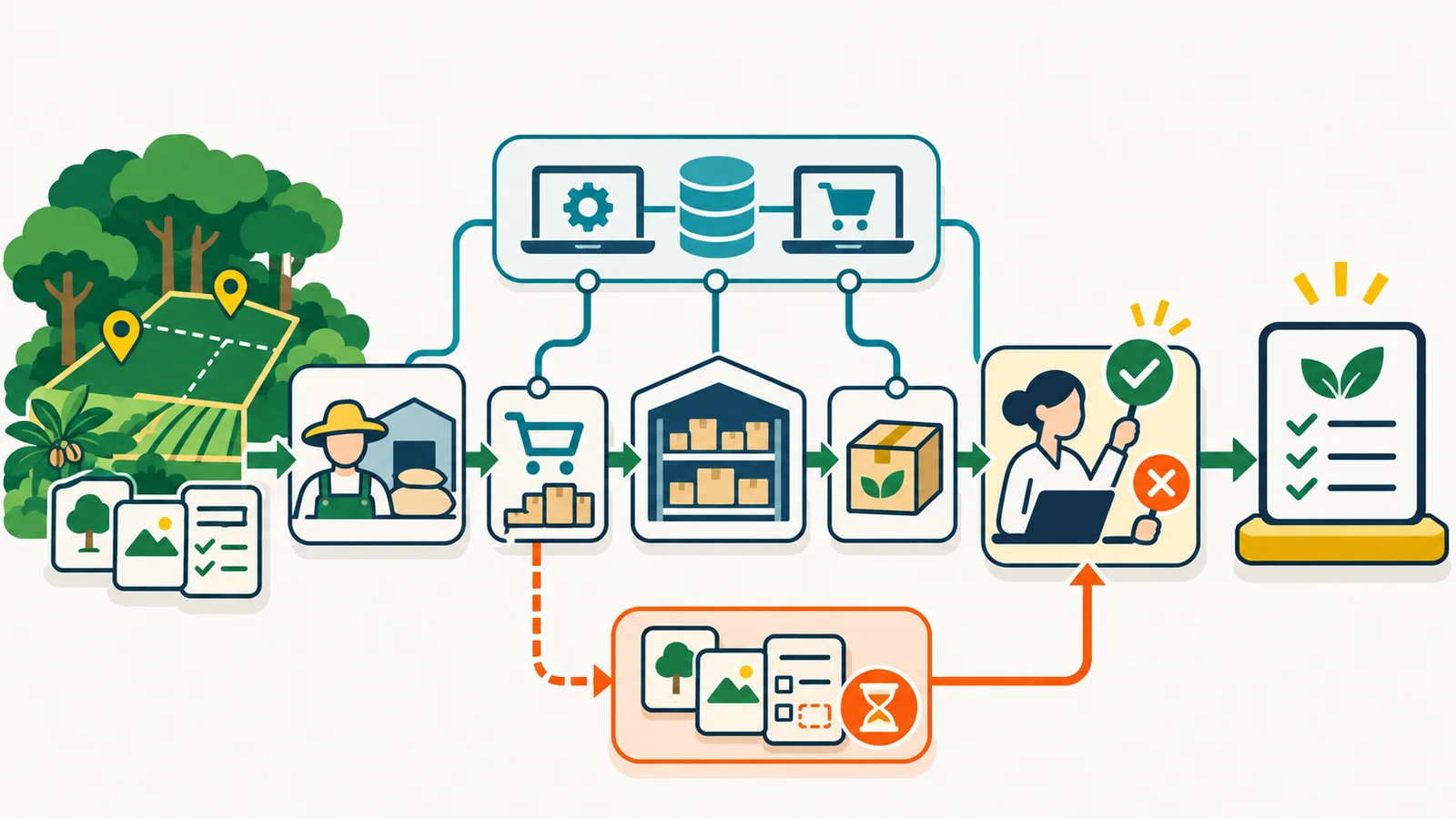
The operational chain that must hold together
1. Product catalog and scope
Connect commercial SKUs to the approved commodity and CN/HS classification, legal entity, and scope status. Variants, bundles, substitutes, and newly introduced products need an owner and an effective date. A Shopify or other storefront description is useful for selling; it is not automatically a defensible regulatory product master.
2. Supplier and geolocation evidence
Define what a supplier must provide before a purchase can proceed: identity, country of production, production timing, and the location evidence required by the approved due-diligence method. Standard DDS flows require plot geolocation. Eligible upstream micro or small primary operators may instead use permitted postal-address or cadastral information in a simplified declaration. Incomplete, contradictory, or expired submissions need an exception queue—not a shared inbox and a spreadsheet colour.
A custom supplier workflow in Zoho Creator or another portal can collect and validate evidence, but the workflow should not make the legal decision. It should route the evidence, expose gaps, preserve review history, and leave an accountable person in control.
3. Procurement, inventory, and transformation
The evidence chain must survive receiving, lot splits, blends, repacking, subcontracting, manufacturing, substitutions, returns, and transfers. Odoo or another ERP can carry lot and batch lineage, but only if the design preserves the relationship between input evidence, output stock, quantities, and the applicable declaration or reference, where required.
This is where a “we have the supplier PDF” approach breaks. One document at vendor level does not necessarily explain which units reached which outbound order.
4. E-commerce orders and release controls
The storefront should not be asked to perform due diligence. It should receive a clear sell, hold, or review signal from the operational system. Product publication, order routing, fulfilment, returns, and marketplace feeds must respect the same scope and release state.
For covered flows, decide what happens when a required DDS reference is missing, the quantity covered by that DDS has been used, a simplified-declaration identifier is missing, the declaration has not been updated after an important change, or new risk information arrives after an order is accepted. The answer may involve an order hold, a warehouse hold, an export hold, or a controlled exception. It should never be “the integration will probably retry.”
5. Registry and integration lifecycle
The Commission’s production Information System is where submissions have legal value; the acceptance environment is for testing and its submissions do not. Keep credentials, endpoints, logs, and test data separated.
An API can reduce re-entry for bulk submissions. It cannot decide whether evidence is sufficient. It also cannot rescue a weak quantity model. The Commission notes that one DDS can cover multiple batches or shipments and that a new DDS is needed after its declared quantity has been fully placed on the market or exported. Operationally, that creates a reconciliation problem: teams need to show which released quantities were associated with which statement. A simplified declaration has a different lifecycle: it is one-off and is updated when important information changes. Do not merge those controls.
6. Finance, analytics, and support
Procurement and finance need to see the cost and status of holds, rejected receipts, replacement supply, and delayed shipments. Operations needs ageing, exception ownership, and release evidence. Customer support needs an approved explanation without access to confidential supplier material. Management reporting should distinguish missing evidence, pending review, a documented no-or-negligible-risk determination after any required mitigation, blocked stock, and completed filing.
One green “EUDR ready” field is too blunt to run any of that safely.
Ten-step implementation checklist
- Approve the applicability matrix. Record covered products, roles, entities, size categories, operative dates, transition-period and timber/EUTR treatment, supporting evidence, source, adviser, and approval date.
- Clean the product master. Map SKU and variant records to the approved commodity and CN/HS scope, including bundles, substitutes, and newly introduced items.
- Define the supplier evidence contract. Specify required fields, geolocation format, supporting records, refresh triggers, reviewer, and incomplete-evidence outcome.
- Prove lot and quantity lineage. Test receipts, splits, blends, transformations, subcontracting, transfers, substitutions, returns, cancellations, and write-offs.
- Model each filing lifecycle separately. For a DDS, capture the statement reference, associated evidence, declared quantity, released quantity, balance, supersession, and status. For a simplified declaration, capture its identifier and important-information changes. For downstream flows, retain the reference number or identifier required for that role.
- Put release gates at the right point. Decide whether controls act at purchase approval, receipt, stock allocation, order release, fulfilment, export, or more than one stage.
- Separate test and production. Use the acceptance server with safe test records, protect production credentials, make retries safe against duplicate submissions, and retain integration outcomes.
- Create an exception runbook. Name the owner for missing evidence, contradictory locations, exhausted DDS quantities, changed simplified-declaration information, new risk information, registry failure, rejected stock, and customer impact.
- Reconcile and retain by role. Upstream operators keep due-diligence records for five years from the relevant placing or export. Downstream operators and traders keep prescribed supplier and buyer information for at least five years. First downstream actors also keep DDS reference numbers or simplified-declaration identifiers for at least five years. Have an adviser confirm the exact records and trigger for the business.
- Run staged user-acceptance testing and recurring review. Test normal, boundary, failure, correction, and new-information paths. Keep human approval over scope, risk, release, and exception closure.
Where the hype is not useful
- A registry connection is not operational readiness. It proves that data can be sent, not that the underlying evidence is complete or linked to the right goods.
- A successful test submission is not a production filing. The acceptance server has no legal value.
- The December 30 date is not universal. Role, size, product scope, and stock timing matter; newly added products have a later date.
- A statement or simplified declaration is not full lineage. Quantity and transformation records still need to connect evidence to the goods placed, made available, or exported.
- AI should assist, not decide. It can extract documents, suggest candidate product codes for human review, compare locations, and flag gaps. A qualified human should own legal scope, risk assessment, release, and exception closure.
- A dashboard does not replace a runbook. Teams still need owners, stop conditions, correction paths, notifications, and evidence retrieval.
AorBorC’s implementation view
AorBorC works as a founder-led Zoho + AI business-systems partner, with practical delivery across custom applications, Odoo, e-commerce operations, integrations, reporting, and rescue/audit work. For EUDR readiness, that means turning an adviser-approved scope into durable product, supplier, inventory, order, release, and evidence controls.
The work may include ERP module development, e-commerce operations and storefront delivery, supplier and exception workflows, registry integration, and human-reviewed document processing. Our company profile explains the broader delivery model.
We do not replace legal classification. We build and test the operational system that must follow it.
Business takeaway
Do not start with the registry form. Start with one covered product and trace it from supplier and production location, through receipt and lot changes, to the exact order or export and the DDS reference number or simplified-declaration identifier required for that flow. Those numbers support traceability; they are not regulatory approval or compliance certification. The first broken handoff is the real implementation backlog.
If that trace cannot be reconstructed today, plan the ERP and e-commerce control work before the deadline turns a data gap into a stock, shipment, or customer problem.
Sources checked
- European Commission: EU Deforestation Regulation overview
- European Commission: updated product scope and implementation tools, July 13, 2026
- European Commission: EUDR implementation FAQ, published August 21, 2026
- European Commission: EUDR implementation guidance
- European Commission: roles and responsibilities
- European Commission: understanding due diligence
- European Commission: EUDR Information System