AorBorC point of view: A successful API response does not prove that the filter inside it worked.
Shopify announced on July 24 that Admin GraphQL API version 2026-10 will return an error when an app filters by a metafield that is not valid for filtering. The version is scheduled for release on October 1, 2026.
A metafield is a structured custom field attached to a Shopify resource. Teams use metafields to carry business-specific data that the standard product, order, or customer record does not hold. A query filter selects records by that data.
The breaking change is useful because Shopify will stop silently ignoring an invalid metafield predicate. But the operational issue starts before the upgrade. On 2026-07 and earlier, an invalid predicate can be ignored and the query can return misleading results. If an integration treats the response as proof that the right products, orders, or customers were selected, the wrong record set can move into another workflow without a visible API failure.
The practical move is not to wait for October. Inventory the filtered queries now, prove what each one returns, and trace what the receiving system does with those records.
This is an integration-correctness story, not a checkout feature story.
What Shopify is changing
Shopify lists three common reasons a metafield filter is invalid:
- The metafield has no definition.
- Its definition is not configured to allow filtering.
- Its type does not support the filter or comparison used in the query.
From API version 2026-10, Shopify checks the metafield filter before running the query. An invalid filter returns an error that identifies the problem instead of quietly producing an incorrect result.
This is a conditional breaking change, not a failure of every Shopify integration. Valid filters keep working. Apps using 2026-07 or earlier keep the previous behavior until they upgrade. Shopify’s examples include filters applied to products, orders, and customers.
Affected only if: An app or integration uses the Admin GraphQL API to filter by a metafield and that filter is invalid. Integrations that do not use metafield filters, and correctly configured filters, are unchanged by this behavior.
Shopify’s metafield documentation also separates several capabilities that teams often blur together. Making a definition filterable allows supported resource queries to filter by its values. It does not automatically make the value unique, accurate, approved, or suitable as an ERP identifier. Those are separate data and workflow decisions.
Why operational leaders should care
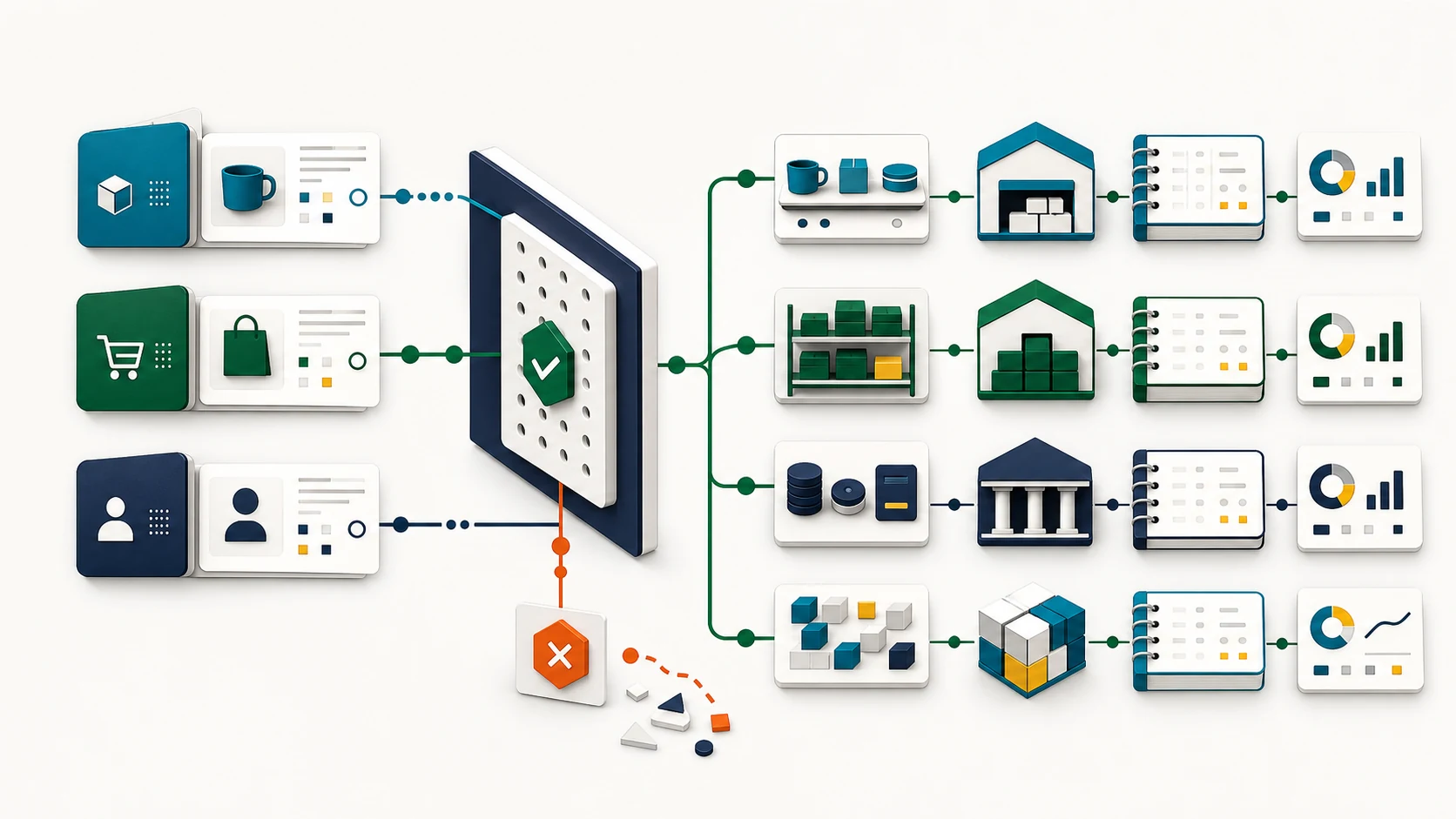
A filtered query is often a business selection boundary.
An e-commerce integration might select products marked ready for an ERP or product-information feed. An order job might select records that need a particular fulfillment, finance, or exception path. A customer workflow might use a custom classification to choose which records move into CRM, service, or reporting.
If the predicate is invalid and silently ignored, the API response may still look structurally normal. The downstream job can then act on a different, potentially broader record set than the team intended. Shopify documents the misleading-result risk; the exact business consequence depends on what the integration does next.
That consequence can cross the full operating system:
- Catalog: products can enter or miss a publication, enrichment, pricing, or ERP export queue.
- Inventory and warehouse: an unexpected product or order set can reach allocation, availability, picking, replenishment, or exception logic.
- Orders and fulfillment: records can be routed to the wrong operational queue or omitted from a reviewed handoff.
- Finance: order exports, settlement checks, tax review, invoice creation, and reconciliation can start from the wrong selection.
- Customer operations: customer classifications can drive the wrong CRM, service, B2B, or support workflow.
- Reporting: a report can faithfully summarize a record set that was selected incorrectly.
The filter does not cause every one of these outcomes by itself. The risk appears when an app or integration uses the query result to make a downstream decision without independently checking the selected IDs, counts, or business conditions.
Treat the upgrade as a correctness audit
The most useful audit artifact is a query-to-workflow register. It connects technical selection logic to the operating decision it controls.
| Selection in Shopify | Possible receiving workflow | Evidence to retain |
|---|---|---|
| Products selected by a custom field | Catalog, PIM, ERP, pricing, or store publication | Definition, capability, query, expected IDs, actual IDs, rejected records |
| Orders selected by a custom field | Fulfillment, warehouse, finance, returns, or exception queue | Test orders, expected count, actual count, downstream response, reconciliation |
| Customers selected by a custom field | CRM, B2B service, support, segmentation, or reporting | Classification rule, sample records, access owner, result review |
Start with the queries that can write, release, post, notify, or exclude records. A dashboard query matters, but a query that feeds an order export or finance posting deserves the earlier review.
Implementation checklist
Use this checklist before moving an app or integration to Shopify Admin GraphQL API 2026-10.
- Find every metafield-filtered query. Search custom apps, integration services, scheduled jobs, scripts, serverless functions, and vendor-managed connectors for Admin GraphQL queries that filter on metafields.
- Record the current API version. Do not assume every job or dependency uses the same version. Note the owner, runtime, credentials, schedule, and planned upgrade date for each caller.
- Name the business decision. For every query, state why records are being selected and what happens next across catalog, checkout, orders, inventory, warehouse, ERP, finance, support, or reporting.
- Verify the definition. Confirm the namespace, key, owner type, data type, and definition exist in the target store and environment.
- Verify filter support. Confirm filtering is enabled for the definition and that the resource, metafield type, and comparison are supported. Do not treat a syntactically valid query as a valid filter.
- Build positive and negative fixtures. Include records that should match, should not match, lack the metafield, contain boundary values, and deliberately use an invalid definition or comparison.
- Test against
2026-10. Confirm valid queries return the expected IDs without error and invalid queries fail visibly. Compare results with the current production version so silent differences are investigated rather than accepted. - Assert the record set, not only the response. Check IDs, counts, pagination, duplicates, missing records, and business invariants. A
200response or non-empty list is not enough. - Stop unsafe downstream work. When the query errors or its result fails an invariant, prevent catalog publication, ERP writes, warehouse release, customer updates, and finance actions from continuing. Route the case to a named owner with enough context to correct it.
- Reconcile the receiving systems. Sample the selected Shopify records against what arrived in Odoo or another ERP, the PIM, warehouse tooling, Zoho, finance, and analytics. Preserve request, response, correction, retry, and approval evidence.
- Upgrade in a controlled release. Use a test store or representative non-production setup, stage the version change, monitor the first production runs, and keep a documented rollback point. If a required metafield cannot yet be filtered, Shopify advises keeping that query on
2026-07or earlier until the definition and query are updated.
Risks and limits
- The change applies to invalid metafield filters in the Admin GraphQL API on version
2026-10and later. It does not mean every Shopify app or integration will break. - Shopify has documented misleading results from silently ignored predicates. That is not evidence that a specific store already has corrupted data. Prove the result set before making that claim.
- A valid filter can still encode a weak business rule. Technical validity does not establish catalog ownership, order approval, inventory policy, tax treatment, or accounting correctness.
- Enabling filterability is not a substitute for defining value ownership, allowed states, uniqueness, correction rules, and access.
- A temporary API-version hold can contain the release risk, but it does not repair a query that the business cannot trust.
- Third-party apps may hide their queries. Ask the vendor to confirm whether it uses metafield filters, which API version it calls, how it will test
2026-10, and what happens when the API returns an error. - Human review remains necessary where the selected record set can release inventory, change customer data, create financial records, or affect regulated reporting.
Where the hype is not useful
This is not a reason to rewrite every Shopify integration or move every custom field into an ERP.
Metafields are useful precisely because commerce systems need structured business context. The problem is not customization. The problem is selection logic that has no owner, no test fixture, no expected record set, and no downstream reconciliation.
The new error also does not make the workflow correct by itself. It makes one class of invalid query easier to detect. Teams still need to decide which system owns product identity, stock, price, order state, customer classification, finance status, and reporting definitions.
AorBorC’s implementation view
AorBorC would begin with the filtered queries that control the highest-consequence handoffs, then trace one real record through Shopify, the integration layer, and the receiving business system.
For a Shopify-to-Odoo or custom ERP flow, that means checking the product or order definition, the expected Shopify IDs, the transformation, the ERP module and identifier, the response, the retry path, and the reconciliation report. For a Shopify-to-Zoho workflow, it means the same discipline around CRM, Books, Creator, Flow, and operational ownership.
This is familiar rescue-and-audit work: find the quiet assumption, make it observable, test the failure path, and leave behind a system that future teams can change safely. AorBorC combines founder-led e-commerce delivery, Odoo and ERP implementation, Zoho integrations, custom modules, and human-reviewed automation around that goal.
Related AorBorC service paths
- E-commerce store development for Shopify catalog, checkout, order, inventory, and connected operations.
- ERP module development for governed downstream workflows, exception handling, and reporting.
- Odoo implementation for sales, inventory, warehouse, finance, and Shopify-to-ERP handoffs.
Business takeaway
Shopify’s October error is a useful deadline, but the present-day question is more important: can your team prove that each metafield-filtered query selects the records the business thinks it selects?
Audit the definition, filter capability, comparison, expected record set, error path, and downstream reconciliation. Fix the quiet correctness problem first; then the 2026-10 upgrade becomes a controlled release instead of a surprise.
Your next move
Choose one filtered query that can change catalog, inventory, fulfillment, customer, finance, or reporting data. Bring its current API version, metafield definition, example records, expected result, and downstream handoff to Plan your project, and turn it into a testable release plan.