Category: AI Workflow Operations
Author: AorBorC Technologies
Published: November 16, 2026
If your team uses OpenAI Agent Builder, there is a real deadline to handle. OpenAI says the visual workflow product is scheduled to shut down on November 30, 2026. Its official migration guide points existing users toward the Agents SDK or ChatGPT Workspace Agents.
That statement is narrower than “OpenAI agents are shutting down.” ChatKit remains available. This deprecation notice does not list the Responses API as an affected product. ChatGPT Workspace Agents are a possible destination, not part of the shutdown. The affected starting point is an Agent Builder workflow, including any ChatKit experience that still depends on an Agent Builder-hosted workflow behind it.
Here is the product map in plain English:
- Agent Builder is the retiring visual workflow builder and its hosted workflow.
- ChatKit is the chat interface; it is not the workflow engine.
- Agents SDK is the code-first path that your team hosts and operates.
- Workspace Agents are agents created and managed in eligible ChatGPT workspaces; published agents can also be triggered from external systems through a separate Workspace Agents API. They remain distinct from ChatKit.
The most important implementation point is this:
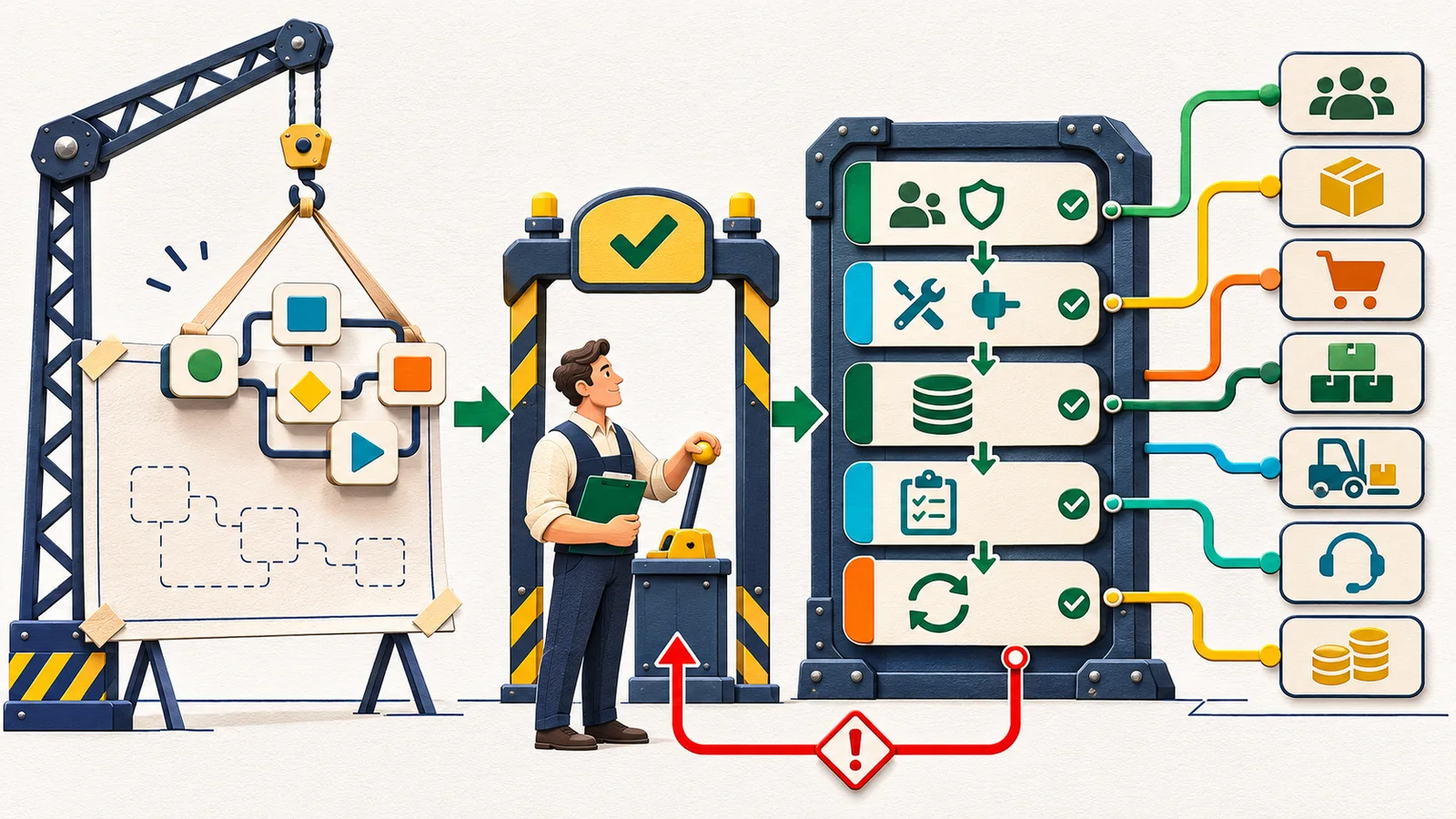
A code export is not a migration. The durable asset is the operating contract across inputs, routes, tools, permissions, approvals, state, evidence, and systems of record.
OpenAI lets teams export an Agent Builder workflow as TypeScript or Python Agents SDK code. The same migration guide warns that this process does not convert the step-by-step workflow or guarantee that every behavior transfers unchanged. Treat the export as source material, not proof that the same business behavior will survive.
Start with an applicability gate
Before starting a rushed rebuild, identify what the business actually uses.
| Question | Evidence to collect | Why it matters |
|---|---|---|
| Is there an Agent Builder workflow? | Workflow owner, purpose, ID, published version, and last known-good export | Separates affected workflows from unrelated OpenAI integrations |
| Does a user-facing experience point to it? | ChatKit configuration, application route, internal tool, or shared operating procedure | Identifies what still depends on the retiring hosted workflow |
| What can the workflow read or change? | Tool list, connected systems, authentication method, credential owner and secret reference—not secret values—scopes, and approval rules | Defines the business risk of an incomplete migration |
| Where does state live? | Agent state, application database, conversation history, external job records, and system-of-record IDs | Prevents duplicate work or lost context during cutover |
| How is correct behavior proven? | Representative inputs, expected routes, outputs, actions in connected systems, refusals, approvals, and failure cases | Creates a portable baseline for the same business behavior |
Do not infer post-shutdown storage or export behavior that OpenAI has not documented. Copy and retain the complete TypeScript or Python export while Agent Builder remains available, retain the version and ownership record, and verify that the export can be built in a safe environment.
Choose the destination before rebuilding the workflow
The two official migration paths solve different operating problems.
| Decision area | Agents SDK | ChatGPT Workspace Agents |
|---|---|---|
| Best fit | An agent inside an application or service that your team builds and deploys | A repeatable agent shared with people inside an eligible ChatGPT workspace |
| Who runs and supports it | Your team owns where it runs, deployment, monitoring, and operational support | The workspace provides the user surface, subject to its agent access and administration |
| Control | Better fit when custom code, fixed routing, proprietary integrations, or application-level state matter | Better fit when natural-language configuration and team sharing matter more than preserving a precise step-by-step workflow |
| Access boundary | Application authentication, tool credentials, permissions, and secrets must be validated and, where the export does not carry their configuration, rebuilt and tested | Requires Business, Enterprise, or Edu access to Workspace Agents plus permission to create agents; apps, tools, skills, authentication, and connection permissions still need review |
| Migration warning | Exported code still needs deployment and connection settings plus behavior testing | OpenAI says workflows that require fixed, repeatable behavior may not migrate faithfully and some behavior requires manual recreation |
ChatKit is an interface layer, not a replacement workflow engine. OpenAI says an existing Agent Builder-hosted ChatKit integration can continue during the transition window. For new work or migration, its documentation directs teams toward an advanced ChatKit integration backed by an agent implementation running on your server.
The path should follow the job. A customer-facing application that updates orders, inventory, or finance records usually needs clarity about where it runs, what each connection may do, how it recovers, and how operators see failures. An internal research or drafting workflow may fit a Workspace Agent if its access, sharing, and behavior requirements can be met there.
What must survive the migration
Inputs and outputs
Record every input type, required field, attachment rule, structured output, and validation error. A route that once received a structured handoff with required fields should not become an open-ended prompt by accident. External text should remain untrusted data, especially when it can trigger an action in another system.
Control flow and stopping rules
Map branches, loops, handoffs, maximum attempts, success conditions, and terminal failures. A workflow that asks a specialist agent to retry is not equivalent to one that can safely retry an ERP write. Define when the run pauses, when it stops, and when a human takes over.
Tools, authentication, and authority
List each read and write separately. A tool that looks up a Zoho CRM record is not the same authority as one that changes a deal stage. A catalog read is not an inventory adjustment. A draft reply is not an email send. Preserve least-privilege credentials, connection ownership, expiry and rotation rules, and an approval boundary for consequential actions.
State and duplicate protection
Decide where the run, approval, external request, and business transaction are recorded. A retry after a timeout must not create a second Shopify order, duplicate an Odoo invoice, repeat a Zoho update, or post the same finance entry twice. Keep a stable internal business key or duplicate-safe request key—often called an idempotency key—and the destination's durable receipt or unique reference. Verify whether each target supports duplicate-safe requests; if it does not, require a lookup-before-retry rule.
Human review and exception handling
OpenAI's safety guidance warns about prompt injection and private-data leakage. For MCP tools—externally connected tools using the Model Context Protocol—it says to keep tool approvals on so end users can review and confirm every operation, including reads and writes. AorBorC's broader implementation recommendation is to require risk-based approval for any consequential action: name the reviewer, show exactly what changed, preserve the evidence they saw, and define reject, revise, escalate, and resume paths. “Human in the loop” is not a control until the person has authority, context, and a recorded decision.
Portable test evidence
Preserve repeatable test cases and expected outcomes outside the retiring canvas. Include normal, boundary, malicious-input, denied-permission, connection-timeout, partial-success, duplicate-retry, and human-rejection cases. OpenAI documents the Evals dashboard, API, and graders for eval workflows as a separate November 30 shutdown and currently marks them read-only. Do not assume the Agent Builder code export carries eval or grader configuration. OpenAI also lists /v1/prompts and reusable prompt objects for a separate November 30 shutdown, so inventory those independently if the application uses them.
Ten-step migration checklist
- Build the affected-workflow register. Record owner, purpose, users, workflow ID and version, ChatKit dependency, connected systems, criticality, and cutover date.
- Export and archive the complete code export. Save the TypeScript or Python export with its generation date, source workflow version, configuration notes, and accountable owner.
- Capture the behavior baseline. Create repeatable test cases for representative inputs, routes, outputs, connected-system actions, approvals, refusals, and failure outcomes.
- Choose the target path deliberately. Document why the workflow belongs in the Agents SDK or Workspace Agents, including hosting, access, fixed-routing needs, sharing, integration, and support requirements. Record the Agents SDK build and deployment owner, or the actual Workspace plan, administrator, agent-creation permission, and connected-app eligibility.
- Rebuild the control flow. Produce a step-and-state map for branches, loops, handoffs, pauses, retries, timeouts, and end conditions. Mark every part that requires manual recreation.
- Rebuild the authorization boundary. Create a tool-and-permission matrix covering credentials, scopes, secret ownership, approval requirements, environment separation, and rotation.
- Reconnect systems of record safely. For Zoho, Shopify, Odoo, ERP, e-commerce, inventory, order, support, and finance actions, define stable identifiers, each target API's support for duplicate-safe requests, lookup-before-retry rules, success receipts, and the reconciliation owner.
- Test the same business behavior and controlled failure. Run the repeatable test cases in a non-production environment. Compare business outcomes, not just generated text. Require human approval for consequential test writes.
- Plan cutover and rollback. Name the decision owner, change window, traffic switch, logs and alert signals, stop conditions, rollback route, and user communication. Define rollback to a supported last-known-good deployment; do not assume the Agent Builder-hosted workflow remains a rollback target after November 30.
- Reconcile after release. Compare source requests, agent runs, approvals, tool receipts, and destination records. Close every mismatch before declaring the migration complete.
Each step should leave a record or piece of evidence that another operator can inspect. A successful demo is not enough for a workflow that creates customer, order, inventory, warehouse, or finance consequences.
Where the hype is not useful
- A new agent surface does not repair a weak process. Undefined ownership, unclear approvals, and missing reconciliation move with the workflow.
- ChatKit remaining available does not establish that an Agent Builder-hosted workflow survives the transition. OpenAI documents that hosted-workflow path only for the transition window and directs new or migrated ChatKit apps to a server-side agent implementation.
- A Workspace Agent is not a universal drop-in replacement. Eligibility, permissions, connected apps, and any need for fixed, repeatable behavior all require review.
- An Agents SDK build is not finished when it runs locally. Deployment, authentication, state, monitoring, support, and recovery become explicit responsibilities.
- More autonomy is not the migration goal. Preserve or tighten human review wherever an agent can change a business record, communicate externally, release an order, move inventory, or affect money.
AorBorC's implementation view
AorBorC is a founder-led Zoho + AI business-systems partner. We build AI around the operational workflow, not around a model demo. That means defining the source of truth, permissions, review path, failure state, and reconciliation evidence before an agent receives write access.
Our AI solutions work covers human-reviewed automation and practical agent workflows. When those workflows touch CRM, finance, commerce, or ERP systems, our Zoho integration work focuses on durable data contracts and recoverable handoffs. We treat a rushed migration as rescue-audit work: produce the affected-workflow register, tool-and-permission matrix, repeatable test cases, and reconciled cutover evidence. For teams vetting whether one delivery partner can cover the surrounding Zoho, Odoo, Shopify, custom-app, and reporting dependencies, the AorBorC company profile provides that capability overview.
Business takeaway
Export the Agent Builder workflow now, but do not call the export the migration. Pick one high-value path and prove that its inputs, routing, tool authority, approvals, state, failures, and destination records still produce the intended business outcome.
For every business-critical workflow, confirm the owner, copy the complete export, and bring its workflow ID, connected systems, ChatKit dependency, and target cutover date when you plan the AI workflow migration. For workflows that can create or change customer, order, inventory, warehouse, support, or finance data, also bring the approval and reconciliation owner. The safest cutover is the one that can show what happened, stop when it should, and reconcile every external effect.