Category: ERP, e-commerce, and integrations
Author: AorBorC Technologies
Published: July 23, 2026
A delivery address is not a party record. If the ERP cannot distinguish the buyer, the Ship-to party, and the physical destination, an API patch only moves the failure downstream.
India's Goods and Services Tax Network, or GSTN, says revised e-Invoice and e-Way Bill API validations will reach production on August 1, 2026. The change makes Ship-to GSTIN mandatory in specified Bill-to/Ship-to flows, adds related validations, and introduces a separate voluntary e-Way Bill closure facility.
This is easy to misread as a tax-field update. Operationally, it is a test of customer master data, delivery-party identity, order routing, ERP payloads, warehouse handoffs, and exception ownership.
AorBorC's view: a tax-field change becomes a fulfilment problem when the required identity is missing from the order and shipment workflow.
What changed
An e-Invoice is the invoice data registered with the government system; an e-Way Bill supports the documented movement of goods. GSTIN is a party's Goods and Services Tax Identification Number, and IRN is the Invoice Reference Number used in the e-Invoice system.
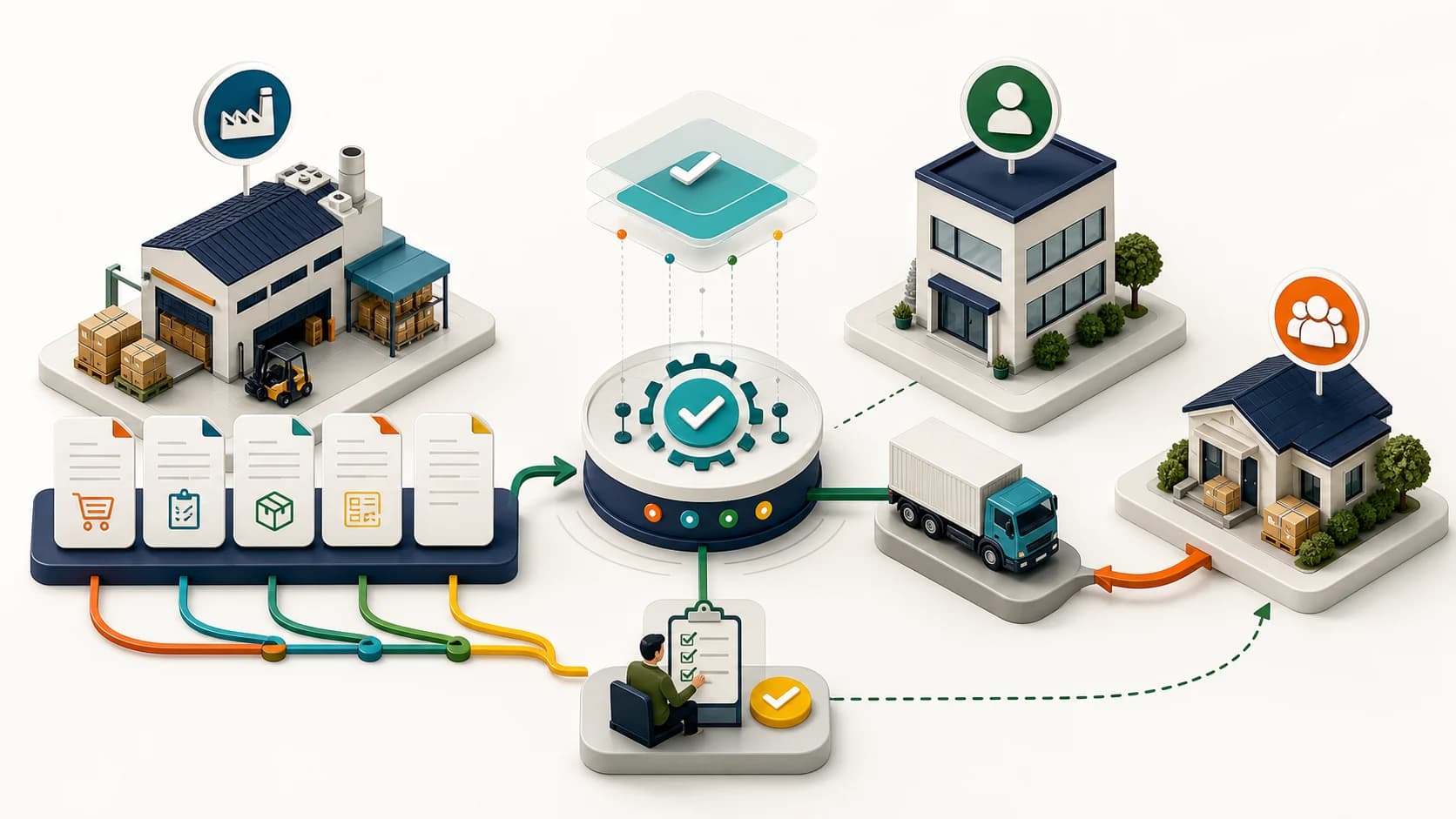
In a Bill-to/Ship-to transaction, one party buys the goods and another party receives them: Supplier A invoices Buyer B but delivers to Recipient C.
From August 1, the standalone Generate EWB API requires Ship-to GSTIN for Bill-to/Ship-to and combination transactions when the Ship-to party is registered. Generate IRN plus e-Way Bill makes ShipDtls.Gstin conditionally mandatory when Ship-to details are provided and an e-Way Bill is requested. E-Way Bill by IRN makes GSTIN mandatory under ExpShipDtls.
The revised validations check more than presence:
- the Ship-to GSTIN must be valid;
- in an actual Bill-to/Ship-to transaction, it must differ from the Bill-to GSTIN;
- the Ship-to state code must match the GSTIN state code; and
- the Ship-to PIN code must belong to the stated Ship-to state.
Where a Ship-to GSTIN is not available, GSTN permits URP wherever applicable. That is not a universal fallback for incomplete master data. A registered Ship-to party in a qualifying Bill-to/Ship-to flow should not be converted into an unregistered record simply because the source system lacks its GSTIN.
The requirement is flow-specific. In the standalone Generate EWB API, regular and Bill-from/Dispatch-from transactions must not send Ship-to GSTIN. Bill-to/Ship-to and combination cases should carry it when the Ship-to party is registered, with URP used only where applicable.
A different delivery address does not automatically mean a different Ship-to party. GSTN treats delivery to the buyer's own warehouse or additional place of business under the same GSTIN as a regular transaction, not Bill-to/Ship-to.
For e-Way Bills generated from an IRN, B2B and Special Economic Zone (SEZ) Ship-to details already supplied during IRN generation cannot be replaced. GSTN separately says a GSTIN omitted during IRN generation may be supplied during e-Way Bill-by-IRN generation, subject to validation; that does not permit replacement of Ship-to details already supplied. Export treatment differs: the published advisory says Ship-to details may be replaced in the export e-Way Bill-by-IRN flow.
GSTN's August 1 production package also introduces voluntary e-Way Bill closure after delivery; the related changes are currently available for sandbox testing. The closure API takes an e-Way Bill number, closure date, and remarks. It is a separate operational feature, not a condition for meeting the Ship-to GSTIN field requirement.
Why operational leaders should care
The buyer, Ship-to party, delivery location, and dispatch location can be four different records.
A Shopify or other e-commerce checkout may capture a shipping address without capturing the registered legal party receiving the goods. A CRM may hold the buyer's commercial relationship. Odoo, Zoho Books, or another ERP and finance system may own the invoice, tax treatment, inventory movement, and e-Invoice payload. A warehouse or transport tool may hold the physical destination and vehicle handoff. If the integration collapses those records into one "customer address," the required identity may not exist when the shipment is ready.
That creates several failure modes:
- checkout or sales-order data reaches the ERP without a governed Ship-to party;
- the correct GSTIN exists in a separate customer or location record but is not mapped into the API payload;
- a state, PIN code, and GSTIN describe different locations;
- a B2B or SEZ order reaches e-Way Bill generation before the non-replaceable Ship-to details already supplied with the IRN have been checked;
- a bulk generation run partly succeeds, but the team retries the entire batch and creates avoidable duplicate work; or
- a delivery is closed in the business system without enough evidence to reconcile it to GSTN's closure response.
The bulk-generation detail matters. For standalone bulk Generate EWB requests, GSTN says only the invalid request fails while other valid requests continue. The integration therefore needs per-record results and a selective retry queue, not one batch-level success flag.
There is also an important readback limit. GSTN says Ship-to GSTIN will not be printed on the e-Way Bill or returned through the later GET e-Way Bill readback APIs. A team cannot use that response to reconstruct a missing Ship-to identity later. The originating system must retain the submitted value, the source record, the response, and the audit trail.
The four records to separate
Before changing an API payload, map these records for one real Bill-to/Ship-to order:
- Buyer or Bill-to party: the entity receiving the invoice and carrying the commercial and tax relationship.
- Ship-to party: the distinct registered or unregistered recipient of the goods.
- Delivery location: the physical address, state, and PIN code used for fulfilment and transport.
- Dispatch-from location: the warehouse, branch, supplier, or other origin from which the goods move.
For each record, name the source system, owner, approval path, identifiers, effective dates, and allowed relationships. A customer master can contain several delivery locations. A delivery location can belong to a separate registered Ship-to party. A warehouse address is not automatically the legal dispatch-from identity.
This distinction should survive the full order lifecycle: catalog or quote, checkout or sales order, credit and approval, invoice, inventory reservation, picking, packing, e-Invoice, e-Way Bill, dispatch, proof of delivery, finance reconciliation, return, and support.
Ship-to GSTIN implementation checklist
Use this as a systems-readiness checklist. It does not replace tax or legal advice on whether a particular transaction falls within an affected flow.
Master data and release controls
- Classify the transaction flows. List regular, Bill-to/Ship-to, Bill-from/Dispatch-from, combination, B2B, SEZ, export, IRN-plus-e-Way-Bill, e-Way-Bill-by-IRN, and standalone e-Way Bill paths actually used by the business.
- Trace the source of each party and location. Identify where Shopify or another storefront, CRM, Odoo, Zoho, a custom app, warehouse software, and transport tools create or change the buyer, Ship-to party, delivery address, and dispatch location.
- Create a governed party-location relationship. Store the Ship-to party separately from the delivery address. Record GSTIN or the reviewed reason
URPis applicable, plus state, PIN code, status, effective dates, and evidence. - Choose the last safe release gate. Check GSTIN through the business's approved validation process, distinct Bill-to and Ship-to identities, state-code alignment, and PIN-to-state alignment—ideally before picking or dispatch, and always before the relevant IRN or e-Way Bill request.
Integration and testing
- Update every affected payload path. Test Generate IRN plus e-Way Bill, e-Way Bill by IRN, and standalone e-Way Bill integrations separately. Do not add Ship-to GSTIN to regular or Bill-from/Dispatch-from-only flows where GSTN says it is not applicable.
- Protect non-replaceable handoffs. For B2B and SEZ flows, validate Ship-to details before IRN generation because details already supplied generally cannot be replaced during e-Way Bill-by-IRN generation. If GSTIN was omitted at IRN generation, GSTN permits it to be supplied later subject to validation; treat that as remediation, not the normal design. Keep the export exception separate.
- Handle partial batch failure. Persist a result for every request and move only failed records into a correction queue. Retry only failed records, using the local request-and-result ledger to prevent already-generated records from being resubmitted.
- Test negative paths in the sandbox. Include missing GSTIN, same Bill-to and Ship-to GSTIN, invalid GSTIN, state mismatch, PIN mismatch, inappropriate
URP, mixed-validity standalone bulk batches, B2B/SEZ replacement attempts, export treatment, a closure request submitted more than one day after validity expiry, a closure date outside the period from e-Way Bill generation through validity expiry, and unavailable dependencies.
Operations and closure
- Decide who owns missing data. Define whether sales, customer service, finance, tax, e-commerce operations, or the warehouse pauses the order and contacts the buyer when a registered Ship-to GSTIN is missing.
- Design closure as its own workflow. If voluntary closure is useful, retain delivery evidence, e-Way Bill number, closure date, remarks, internal actor and approval, request, response, and retry history. GSTN advises closure on the delivery day or the next day; the closure facility remains available until one day after e-Way Bill validity expires, while the entered closure date must fall between generation and expiry. Capture the actor internally because the API response does not identify who closed the e-Way Bill, and GET EWB Details currently exposes neither a separate Closed status nor a closed date. The API also does not support date-wise bulk closure or a separate closed-EWB retrieval call.
- Monitor the first production runs. Reconcile ERP shipments, IRNs, e-Way Bills, API failures, manual portal actions, warehouse dispatches, proof of delivery, closure records, and finance postings. Keep human review on exceptions until the end-to-end evidence is stable.
Where the hype is not useful
This is not a mandatory Ship-to GSTIN field for every transaction. Applying the new field across all flows can be as wrong as omitting it from the qualifying ones.
URP is not a data-cleanup shortcut. Its published use is limited to cases where the Ship-to GSTIN is unavailable and URP is applicable.
Voluntary closure is not cancellation; it is not mandatory and it does not replace proof of delivery. GSTN's FAQ describes an initial stabilisation period in which the GET details API does not return a separate Closed status or closed date and some post-closure actions remain available. A business system should not infer a stronger final state than the government interface exposes; warehouse, carrier, customer-service, and finance teams still need evidence of what was delivered, when, to whom, and what happened next.
Finally, an ERP change is not tax advice. The responsible business and its qualified advisers must confirm the treatment of its real transaction types. The implementation team's job is to preserve that approved treatment through the systems.
AorBorC's implementation view
AorBorC would first trace one representative order from storefront or CRM through ERP, finance, warehouse, transport, e-Invoice, e-Way Bill, and reporting. The implementation then defines party and location ownership, GSTIN review, URP governance, fulfilment holds, exception queues, and retained evidence; configures Odoo or Zoho workflows, Shopify and e-commerce order capture, ERP modules, integrations, and reporting; and uses human-reviewed sandbox tests and production reconciliation before reducing manual oversight.
The goal is not a one-off field patch. It is a long-lived order-to-delivery control that survives new locations, changed registrations, new commerce channels, warehouse changes, integration retries, returns, and audits.
Relevant service paths:
- ERP and Zoho solutions for finance, approvals, master data, reporting, and cross-application workflows.
- Odoo implementation for sales, invoicing, inventory, warehouse, procurement, and delivery operations.
- E-commerce store development for Shopify and other storefront order, customer, catalog, checkout, and ERP handoffs.
Business takeaway
GSTN's August 1 change turns Ship-to identity into a release control for qualifying order flows. The practical work is to separate buyer, recipient, delivery, and dispatch records; validate them before the relevant government request; send the right field only in the right flow; and retain enough evidence to reconcile failures and closure.
If your team needs to map one real order before the production change, plan the workflow with AorBorC. Bring the storefront order, customer and location records, ERP invoice, warehouse movement, current API payload, failure log, and proof-of-delivery process.