Category: Digital Waste Tracking, ERP & Integration Operations
Author: AorBorC Technologies
Published: September 28, 2026
From October 1, affected waste receivers in England and Wales must report each receipt of controlled waste through the digital waste tracking service. The operational problem is larger than an upload.
A load is not operationally closed when it crosses the gate. It is closed when the required data is accepted, tied to its waste tracking ID, corrected when necessary, and replayed after an outage.
The official guidance keeps an initial or rejected submission inside the same two-working-day window, gives a later-discovered error a one-month limit, and sets separate outage deadlines. It also keeps several existing notes and returns in place.
What changes on October 1
The GOV.UK scope guidance says the duty starts on October 1, 2026, for organisations licensed or permitted to receive controlled waste at affected sites in England and Wales. Use its scope and exceptions to check each site, permit, activity, and movement; do not assume one UK timetable.
For a non-pipeline in-scope receipt, the record must be submitted and its unique reference received within two working days, starting on the day after the waste is received. Defra's API guidance calls the movement identifier a Waste Tracking ID. That ID needs to come back into the operating record so the team can prove which accepted record belongs to which load.
Piped receipts use separate start rules; follow the official guidance for multi-day or continuous flows.
The September 25 update clarified help contacts; it did not create the October 1 duty. The timely issue is the approaching deadline and the exception work missed by a submission-only plan.
The deadline is a closed-loop workflow
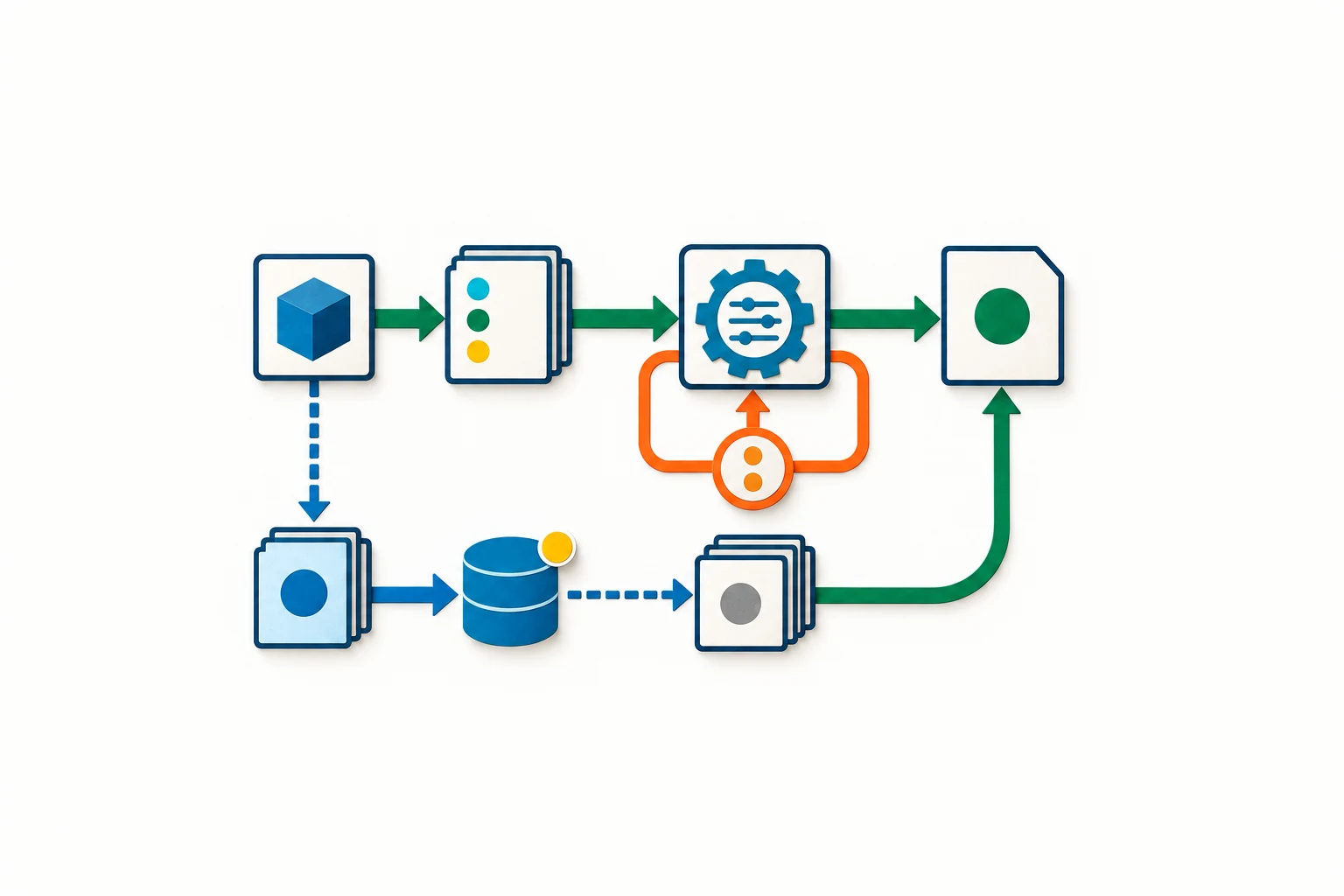
The minimum useful flow is:
- identify whether the site and receipt are in scope;
- capture the required movement data against an internal load or receipt ID;
- submit through the chosen route;
- store the returned waste tracking ID;
- route rejections and corrections to a named owner;
- keep an outage record when an outage prevents submission; and
- reconcile received loads, accepted references, corrections, and backfilled records.
The internal identifier and the official waste tracking ID solve different problems. The first links the gate, weighbridge, warehouse, supplier, purchase, or ERP record. The second identifies the submitted movement in the government service. They should be joined, not treated as interchangeable.
The same applies to the organisation API code described in the technical guidance. It identifies the reporting organisation for an API connection; it is not the movement's waste tracking ID. Multi-organisation groups need an explicit map of which organisation code, site, internal record, and reporting route belongs together.
Two submission routes, one operating obligation
The reporting guidance describes two routes: compatible software connected to the API, or the prescribed spreadsheet template. An organisation may use either route or combine them; API software still needs the relevant integration and production approval.
GOV.UK says to use the supplied spreadsheet without changing its format and to start with a new template after submission. That requires controls around version, review, upload, returned IDs, and exception follow-up.
The API is not just a URL to call. The official software-provider guidance says connected software must integrate with the service. API software must follow Defra's onboarding process, complete the required scenarios, and satisfy the production approval tests applicable to its product; some products have test exemptions. The receiver remains responsible for checking suitability. AorBorC is not presented as a listed compatible software provider. Its role is the intake, handoff, exception, reconciliation, and test controls around the service or compatible software.
Corrections run on different clocks
Four clocks need separate evidence:
- Initial receipt: submit and receive the reference within two working days after receipt, excluding weekends and bank holidays.
- Notified submission error: correct it inside that original two-working-day window.
- Later-discovered error: correct it promptly and within one month of discovery.
- Outage: make and retain the written record within two working days, then transfer it within seven working days after resolution.
If a submission is rejected and the organisation is notified of errors, the errors need to be corrected and the record resubmitted within the original two-working-day reporting window. That is a live operational exception, not a month-end clean-up item.
If a mistake is discovered later, the guidance says to correct it as soon as possible and always within one month of discovering it. That needs an owner, a reason, an audit trail, and a way to identify linked internal records.
The outage lane is part of the system
An outage can be a local building or network failure, not only central-service unavailability. The official guidance requires an in-scope receiver to make a written record containing the required receipt data within two working days, starting the day after receipt. Unless the organisation has been notified that the central service itself is unavailable, it must tell its regulator as soon as possible and give the regulator access to the written record when requested. After recovery, the record must be transferred to the service within seven working days, starting the next day.
The outage ledger should preserve the internal ID, required data, receipt time, evidence, owner, and later waste tracking ID. It needs a replay state: waiting, ready, submitted, rejected, accepted, or reconciled. Offline files without a controlled replay queue are not an outage process.
Paper notes and returns still run in parallel
Digital reporting does not remove every existing record. The scope guidance says relevant waste transfer notes, Annex VII forms, hazardous-waste consignment notes, permit returns, and consignee returns continue where required.
Parallel reconciliation is required because the service, operational system, statutory note, and return may describe the same movement at different times. Shared identifiers and a discrepancy rule keep the new service from becoming another silo.
A ten-output October 1 readiness checklist
These are AorBorC implementation recommendations, not legal advice, waste-classification advice, compliance certification, or a substitute for regulator and provider guidance.
Confirm scope by site and activity. Record the permit or licence context, receiving activity, waste types, exclusions, and the person who confirmed the interpretation. Artifact: site scope register. Owner: compliance lead.
Map each required field to its source. Identify what comes from the producer or carrier, what is captured at receipt, what is derived, and what requires human review. Artifact: field-and-source map. Owner: operations analyst.
Join the identifiers and attempts. Link the internal load ID, organisation, site, route, attempt ID, payload version, submission time, response or error, Waste Tracking ID, correction, and any ERP record. Artifact: identifier contract. Owner: solution architect.
Make the reporting clock visible. Exclude weekends and bank holidays, show the due date, and set an earlier first-attempt cutoff so a notified error can be fixed inside the same window. Artifact: deadline and escalation rule. Owner: site operations manager.
Control the reporting route. Record whether each organisation and site uses the prescribed spreadsheet, compatible API software, or a combination of both; keep organisation API codes separated by organisation. Artifact: organisation-site-route matrix. Owner: programme owner.
Capture accepted references. Bring each returned waste tracking ID back to the source record and prevent a movement from being closed without the expected reference or an explicit exception. Artifact: accepted-reference register. Owner: reporting administrator.
Separate rejection and correction queues. Preserve the attempt and payload version, response, notification or discovery time, applicable due date, owner, correction evidence, resubmission result, and Waste Tracking ID when issued. Artifact: correction queue and audit log. Owner: exception manager.
Build outage capture and replay. Keep the required receipt data, regulator notification or central-service outage notice, and any requested-access evidence. Transfer each queued record within the seven-working-day recovery window, then track rejection, acceptance, and reconciliation separately. Artifact: outage ledger and replay report. Owner: business continuity lead.
Reconcile parallel records. Compare received loads, submissions, accepted references, corrections, outage replays, continuing notes, returns, inventory or ERP movements, and unresolved differences. Artifact: daily reconciliation report. Owner: data and reporting lead.
Prove access, retry, and failure behaviour. For API routes, test roles, accepted and rejected scenarios, 429 handling with backoff, outages, and corrections. Keep each retry traceable as one attempt against one receipt. Artifact: signed boundary-scenario evidence pack. Owner: QA lead.
Where automation hype is not useful
AI can help extract candidate fields from documents, flag missing values, group exception reasons, or prepare an operator's review queue. It should not silently decide waste classification, permit applicability, legal scope, or whether a questionable record is acceptable. Those decisions need an accountable human and evidence from the applicable guidance and operating records.
The same discipline applies to API automation. A green response is not the business outcome. The useful proof is that every in-scope receipt has the right data, an accepted reference, a closed correction or outage path, and agreement with the records the operation still relies on.
Risks and limits
The guidance is specific to affected receivers in England and Wales. It should not be presented as a single UK-wide start date or as a rule for every organisation that handles waste. Operators should use the official scope guidance and qualified advisers for their circumstances.
Technical fields, provider behaviour, and service guidance may change. Test the spreadsheet version, compatible software, credentials, API responses, and production process in use. Do not describe an internal Zoho Creator app, ERP module, or general integration as compatible reporting software unless that exact product has passed the applicable tests.
Where AorBorC fits
AorBorC can build the operating layer around the prescribed spreadsheet or compatible software without presenting internal tools as the reporting product. Zoho integrations can support reviewed field capture, owner queues, and returned-ID capture; ERP module development can join receipt and load records to purchase, inventory, warehouse, or finance records; and Zoho QEngine implementation can exercise accepted, rejected, rate-limited, outage, correction, and role paths where applicable.
Founder-led rescue traces one receipt across every handoff, finds orphaned IDs and unowned exceptions, and leaves a maintained field map, queue, and reconciliation report rather than a one-off upload.
Business takeaway
Submission is not operational closure. Closure evidence is an in-scope receipt joined to its internal record and accepted Waste Tracking ID, with rejected attempts, later corrections, outage transfers, and parallel-record differences resolved. Anything unresolved stays open with an owner and due date.
What to do before October 1
Trace one site's representative receipt through field capture, submission, returned Waste Tracking ID, internal update, and reconciliation. Then run rejection and outage paths. Any step without an owner, due clock, or evidence is the first gap to fix.
If the workflow crosses spreadsheets, compatible software, custom apps, and an ERP, plan the integration and exception review with AorBorC.
Sources checked
- GOV.UK, Digital waste tracking: check if you need to report the waste you receive, updated September 25, 2026. Used for scope, October 1 start, reporting and correction clocks, outage handling, and continuing records.
- GOV.UK, Report receipt of waste, updated September 25, 2026. Used for account, spreadsheet, API, and organisation-code guidance.
- GOV.UK, Report receipt of waste: choose a software provider, updated September 24, 2026. Used for compatible-software and production-approval boundaries.
- Department for Environment, Food & Rural Affairs, API receipt of waste getting started guide, checked September 28, 2026. Used for testing, production access, organisation API codes, and Waste Tracking ID terminology.