Integrating QuickBooks with Zoho CRM saves time, reduces manual errors, and keeps your sales and finance teams aligned. Here's what you gain:
- Real-Time Sync: Sales data, invoices, and customer details update instantly across both systems.
- Automation: Eliminate manual data entry with workflows for invoices, payments, and inventory updates.
- Customizable Options: Choose between native connectors, Zoho Flow, or custom APIs based on your business needs.
- U.S. Compatibility: Supports U.S. currency, date formats (MM/DD/YYYY), and financial reporting standards.
Key Steps to Get Started:
- System Requirements: Ensure active subscriptions and admin access for both platforms.
- Data Backup: Export key reports and records from QuickBooks and Zoho CRM.
- Define Goals: Decide on one-way or two-way sync, prioritize automation, and map fields for consistency.
- Integration Methods:
- Native Connectors: Simple setup, ideal for basic syncing.
- Zoho Flow: Flexible workflows with a drag-and-drop interface.
- Custom APIs: Advanced, tailored solutions for complex needs.
- Testing: Validate with sample data and troubleshoot issues like duplicates or sync errors.
By integrating these tools, you streamline operations, improve accuracy, and free up your team for strategic tasks. Whether you're a small business or a growing company, this connection can scale with your needs.
Prerequisites and Planning
Laying the groundwork for your integration is key to avoiding data headaches later on. By understanding technical needs, securing your data, and setting clear goals, you’ll set yourself up for a smoother process.
System Requirements
To successfully integrate QuickBooks Online and Zoho CRM, both systems must meet specific technical criteria. First, ensure you have active subscriptions to both platforms - note that the desktop version of QuickBooks is incompatible with most integration methods. Also, double-check that your QuickBooks Online account is up to date with no billing issues, as an expired subscription can disrupt the connection.
You’ll also need administrative access for both systems. In QuickBooks Online, this means having either Company Administrator or Master Administrator permissions to authorize third-party connections. For Zoho CRM, Administrator or Super Admin privileges are required to configure integration settings and manage data sync rules.
Additionally, confirm that you have a stable internet connection and are using an updated browser (such as Chrome, Firefox, Safari, or Edge) to avoid technical hiccups during the process.
Backing Up Data
Before diving into integration, protect your existing data. QuickBooks Online automatically creates backups, but it’s wise to manually export key reports for added security. Save your Profit & Loss statement, Balance Sheet, Customer Contact List, Chart of Accounts, and Item List as Excel files for easy reference during the integration process.
Zoho CRM includes backup tools in its Data Administration section. Export your Contacts, Accounts, Deals, and any custom modules as CSV files to ensure you have complete records on hand in case restoration becomes necessary.
To further safeguard your data, consider using the 3-2-1 backup rule: maintain three copies of your data, stored on two different types of media, with one copy kept off-site. Cloud services like Google Drive or Dropbox are ideal for off-site storage, while local drives can provide quick access when needed. Finally, test your backups by opening the exported files to confirm everything is intact and usable.
Setting Integration Goals
Defining clear goals will help guide your integration setup and allow you to measure its success. Start by identifying areas where manual data entry between your CRM and accounting system slows down your workflow.
Focus on data synchronization priorities that eliminate redundant tasks. For example, decide whether you need one-way sync (data flows in a single direction) or two-way sync (updates occur in both systems). For customer contact information, two-way synchronization is often the best choice, while invoice data typically flows one-way from QuickBooks to Zoho CRM.
Tailor automation to your team’s needs. If sales reps frequently check payment statuses before processing orders, prioritize real-time invoice synchronization. On the other hand, if your accounting team spends hours manually entering customer data from CRM deals, automating contact and deal synchronization can save time and reduce errors.
Set measurable goals to track progress. Instead of a vague aim like "improve efficiency", define specific targets - such as cutting manual invoice entry time from two hours to 15 minutes per day.
Timing is another factor to consider. Critical data, like payment statuses, may require real-time updates, while less urgent information, such as address changes, can be updated on a schedule.
Lastly, plan for data mapping. Review field names and formats in both systems to ensure consistency. For instance, QuickBooks might use "Company Name" while Zoho CRM uses "Account Name" for the same data. Creating a simple mapping document to align these fields can save you time and frustration during setup and troubleshooting.
With these foundational steps completed, you’ll be ready to explore integration methods with confidence.
Integration Methods
After completing your planning phase, the next step is selecting the right integration method to suit your business needs. You’ll typically choose between native connectors, Zoho Flow, or custom APIs. Once you’ve made your choice, you can follow a step-by-step process to ensure your integration runs smoothly.
Native Connectors
Native connectors provide a straightforward way to integrate systems. These built-in tools are designed for basic synchronization tasks and don’t require any coding knowledge.
Setting up native connectors is quick and simple, making them a great choice for small to medium businesses that need essential data sharing. You can find these connectors directly within the Zoho CRM interface, where you can authorize and configure sync settings in just a few clicks.
However, native connectors are best suited for standard workflows. If your business requires syncing custom fields, applying complex business logic, or handling unique data transformations, this option may feel limiting.
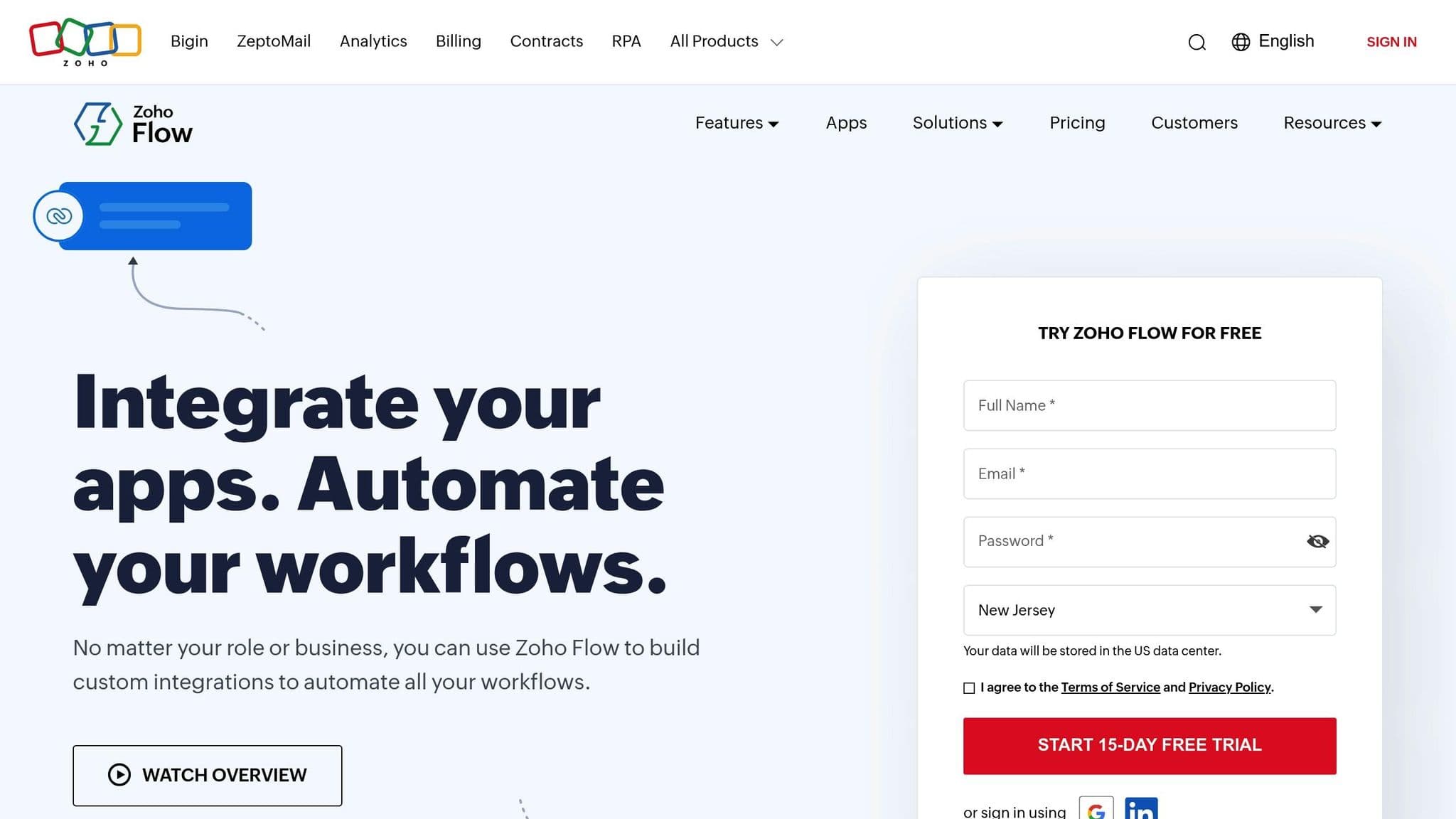
Zoho Flow

Zoho Flow offers more flexibility with its drag-and-drop interface, allowing you to create custom workflows and triggers for specific events. This platform is ideal for automating tasks across systems.
For example, you could set up a workflow that automatically creates a deal in Zoho CRM when a new customer is added to QuickBooks or updates payment statuses in your CRM when invoices are marked as paid. Zoho Flow supports both one-way and two-way synchronization, giving you control over how data moves between systems.
While the platform doesn’t require advanced programming skills, a moderate level of technical understanding is helpful. Most businesses can get comfortable with the interface and set up functional workflows within a few days. Keep in mind, though, that Zoho Flow uses task-based pricing, which can increase costs if you’re syncing high volumes of data.
This method works well for businesses needing more than basic syncing but not requiring highly specialized integration logic. It’s especially useful for automating repetitive tasks involving multiple steps or conditions.
Custom APIs or Middleware
If your integration needs go beyond what standard tools can handle, custom APIs offer the most powerful and flexible solution. This approach caters to highly specific requirements, such as complex field mappings, integrating with QuickBooks Desktop, or connecting additional business systems.
Custom API projects typically require experienced developers familiar with Zoho CRM and QuickBooks APIs. Development timelines can range from several weeks to months, depending on the complexity of your requirements. Additionally, ongoing maintenance costs should be part of your budget considerations.
Despite the higher investment, custom APIs provide unmatched capabilities. They allow for advanced business logic, efficient handling of large data volumes, and seamless integration tailored to your evolving needs. This method is ideal for businesses with unique requirements, substantial data volumes, or the need to integrate QuickBooks Desktop.
| Integration Method | Advantages | Limitations | Skills Required | Cost |
|---|---|---|---|---|
| Native Connectors | Easy setup, user-friendly, included in Zoho subscription | Limited customization, basic syncing only | None | Included in Zoho subscription |
| Zoho Flow | Flexible workflows, custom triggers, drag-and-drop interface | Limited by task-based pricing, moderate learning curve | Some technical skills | Zoho Flow subscription |
| Custom APIs | Fully tailored, supports complex logic, handles large data volumes | Time-intensive, requires ongoing maintenance | Experienced developers | Development costs |
Your choice will depend on your business’s specific needs, technical expertise, and budget. Many businesses start with native connectors or Zoho Flow to address immediate needs, then transition to custom APIs as their requirements grow. You can always begin with a simpler solution and scale up when necessary.
If you’re unsure which approach is best, AorBorC Technologies can assist with evaluating your needs and implementing the most suitable integration method - whether it’s a quick native setup or a fully customized API solution.
Step-by-Step Integration Process
Once you've chosen your integration method, it's time to connect QuickBooks to Zoho CRM. Whether you're using native connectors or Zoho Flow, the core steps remain largely the same and require administrator access. Building on your initial planning, follow these steps to link QuickBooks and Zoho CRM effectively.
Access Zoho CRM Integration Settings

Begin by logging into your Zoho CRM account with administrator privileges. In the dashboard's top-right corner, click Settings. From there, locate the Integration section in the left-hand sidebar.
If you're integrating with Zoho People, navigate to Settings > Integration > Others > QuickBooks. For Zoho Subscriptions users, go to Settings > Integrations > Accounting. In some cases, you might need to install the QuickBooks integration from the Zoho Marketplace before it appears in your settings.
Before proceeding, make sure you have data backups in place.
Authorize QuickBooks Access

Once you've found the QuickBooks integration option, click Connect or Authorize. You'll be redirected to the QuickBooks Online login page. Enter your QuickBooks credentials, and after signing in, you'll see a list of organizations linked to your QuickBooks account. Select the organization you want to connect to Zoho CRM to ensure data syncs with the correct account.
Next, review and confirm the permissions required for accessing customer data, invoices, products, and payments. Click Authorize to grant access. This process typically takes 30–60 seconds. Check that both systems use the same base currency to prevent sync errors or inaccurate financial data.
Configure Sync Settings
After establishing the connection, configure how data will flow between the two platforms.
- Select modules to sync: Choose the data categories (e.g., Contacts, Accounts, Invoices) that align with your business needs.
- Set sync direction: Decide if the sync will be one-way (from QuickBooks to Zoho CRM or vice versa) or bidirectional for real-time updates in both systems.
- Map fields: Ensure accurate data transfer by mapping fields between the systems. Standard fields like customer names, addresses, and phone numbers are pre-mapped, but you can customize these or add new mappings using a drag-and-drop interface.
- Choose sync frequency: Options include instant sync, scheduled syncs (hourly, daily, or weekly), or manual syncs, depending on your needs.
- Configure record actions: Enable or disable actions like create, update, and delete for each module. For instance, you might allow creating and updating vendors but disable the delete option, ensuring that vendor deletions in Zoho CRM won't affect QuickBooks records.
For Zoho Subscriptions users, it's crucial to map taxes accurately between the two systems to maintain compliance with U.S. financial regulations.
Once your sync settings are complete, you're ready to validate the integration.
Test and Troubleshoot
Before rolling out the integration, test it with a small data sample. For example, create a test contact in Zoho CRM and check if it syncs correctly to QuickBooks. Update the contact's details and confirm the changes reflect properly.
Use the audit page to monitor sync statuses and review which records have been synchronized. This tool lets you filter by sync date and quickly identify issues like duplicate records or failed syncs. Duplicates often occur when similar records exist in both systems, such as "John Smith" and "J. Smith." To minimize duplicates, refine your field mapping and use unique identifiers like email addresses or customer IDs.
Failed syncs are usually caused by missing fields, incorrect formatting, or permission errors. Check the error logs on the audit page for details, adjust field mappings, or update source data as needed.
Test scenarios that reflect your actual processes, such as converting leads or syncing invoices, to ensure seamless data transfer. Allow 24–48 hours for thorough testing before deploying the integration across your team.
If you run into complex challenges or need help optimizing the setup, AorBorC Technologies offers expert support to ensure your QuickBooks and Zoho CRM integration works smoothly from the start.
sbb-itb-058cafb
Best Practices and Optimization
Once you've successfully integrated QuickBooks with Zoho CRM, keeping the system running smoothly requires ongoing effort. Paying attention to data quality, automation opportunities, and compliance with U.S. financial standards will help you get the most out of your integration while avoiding potential issues.
Data Accuracy and Consistency
The quality of your data is the backbone of a successful integration. Poor data can cause errors that ripple through both systems. To avoid this, conduct quarterly audits to catch duplicates, incorrect entries, or missing information. Focus on crucial areas like customer contact details, product pricing, and payment statuses. For a thorough review, include checks for email formatting, consistent phone numbers (with area codes for U.S. customers), and standardized addresses.
Set up field validation rules in both QuickBooks and Zoho CRM to catch errors before they sync. For example, enforce proper email formatting and ensure phone numbers follow a consistent format. Document your data entry standards and train your team on naming conventions, required fields, and formatting rules. Clean, reliable data sets the stage for effective automation.
Automation and Task Management
Once your data is in good shape, automation can take your efficiency to the next level. Use your integration to automate repetitive tasks and minimize manual errors. For instance, configure workflows that automatically generate invoices in QuickBooks when deals are marked as closed in Zoho CRM. This eliminates the need for manual entry and ensures accuracy.
You can also automate payment tracking, allowing QuickBooks to update deal stages in Zoho CRM. This keeps your sales team informed about payment statuses without requiring constant manual updates. Additionally, set up inventory management workflows to adjust product availability in Zoho CRM based on inventory levels in QuickBooks, preventing the risk of selling items that are out of stock.
For more advanced workflows, Zoho Flow is a powerful tool. You can, for example, create automations that generate purchase orders in QuickBooks whenever inventory falls below a certain threshold. Use analytics dashboards in both systems to monitor your automation's performance, tracking metrics like time saved, fewer errors, and faster process completion. While automation can streamline operations, compliance remains a critical focus.
Compliance with U.S. Financial Standards
When data moves between systems, staying compliant with U.S. financial regulations can get tricky. Your integration should adhere to Generally Accepted Accounting Principles (GAAP), which are essential for publicly traded companies and preferred by many lenders.
To meet these standards, configure your integration to use accrual-basis accounting. This ensures that revenue is recognized in the correct accounting period, even if payments come later. Sync settings between Zoho CRM and QuickBooks should align to reflect this. Additionally, log all transaction changes with user details and timestamps, and enforce period-end controls to prevent edits to finalized accounting periods. This ensures that updates in Zoho CRM don’t disrupt closed financial records.
Getting Expert Support
For complex integrations, expert guidance can make all the difference. While basic setups might be manageable on your own, optimizing your QuickBooks–Zoho CRM integration often requires custom configurations and ongoing fine-tuning.
AorBorC Technologies specializes in Zoho CRM customization and can help design workflows tailored to your business needs. Whether you need custom field mappings, advanced automation workflows, or compliance consulting, their team can ensure your integration aligns with your processes and regulatory requirements.
Scheduling regular health checks with integration experts is also a smart move. These reviews can uncover performance bottlenecks, security risks, or opportunities to add new automations as your business grows. Typical assessments include performance analysis, security evaluations, and actionable recommendations to keep your systems running at their best.
Conclusion
Integrating QuickBooks with Zoho CRM transforms how you handle financial data and customer relationships. By cutting out manual data entry, this connection streamlines operations, allowing your team to focus on their core responsibilities.
With synchronized customer and financial data, errors are minimized, and a unified source of truth emerges. This improves collaboration between sales and finance teams, ensuring everyone works from the same accurate information.
The integration also provides deeper insights into customer interactions and financial history. This helps with better forecasting, managing cash flow, and crafting more effective sales strategies. A setup tailored to your business needs ensures these benefits are fully realized.
Success hinges on customizing the integration to fit your workflows and keeping the system updated as your business evolves. Training your team on the new processes and maintaining clear data standards are equally important for ensuring accurate financial reporting and compliance with GAAP.
For businesses needing help with advanced customizations or ongoing optimization, AorBorC Technologies offers specialized Zoho CRM customization services. Their expertise in designing integrations and automating workflows can help you unlock the full potential of connecting QuickBooks and Zoho CRM, setting the stage for growth.
FAQs
What are the main advantages of integrating QuickBooks with Zoho CRM for small businesses?
Integrating QuickBooks with Zoho CRM offers small businesses a range of practical advantages. By automating data sharing between the two platforms, it eliminates the need for tedious manual data entry. This not only saves time but also reduces the risk of errors, ensuring your financial and customer management records stay consistent and accurate.
Another key benefit is the improvement in financial reporting. With real-time data synchronization, businesses gain better insights, enabling smarter decision-making. The integration also simplifies tasks like sales tracking, invoicing, and inventory management, making daily operations more efficient. By connecting customer and financial information, businesses can build stronger relationships with their clients and channel their efforts toward growth and productivity.
How can I maintain accurate and consistent data when integrating QuickBooks with Zoho CRM?
To keep your data accurate and consistent when integrating QuickBooks with Zoho CRM, start by reviewing and cleaning up both systems. Remove duplicate entries and outdated records to ensure you're working with reliable information. It's important to update both platforms before and after the integration to avoid any mismatches.
Using real-time updates or bidirectional syncing can help keep data aligned across both systems. You can also set up data validation rules and plan regular data audits to catch and fix any errors. These practices will help streamline the integration process and ensure your business runs smoothly.
How do I decide between native connectors, Zoho Flow, and custom APIs for integrating QuickBooks with Zoho CRM?
When connecting QuickBooks with Zoho CRM, the right option depends on what your business requires and how technical your setup needs to be:
- Native connectors are straightforward to implement and work well for standard processes. However, they come with limited options for customization.
- Zoho Flow offers a no-code solution, making it easier to design workflows that better fit your needs. While it provides more flexibility, it does require some initial configuration.
- Custom APIs are ideal for advanced, highly specific integrations. They give you complete control over data handling and workflows but demand technical skills and development resources.
Think about how complex your processes are, how much customization you need, and the resources you have available before choosing the best approach.