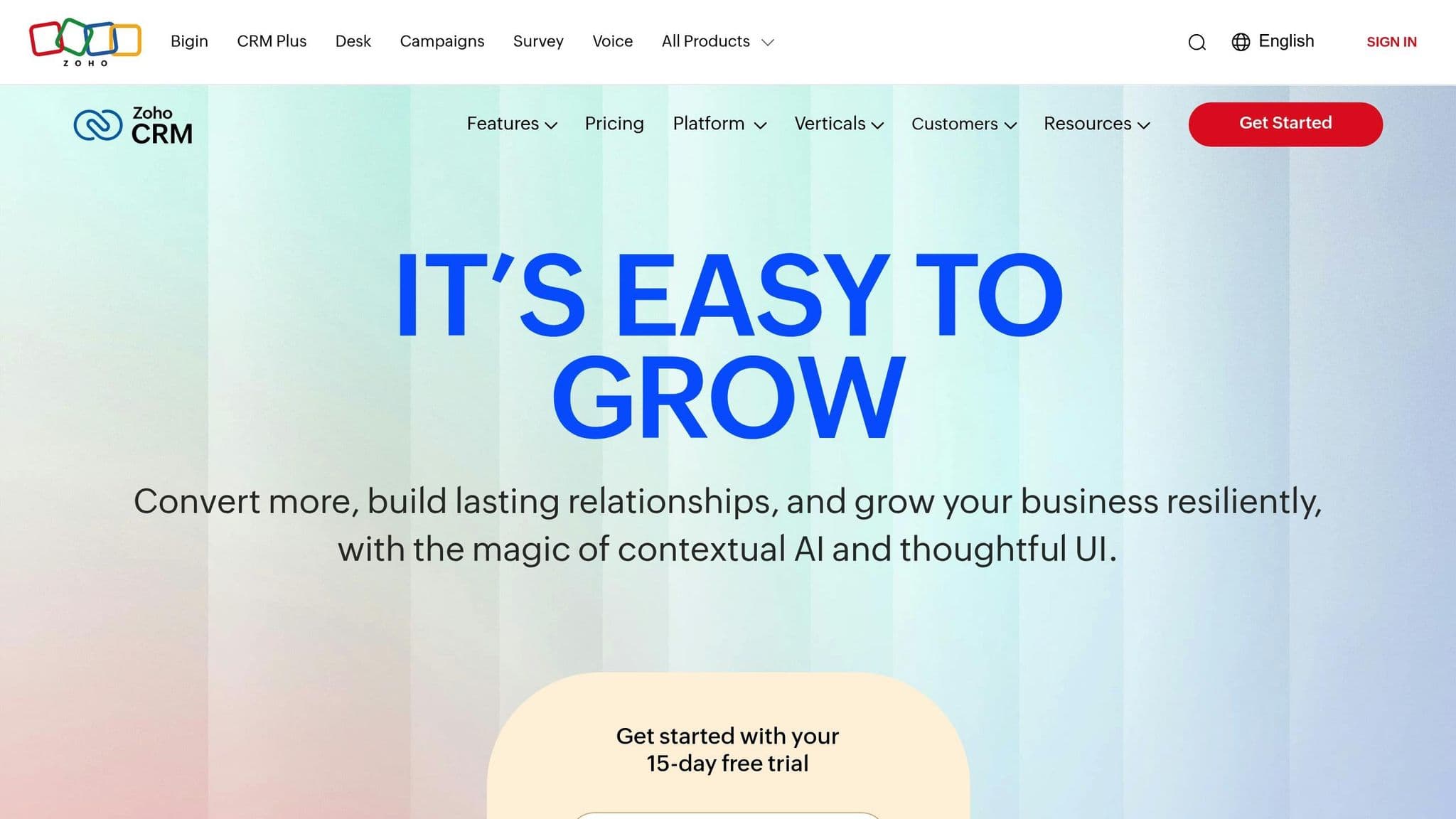
Machine learning helps businesses predict customer behavior by analyzing large datasets like purchase history, browsing habits, and demographics. This enables companies to create personalized marketing strategies, predict churn, and even detect fraud. Tools like Zoho CRM simplify this process by offering AI-driven insights, such as lead prioritization and campaign timing, without needing advanced technical skills.
Key Takeaways:
- Why It Matters: 80% of customers value how they’re treated as much as the product itself, and personalization can increase brand loyalty by 82%.
- Popular Models: Logistic regression for simple predictions, decision trees for interpretability, and neural networks for complex datasets.
- Applications: Churn prediction, purchase forecasting, customer segmentation, and fraud detection.
- Tools: Platforms like Zoho CRM and Zoho Analytics use AutoML for easy integration, while custom solutions from providers like AorBorC Technologies offer tailored workflows.
Machine learning isn’t just for tech giants. With tools and strategies tailored to your needs, even small businesses can leverage it to boost efficiency and customer satisfaction.
Machine Learning Models for Customer Behavior Prediction
Predicting customer behavior with machine learning is a game-changer for marketing and sales. Almost half of organizations now use ML to gain insights into customers and improve sales prospecting. Choosing the right model is critical to stay ahead in a competitive market.
The key to success lies in matching the model to your business goals and the specific data you're working with. Each model has its strengths, and here’s a breakdown of some popular options for different predictive needs.
Basic Predictive Models
Logistic Regression is a go-to for binary predictions, like determining whether a customer will make a purchase or not. It’s straightforward, efficient, and offers transparency by showing why certain predictions are made - making it ideal for personalized marketing.
Decision Trees mimic human decision-making by breaking down data into a series of yes-no questions. For instance, they might analyze recent purchase activity or spending habits to arrive at predictions. Their simplicity and interpretability make them a popular choice.
Neural Networks dive deeper, uncovering patterns in complex datasets that simpler models might miss. They’re especially useful when working with large, multi-dimensional data like demographics, purchase history, and behavioral patterns. While they require more computational power and are less transparent, their ability to handle intricate relationships in data makes them invaluable in dynamic markets where customer preferences shift frequently.
The more data these models have, the better they perform - an advantage in fast-changing industries. Next, let’s look at segmentation models that refine customer insights even further.
Customer Segmentation Models
K-Means Clustering groups customers based on shared characteristics like behavior, demographics, or purchasing habits. This helps businesses create targeted marketing strategies by identifying natural clusters in their audience.
Hierarchical Clustering takes segmentation a step further by building a tree-like structure that shows relationships between customer groups. For example, it can reveal connections between different segments, aiding strategies like cross-selling.
RFM Analysis (Recency, Frequency, Monetary Value) is another powerful tool when paired with machine learning. It evaluates how recently customers made a purchase, how often they buy, and how much they spend. This approach uncovers subtle behavioral patterns that traditional methods might miss. By incorporating multi-dimensional data - like website activity, social media engagement, and customer service interactions - businesses can create highly actionable segments.
Time-Series Models for Sequential Customer Data
Recurrent Neural Networks (RNNs) shine when analyzing customer behavior over time. By factoring in past interactions, RNNs can predict future actions, making them invaluable for understanding customer journeys and optimizing personalized marketing efforts.
Long Short-Term Memory (LSTM) Networks, a type of RNN, are particularly good at identifying patterns in long sequences of data. They can track seasonal buying trends or gradual declines in engagement that might signal a customer is about to churn.
"RNNs have revolutionized time series analysis, enabling us to predict future values with remarkable accuracy. Through the lens of LSTM and GRU, you can decipher hidden patterns within temporal data, paving the way for transformative insights in diverse industries." - Dr. John Smith
Gated Recurrent Units (GRUs) offer a simpler alternative to LSTMs while maintaining much of their effectiveness. They’re ideal for businesses dealing with shorter customer interaction sequences or those needing quick, real-time predictions.
Time-series models are particularly useful for subscription-based businesses, where they can predict renewal likelihood by analyzing engagement trends. They also play a critical role in recommendation systems, tracking how a customer’s interests evolve over time to provide relevant suggestions.
While these models can struggle with very long sequences or rapidly shifting data, companies that implement them effectively often see major gains in anticipating customer needs and taking proactive steps. Integrating these analyses with CRM systems can deliver real-time insights that drive smarter decisions.
Business Use Cases for Customer Behavior Prediction
Machine learning is transforming the way businesses tackle challenges by turning customer data into actionable strategies. Companies across various sectors are using these tools to predict churn, enhance marketing efforts, and detect fraud before it causes damage.
Churn Prediction
One of the most impactful uses of machine learning is identifying customers who are likely to leave. By analyzing factors like customer lifetime value, engagement levels, usage trends, and Net Promoter Scores, these models can pinpoint individuals at risk of switching to competitors.
The financial stakes are high - a mere 5% boost in customer retention can increase profits by 25% to 95%. Machine learning techniques like logistic regression, random forest, and gradient boosting are particularly effective because they can process a wide array of data sources simultaneously. These tools monitor everything from subscription cancellations to the time elapsed since the last interaction, along with competitor activity in the market.
"We see our customers as guests to a party, and we are the hosts. It's our job every day to make every important aspect of the customer experience a little bit better." - Jeff Bezos
Take the telecommunications industry, for instance. Data often reveals that customers with fiber optic internet service have higher churn rates, possibly due to pricing or increased competition. Similarly, customers with shorter contracts are more likely to leave.
By predicting churn weeks in advance, businesses can shift from reactive to proactive strategies. They can offer personalized incentives, address specific pain points, or improve support for at-risk customers - keeping them engaged before they decide to leave.
Next, let’s look at how machine learning helps fine-tune marketing through purchase predictions.
Purchase Prediction and Personalized Marketing
Machine learning takes the guesswork out of marketing by predicting what customers are likely to buy and when. These algorithms analyze consumer behavior, preferences, and purchasing patterns, enabling businesses to deliver highly targeted campaigns.
Personalized marketing doesn’t just improve customer experience - it also delivers results. Studies show that personalization can increase marketing ROI by 10–30% and boost engagement, with some platforms reporting up to a 30% jump in conversion rates. Netflix is a prime example: its recommendation system has driven more than a 30% increase in user engagement.
Advanced techniques like deep learning and natural language processing (NLP) enhance sentiment analysis by about 25%, offering a deeper understanding of customer preferences. These systems don’t just rely on past purchases; they build detailed behavioral profiles by examining a range of customer data.
Machine learning also optimizes user experiences, from page layouts to loading speeds and content recommendations. If a user seems ready to leave a webpage, the system can intervene with personalized suggestions or guide them to products that align with their interests.
"Correctly analyzing and forecasting consumer behavior is more important than ever, especially in the current complex world of increasing online presence." - Max Dewod, Freelance Writer
Reinforcement learning further boosts engagement by adapting recommendations in real time based on user feedback. This dynamic approach has been shown to improve customer engagement by about 20%.
While purchase prediction enhances marketing precision, machine learning also plays a crucial role in safeguarding transactions through advanced fraud detection.
Fraud Detection and Risk Analysis
Machine learning has revolutionized fraud detection by identifying anomalies in real time. The scale of the problem is enormous - 80% of organizations faced attempted or actual payment fraud in 2023, with global losses reaching $41 billion in 2022.
Fraud detection algorithms have proven highly effective, achieving 96% accuracy in reducing fraud for e-commerce businesses. Financial institutions leveraging predictive analytics report up to a 60% drop in fraud losses and a 50% reduction in false positives. Generative AI has further improved detection rates, doubling their effectiveness while minimizing errors in transactions.
Behavioral biometrics add another layer of security by monitoring unique user patterns, such as typing speed, mouse movements, and navigation habits. These systems create individual behavioral profiles and flag deviations that may indicate fraud or account takeovers.
The results speak for themselves. In 2023, Citibank saw a 66% drop in account takeover attempts and a 29% reduction in false fraud alerts after adopting behavioral biometrics. Similarly, Wells Fargo reported a 34% increase in mobile banking satisfaction thanks to biometric authentication, while TD Bank saved $14.8 million annually by reducing fraud losses and cutting operational costs.
"64% of banks report that analyzing historical customer data to define 'normal' behavior effectively flags anomalies and reduces false positives, while 63% rate real-time monitoring as effective for spotting unauthorized activity." - KPMG's Global Banking Scam Survey 2025
Real-time monitoring shifts fraud prevention from reactive to proactive. Instead of uncovering fraud after the fact, these systems can stop suspicious transactions as they occur, protecting both businesses and customers. As fraudsters develop more sophisticated tactics, machine learning models evolve by studying new patterns, staying one step ahead. This adaptability not only prevents fraud but strengthens overall risk management strategies.
Setting Up Machine Learning in Zoho CRM and ERP Systems

Adding machine learning to your Zoho CRM and ERP systems transforms raw customer data into actionable insights. While it requires careful planning and execution, the payoff is a deeper understanding of customer behavior and the ability to make smarter predictions. Here's how to set up machine learning within Zoho's suite for a smooth transition from data to insights.
Steps to Integrate Machine Learning
The first step is assessing and preparing your data. Before diving into model creation, take a close look at your data formats, dependencies, and overall quality. This process helps pinpoint gaps in your data collection and highlights areas needing improvement.
Next is data cleansing and formatting. Poor-quality data can derail even the best machine learning models, so ensure your data is clean and well-structured.
Zoho Analytics simplifies this process with its AutoML capabilities. This tool supports regression, classification, and clustering models, making it accessible even for businesses without a dedicated data science team.
The AutoML process in Zoho Analytics is straightforward:
- Select relevant data: Focus on tables and columns that directly impact your business goals. Exclude unnecessary data to improve accuracy and reduce processing time.
- Model training and validation: The platform automatically tests various algorithms and picks the one that fits your data best.
- Deployment and interpretation: Once the model is ready, deploy it to start generating predictions. Zoho Analytics offers visualization tools to help you understand the results and identify factors influencing customer behavior.
To keep your models accurate, schedule regular retraining sessions. This ensures your system adapts to changes in customer behavior over time.
"Since Zoho Creator's introduction in 2006, we have been laser-focused on simplifying and speeding up the app development process without sacrificing functionality. This focus has enabled our users to launch millions of business-critical applications successfully. AI allows us to take it to another level. We are now able to help users transform abstract business ideas into apps, while raising the baseline on speed of quality app creation with deep capabilities. Keeping with Zoho's philosophy, we are incorporating this capability into our main platform–no additional or hidden costs." - Bharath Kumar B, Head of Marketing and Customer Experience at Zoho Creator
Data mapping is a critical step in the process. Align fields between your existing systems and Zoho platforms to ensure customer information, transaction history, and behavioral data are preserved without losing important relationships.
It's also wise to test the integration in a sandbox environment. This reduces the risk of disrupting your operations while ensuring accuracy and stability.
Custom Implementation with AorBorC Technologies

For businesses with unique needs, standard AutoML might not be enough. This is where custom implementations, like those offered by AorBorC Technologies, come in. They specialize in tailoring Zoho CRM and ERP systems to integrate advanced machine learning capabilities.
Instead of generic solutions, AorBorC Technologies designs workflows that fit your specific processes, helping you make the most of machine learning insights. Their custom Zoho Creator applications handle more complex data relationships, use specialized algorithms, and create dashboards tailored to your team's decision-making style.
The custom integration process typically involves:
- Connecting multiple data sources, including CRM, ERP systems, and external databases.
- Handling technical API integrations and enabling real-time data processing.
Training and support are key to their approach. They teach your team how to interpret machine learning outputs, fine-tune models, and maintain system performance, ensuring long-term success.
They also offer ongoing optimization services, monitoring model performance and suggesting updates to improve accuracy and business value.
Zoho Analytics' Enterprise plan includes 500 free credits for AutoML, with additional usage charged on a pay-as-you-go basis. AorBorC Technologies can help you manage these costs while maximizing the return on your machine learning investment.
Custom implementations often yield impressive results, delivering up to 35% better performance while cutting resource usage by up to 40%. This is achieved by testing and selecting the best model architectures for your specific needs.
Finally, integrating machine learning across Zoho's 55-application ecosystem unlocks cross-application intelligence. This approach provides a unified view of customer behavior, connecting insights across workflows and applications for a more comprehensive understanding.
sbb-itb-058cafb
Comparing Machine Learning Models for Customer Insights
Continuing our look at integrating machine learning into CRM and ERP systems, this section focuses on comparing models to enhance customer insights. Picking the right machine learning model is crucial for accurately predicting customer behavior and ensuring insights align with your business goals. Each model has strengths and limitations, and understanding these can help you make informed decisions based on your specific needs.
Model Strengths and Weaknesses
Different machine learning models excel under particular conditions, so knowing their trade-offs is key. For instance, logistic regression is straightforward and easy to interpret, making it a great starting point. However, it struggles with non-linear relationships often found in customer behavior.
On the other hand, Random Forest algorithms handle complex, non-linear patterns effectively and provide high accuracy. The trade-off? They require more computational power and longer processing times.
Gradient Boosting Machines (GBM) are the go-to for maximum accuracy. Businesses using GBMs often see a 25% boost in performance over traditional methods. For example, financial institutions have reduced default rates by 30%, and retailers have improved sales predictions by about 20%, leading to better inventory management and fewer overstock issues.
| Model Type | Accuracy | Ease of Use | Interpretability | Computational Cost | Best Applications |
|---|---|---|---|---|---|
| Logistic Regression | Moderate | High | High | Low | Baseline models, simple classification |
| Random Forest | High | Moderate | Moderate | Moderate | Complex relationships, feature selection |
| Gradient Boosting | Very High | Low | Low | High | High accuracy needs, complex patterns |
| Time-Series Models | High | Moderate | Moderate | Moderate | Seasonal trends, forecasting |
| Clustering Models | Variable | High | High | Low | Customer segmentation, pattern discovery |
In addition to these models, specialized approaches can refine insights further. Time-series models are ideal for identifying trends and seasonal patterns, helping businesses with timely marketing and accurate sales forecasts. Companies with cyclical customer behaviors benefit significantly from these models.
Clustering models are excellent for customer segmentation, enabling more precise targeting. Retailers, for instance, have reported up to a 30% improvement in marketing efficiency by using clustering algorithms to personalize messaging and enhance customer experiences.
Ensemble methods, which combine multiple models, can improve precision by 10-15%. However, this comes with added complexity and higher computational demands.
How to Choose the Right Model for Your Business
Selecting the best model depends on your business goals, resources, and performance needs. A good starting point is to use simpler models first and gradually incorporate more complex ones as necessary. This approach helps establish a baseline while keeping costs manageable.
Define your goals clearly before deploying AI tools. For example, if you're trying to identify customers likely to churn, a straightforward classification model like logistic regression may suffice. But if you need to pinpoint when and how likely churn is to occur, investing in GBM could be worth the added complexity.
Data quality and quantity also heavily influence your choice. Predictive analytics can achieve up to 80% accuracy with high-quality historical data. Simpler models work well with smaller datasets, while advanced models like GBM require substantial data to avoid overfitting.
Consider your team’s expertise and available resources. Complex models often demand specialized knowledge for setup and maintenance. If your team lacks this expertise, tools like Zoho Analytics' AutoML can provide a more accessible starting point while you build internal capabilities.
Another key factor is balancing interpretability and accuracy. Models like GBM offer exceptional accuracy but can be "black boxes", making it hard to explain predictions. In industries where decisions must be transparent, simpler, more interpretable models may be the better choice.
Time and resource constraints also play a role. Simpler algorithms are quicker to implement and require less processing power, while complex ones demand more time and resources but yield higher accuracy.
"Data alone doesn't create understanding - insight does. Artificial intelligence (AI) converts raw information into clear, actionable customer insights, enabling businesses to recognize customer behaviors while foreseeing needs and resolving problems before they escalate." - The Team at CallMiner
Finally, always test your model on fresh data to confirm its robustness and prevent overfitting. This ensures the model performs well not just on historical data but also on future customer interactions.
Leverage domain expertise when selecting features and algorithms. A deep understanding of customer behavior in your industry will guide better model choices and improve predictions.
With the global machine learning market projected to hit $225.91 billion by 2030, the value of these technologies in understanding customer behavior and driving growth is undeniable. To stay ahead, businesses must continuously refine their models to account for evolving behaviors, market changes, and new trends. This adaptability ensures your insights remain accurate and relevant over time.
Using Machine Learning for Business Growth
Machine learning transforms customer data into actionable insights that drive growth. By predicting customer behavior, businesses can not only gain a competitive edge but also improve operations and customer service.
Main Takeaways
The impact is clear: businesses using machine learning to predict customer behavior see impressive outcomes. Companies that integrate machine learning into customer experience efforts report up to a 10% increase in revenue and a 15% reduction in costs. The key is starting with well-defined goals. Whether your focus is on reducing churn, optimizing marketing campaigns, or boosting customer satisfaction, clear objectives guide every decision along the way.
The quality of your data matters more than the complexity of your algorithms. Clean, organized, and consistent data from multiple customer touchpoints is essential. Even the most advanced models fail without it. Take Target, for example - they analyzed purchasing patterns to predict life events, such as pregnancy, and used this information to send perfectly timed offers. This approach led to a 30% increase in average spending among identified customers.
Personalization also yields tangible results. E-commerce platforms that use machine learning for personalized product recommendations often see conversion rates jump by as much as 150%. Wayfair is a prime example: by analyzing billions of customer interactions, they improved product discovery and achieved a 40% increase in average order value.
Proactive customer service is another advantage. T-Mobile uses machine learning to analyze network performance and usage patterns, identifying potential service issues before customers even report them. This approach has reduced support calls by 25%, while also improving customer satisfaction.
The market momentum for machine learning is undeniable. Currently, 56% of organizations use machine learning in at least one area of their business, and the global market is expected to hit $210 billion by 2030. Early adopters are already reaping the rewards, gaining a significant edge over competitors.
However, machine learning is not a one-and-done solution. Models must be continuously refined to adapt to evolving customer behaviors and market conditions. Businesses that use predictive models to anticipate customer needs report Net Promoter Scores that are, on average, 20 points higher than their industry peers. This underscores the long-term value of consistent investment and improvement.
As emphasized earlier, clean data and tailored personalization are the cornerstones of sustainable business growth through machine learning. These foundations pave the way for strategic implementation, where expert guidance can make all the difference.
How AorBorC Technologies Supports Machine Learning Implementation
To unlock these opportunities, specialized expertise is critical. AorBorC Technologies provides the tools and strategies needed to establish the infrastructure for successful machine learning initiatives.
As a Zoho Certified Solution Provider since 2013, AorBorC Technologies excels in structuring customer data for maximum analytical impact. Their Zoho CRM customization services ensure your data is well-organized and ready for machine learning. This is a crucial first step - businesses that automate processes can boost efficiency by 30%, and proper data organization lays the foundation for effective automation.
Their ERP implementation services create a seamless operational backbone, integrating customer behavior predictions with inventory management, financial planning, and marketing automation. This means businesses can act on insights immediately, rather than dealing with disconnected systems.
"We craft strategies that lead your business to new heights." – AorBorC Technologies
AorBorC Technologies takes a flexible, project-based approach. Instead of locking clients into long-term contracts, they focus on specific objectives, such as improving customer segmentation or implementing churn prediction. This allows businesses to scale their machine learning efforts as they see results.
"We don't lock you into long-term contracts. We work on a project basis, ensuring you get the results you need without being weighed down by commitments." – AorBorC Technologies
Their combination of Zoho CRM development and ongoing support ensures that your machine learning initiatives continue to deliver value. As customer behaviors evolve and new data sources emerge, AorBorC Technologies helps adapt your systems to maintain accuracy and relevance.
With machine learning becoming a key tool for deeper customer insights - 48% of organizations already leverage it - partnering with experienced specialists like AorBorC Technologies accelerates your journey to measurable results, while helping you avoid common pitfalls that can derail such projects.
FAQs
How can small businesses use machine learning to predict customer behavior without hiring a data science team?
Small businesses can tap into machine learning to predict customer behavior without hiring a full-fledged data science team, thanks to user-friendly AI tools and platforms. These solutions often include pre-built models and automation features, making them accessible even for those without a technical background.
With these tools, businesses can analyze sales trends, customer interactions, and market data through straightforward dashboards or cloud-based platforms. This allows companies to use these insights to make informed decisions that enhance customer experiences, refine marketing efforts, and increase sales - all without needing advanced coding skills or specialized personnel.
What’s the difference between logistic regression, decision trees, and neural networks when predicting customer behavior?
Logistic Regression, Decision Trees, and Neural Networks: A Breakdown
When it comes to predicting customer behavior, three popular models - logistic regression, decision trees, and neural networks - each bring distinct advantages to the table:
- Logistic regression is a straightforward and easy-to-understand model, perfect for identifying linear relationships. It’s particularly useful for making binary decisions, like predicting whether a customer will buy a product or not, based on clear input variables.
- Decision trees offer more flexibility, especially for nonlinear relationships. By splitting data into branches based on specific conditions, they can capture complex interactions between variables. Plus, their visual nature makes them intuitive and easy to interpret.
- Neural networks shine when working with large datasets and uncovering intricate, nonlinear patterns. While they’re incredibly powerful, they demand significant computational resources and can be harder to interpret compared to logistic regression or decision trees.
The right choice depends on your data’s complexity and the specific insights you’re aiming to uncover. Each model serves a unique purpose, so understanding their strengths can help you make the best decision for your business needs.
How does machine learning help detect fraud and identify unusual activity in real-time?
Machine learning enhances fraud detection by sifting through massive datasets to spot patterns and irregularities that could signal suspicious activities. It employs techniques like unsupervised learning, including methods such as Z-score and Interquartile Range, along with density-based algorithms like K-Nearest Neighbor (KNN) to pinpoint unusual behavior.
These tools allow for real-time data monitoring, enabling swift identification of deviations from typical behavior. By automating this process, businesses can act faster and more efficiently to address potential fraud, minimizing risks and safeguarding critical information.