
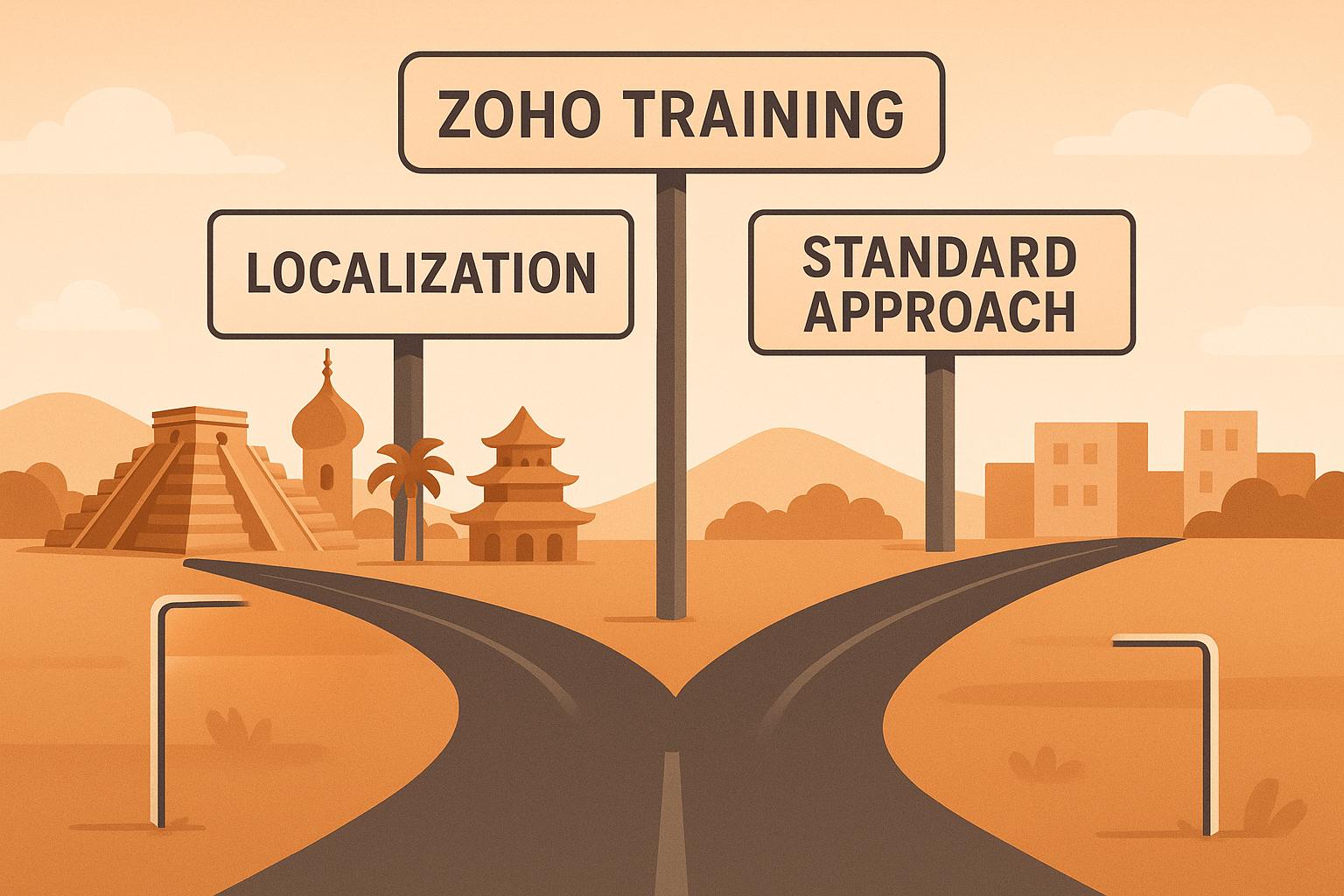
Choosing the right Zoho training method is critical for successful implementation. The two main options are standard training and localized training, each serving different needs.
- Standard Training: A uniform, one-size-fits-all method. It’s cost-effective, quick to deploy, and focuses on Zoho’s core features. Best for small businesses or teams with simple workflows.
- Localized Training: Tailored to regional, linguistic, and cultural specifics. It aligns with local regulations and workflows, ensuring higher engagement and faster adoption. Ideal for large, multinational companies or regulated industries.
Key Takeaways:
- Standard training is affordable and scalable but lacks regional customization.
- Localized training costs more upfront but addresses specific needs, improving adoption and compliance.
- A hybrid approach combines both methods, offering flexibility for mixed-use cases.
Quick Comparison:
| Criteria | Standard Training | Localized Training |
|---|---|---|
| Cost | Low | High |
| Deployment Speed | Fast | Slower |
| Regional Relevance | General | Specific |
| Compliance Coverage | Basic | Integrated |
| User Engagement | Moderate | High |
Choosing the right method depends on your business size, industry, and team needs. Partnering with Zoho experts can further streamline your training process.
Standard Training Method: Features, Benefits, and Use Cases
Standard training provides a straightforward way to learn Zoho’s core functionalities, focusing on universal workflows that work well across various industries and business types.
Key Features of Standard Training
This training method relies on pre-designed curricula that cover the essentials of Zoho. The material is structured to guide learners from basic navigation to more advanced features, using consistent terminology and relatable examples.
Standard workflows are a key component, covering processes like setting up customer records in Zoho CRM or managing invoices in Zoho Books. These scalable modules are designed to accommodate both small teams and larger groups, ensuring a smooth onboarding experience for everyone.
Participants also gain access to a range of resources, including user manuals, video tutorials, and reference sheets. These materials provide a solid foundation for learning and make it easier to revisit concepts as needed.
Benefits of Standard Training
One of the biggest advantages of standard training is its affordability. Since the materials are pre-developed, businesses can save on the costs typically associated with creating custom training programs.
Speed is another major plus. Companies that need to get their teams up and running quickly can implement standard training without the delays that often come with customized solutions.
This approach also ensures consistency. All team members learn the same workflows and processes, which reduces confusion during collaboration and simplifies onboarding for new hires.
Additionally, the training content is regularly updated based on user feedback. This helps keep the materials relevant and effective for a variety of learning needs.
Managing training programs becomes easier, too. With a single set of standardized resources, HR and IT teams can oversee the training process without juggling multiple versions or formats. This makes it a great fit for companies that prioritize quick rollouts and uniform processes.
Use Cases for Standard Training
Standard training is a smart choice for businesses with straightforward operations, particularly those based in the U.S., where it aligns with local practices like date formats (MM/DD/YYYY), currency ($), and customary measurement units.
It works well for teams that are already comfortable with English-language software and have experience adapting to new digital tools. These groups often find the general workflows provided in standard training easy to adopt.
This training method is especially useful in situations requiring quick implementation, such as system migrations, company acquisitions, or other time-sensitive transitions. Rapid deployment ensures that businesses can start training without delay.
Industries with well-defined processes – such as professional services, retail, or manufacturing – often find that standard training meets their needs effectively. It’s also a practical option for organizations looking to balance cost efficiency with effective learning outcomes.
Localized Training Method: Features, Benefits, and Use Cases
Localized training introduces a tailored approach to Zoho education, moving away from generic materials to focus on region-specific needs. It adapts the training content to align with regional, cultural, and business-specific requirements, ensuring a more meaningful learning experience.
Key Features of Localized Training
One of the standout aspects of localized training is its ability to adjust details like date formats, currency symbols, and measurement units to fit regional norms. For instance, U.S. teams might see MM/DD/YYYY formats, while European teams work with DD/MM/YYYY.
Language adaptation goes far beyond basic translation. It incorporates cultural nuances, business-specific terminology, and communication styles that resonate with local audiences. Technical terms are explained using relatable examples, and workflows are demonstrated with scenarios that reflect actual regional practices.
Regulatory compliance integration ensures that training materials include local legal requirements, tax systems, and industry-specific regulations. This means users learn to use Zoho tools within the framework of their specific regulatory environment.
The training also embraces role-based customization, tailoring content to reflect how different roles function in various cultural and organizational structures. This includes addressing local management hierarchies, decision-making protocols, and communication styles.
Finally, interactive elements are designed to match regional learning preferences. Some regions may favor collaborative group exercises, while others might benefit more from self-paced modules. This customization ensures the training resonates with diverse audiences and delivers tangible results.
Benefits of Localized Training
Localized training creates stronger engagement by presenting users with familiar business scenarios, local terminology, and data formats they encounter daily. This familiarity helps users connect with the material more effectively.
This approach also reduces implementation time and improves retention. Because the training mirrors real-world scenarios, users can immediately apply what they learn, eliminating the need to adapt generic examples to their specific work environment.
Localized training boosts user confidence by addressing their unique situations. Confident users are more likely to adopt new features enthusiastically and explore advanced functionalities, leading to better overall outcomes.
Additionally, better compliance outcomes are achieved when local regulations are integrated into the training from the start. This proactive approach eliminates the need to retrofit compliance requirements later, saving time and reducing errors.
Finally, cultural alignment plays a vital role. Training that respects local customs and communication styles creates a more comfortable learning environment, improving knowledge retention and fostering positive attitudes toward the new system.
Use Cases for Localized Training
Localized training proves invaluable for several scenarios:
- Multi-national corporations: Companies with operations across different regions benefit from training that addresses varying tax systems, reporting requirements, and business practices.
- Regulated industries: Industries with strict compliance requirements need training that incorporates these rules from the outset, ensuring proper implementation.
- Organizations with diverse skill levels: Teams in some regions may have advanced software experience, while others require more foundational support.
- Companies expanding into new markets: Localized training helps teams navigate the regulatory and cultural specifics of new regions, avoiding costly mistakes.
- Businesses with complex organizational structures: Training tailored to regional management styles and decision-making processes ensures smoother adoption.
- Remote or distributed teams: Teams spread across time zones and cultures benefit from training that accommodates varying learning preferences.
Although localized training requires more planning and resources upfront, the payoff is clear. It leads to faster adoption, fewer support issues, and better utilization of advanced features. For organizations operating in diverse, complex, or highly regulated environments, this approach ensures smoother Zoho adoption and long-term success.
Standard vs. Localized Training: Direct Comparison
Deciding between standard and localized training methods requires a clear understanding of how each approach impacts key business areas. This choice influences everything from upfront costs to how quickly users adopt the system and how efficiently operations run over time. Let’s break down the differences in cost, deployment speed, and overall return on investment (ROI).
Comparison Table of Key Criteria
Here’s a side-by-side look at how standard and localized training stack up:
| Criteria | Standard Training | Localized Training |
|---|---|---|
| Initial Cost | Lower upfront investment | Higher initial cost due to tailored content |
| Time to Deploy | Quick to implement | Takes extra time to include regional nuances |
| Scalability | Easily scalable across regions | Scaling requires additional effort for local details |
| Regional Alignment | Uses general examples without specific context | Features scenarios tailored to local environments |
| Compliance Coverage | Basic compliance requiring further refinement | Incorporates local regulations directly |
| User Engagement | Moderate engagement due to a generic approach | Higher engagement through contextually relevant content |
| Support Requirements | More ongoing support needed for clarification | Reduced support needs thanks to localized focus |
| ROI Timeline | Lower initial cost but delayed ROI | Faster ROI despite higher upfront investment |
This comparison highlights the trade-offs between the two approaches, setting the stage for a deeper dive into their impact on business outcomes.
Analyzing the Impact on Business Outcomes
The choice between standard and localized training methods has a ripple effect on several critical business areas:
- User Adoption: Localized training helps users adopt systems faster by tailoring content to their specific regional operations. In contrast, standard training, with its one-size-fits-all approach, often leads to slower adoption rates.
- Training Effectiveness: Generic content in standard training can make it harder for users to connect the material to their daily tasks. Localized training bridges this gap by using relevant examples, enabling users to grasp concepts more effectively and apply them in practice.
- Time-to-Productivity: Teams trained through standard methods often take longer to translate what they’ve learned into actionable results. Localized training, on the other hand, speeds up the process by aligning examples with actual workflows.
- Support Requirements: Because localized training addresses region-specific details upfront, it tends to reduce the need for post-training support, unlike standard training, which often leaves users seeking further clarification.
- Return on Investment (ROI): While standard training may seem cost-effective initially, its slower adoption and higher support needs can delay ROI. Localized training, despite its higher upfront costs, often delivers faster and more impactful returns.
- Compliance: Localized training integrates local compliance requirements directly into the program, eliminating the need for additional adjustments after the fact.
- Employee Satisfaction: When training content reflects real-world challenges and regional specifics, employees feel more confident and engaged, leading to consistent adoption and satisfaction.
Understanding these differences makes it easier to align your training approach with your business goals, ensuring both immediate and long-term success.
sbb-itb-058cafb
Best Practices for Choosing the Right Training Method
To ensure a smooth transition to Zoho, your training strategy should align with your organization’s specific operational needs and compliance requirements. Choosing between standard and localized training is a critical decision – it directly affects user adoption, efficiency, and overall costs.
Assessing Company Needs
Start by evaluating your workforce’s structure and distribution. A team spread across multiple locations will face challenges that a centralized team might not. Also, consider the range of technical skills and language preferences among your employees.
For smaller organizations, standard training often suffices. Larger enterprises, however, may find tailored training more effective due to varied departmental demands and regional differences.
Don’t overlook regulatory requirements. Industries like healthcare, finance, and manufacturing often need training programs that adhere to strict local compliance standards.
Budget and timeline are also key factors. While localized training might require a higher upfront investment, think long-term. Factor in the total cost of ownership, including ongoing support, retraining, and potential productivity dips during the adoption phase.
If your organization has limited internal training resources, standard training might be the best fit. On the other hand, companies with robust internal training teams often succeed with hybrid approaches that combine standard and localized methods.
Once you’ve identified your needs, you can leverage Zoho’s tools to fine-tune your training program.
Using Zoho’s Built-in Localization Features
Zoho offers a range of customization options to help you tailor training to your team’s needs. Its multi-language support, covering over 25 languages, allows you to create training materials suited for diverse teams without starting from scratch.
Zoho’s regional customization options are another powerful tool. For instance, in Zoho CRM, you can adjust settings like territory management, currency, and time zones to mirror your operational setup. Training users in an environment that reflects their actual workflows ensures a smoother learning process.
With role-based access controls, you can design training scenarios that align with the permissions users will have in their daily roles. This prevents confusion caused by training on features they won’t actually use.
Zoho’s workflow automation can also be tailored to reflect regional business processes during training. This is especially beneficial for companies operating across different states or regions with varying requirements.
Additionally, custom fields and modules in tools like Zoho Creator allow you to incorporate industry-specific terminology and processes into your training. This bridges the gap between generic content and your company’s unique operations.
Considering Hybrid Training Models
When a single approach doesn’t meet all your needs, a hybrid model can provide the best of both worlds. Many organizations find success by combining standard and localized training methods. Typically, this involves starting with standardized core training to cover universal Zoho features, followed by localized modules tailored to specific regional, departmental, or compliance needs.
This model is especially effective for multi-location businesses. For example, sales processes might be consistent across all locations, but inventory management could vary depending on local supplier relationships or state regulations.
A phased implementation is another hybrid strategy worth considering. Begin with standard training to get everyone familiar with the basics, then roll out localized sessions for advanced features or region-specific needs.
Hybrid training also allows for role-specific customization. For instance, while all employees might complete the same foundational training, managers could receive additional modules on regional reporting requirements, and compliance officers might focus on local regulatory features.
From a cost perspective, the hybrid model is efficient. You can focus localization efforts on areas where they’ll make the most impact, such as complex processes that vary significantly by location or department, while relying on standard training for universal features.
Finally, ongoing support structures complement hybrid approaches well. Maintain centralized help documentation and basic support resources, but also offer localized support channels for region-specific questions or compliance issues. This ensures efficient resource allocation while addressing diverse team needs effectively.
The Role of Expert Partners in Training Customization
While Zoho’s built-in features allow for a good degree of training customization, bringing in expert partners can make the process faster and more reliable. These professionals bring the technical know-how needed to turn basic training into a powerful tool tailored to your business needs. Whether you’re leaning toward localized or standard training, expert partners fine-tune the process to align with your specific operational goals. Since deciding between these training methods can be challenging, having professional guidance ensures the solutions not only fit Zoho’s capabilities but also meet your industry’s unique demands. This collaboration lays the foundation for training that’s both effective and personalized.
How AorBorC Technologies Supports Businesses
AorBorC Technologies takes Zoho customization to the next level, offering services that go far beyond basic setup. They tailor Zoho CRM to fit your business processes before training even begins, ensuring the system aligns with your workflow. By implementing Zoho One, they can identify where localized training might be more effective than a standard approach, creating a system that feels intuitive and relevant to your team.
They also specialize in using Zoho Creator to develop custom training modules. These modules are designed to replicate your real-world workflows, creating a learning experience that’s practical and directly applicable. This approach enhances knowledge retention and helps employees get up to speed faster, reducing the time it takes for them to become fully productive.
Beyond initial setup and training, AorBorC Technologies provides ongoing support by connecting you with the right Zoho partners. As your business evolves, they ensure you have access to specialized resources to tackle new challenges while keeping your systems seamlessly integrated with your broader technology stack.
Benefits of Partnering with Experts
When it comes to tailored training, working with expert partners offers a range of advantages. Specialized partners like AorBorC Technologies streamline implementation by using proven frameworks, helping to configure systems more efficiently. Their experience helps avoid common mistakes that can lead to delays or compliance issues, reducing risks from the start.
These experts also help cut down on rework and downtime, making the entire process more cost-effective. With their deep understanding of industry trends and Zoho’s evolving capabilities, they ensure your training programs stay relevant and continuously improve over time. Acting as both technical experts and strategic advisors, they help your organization stay ahead by anticipating future training needs and adapting to new challenges, keeping you competitive in a dynamic market.
Conclusion: Key Takeaways on Localization vs. Standard Training
Choosing between localized and standard Zoho training depends on understanding what aligns best with your business goals. For companies with straightforward workflows and limited budgets, standard training offers an affordable and quick solution. It’s especially useful for small businesses or startups where maintaining consistency across basic functions takes priority over customization.
On the other hand, companies operating in multiple regions or dealing with strict compliance requirements often gain more from localized training. While the upfront cost is higher, the tailored approach leads to better productivity, faster onboarding for new employees, and stronger user adoption – benefits that often outweigh the initial investment.
Many organizations find success with a hybrid approach, which combines the best of both worlds. Starting with standard training for foundational functions and layering in localized elements for critical processes allows you to gradually scale your training efforts. This approach helps you grow your program without straining resources or budgets early on.
Additionally, partnering with experts can make a significant difference. Providers like AorBorC Technologies specialize in aligning Zoho training with your actual business needs. By customizing your system before training begins, they create a smoother learning experience that directly improves day-to-day performance.
Keep in mind that your training strategy isn’t set in stone. As your business evolves, so can your approach. Adjust your model to meet new challenges while maintaining efficiency and ensuring your Zoho implementation continues to support your growth.
FAQs
What should businesses consider when choosing between localized and standard Zoho training?
When choosing between localized and standard Zoho training, it’s essential to consider your business’s specific needs and objectives. Localized training works well if your team benefits from content tailored to local languages, regional business practices, or unique workflows. This approach can make training more relevant and engaging, especially for teams spread across different locations.
In contrast, standard training focuses on consistency, making it a solid option for businesses looking to unify processes and ensure uniform practices across various regions. Another factor to weigh is how frequently your organization updates its workflows or software. Localized training might provide more flexibility to accommodate those changes.
The key is finding the right balance between customization and consistency to align with your business goals.
How does localized training improve compliance and engagement compared to a standard approach?
Localized training makes a big difference by customizing content to meet the unique needs of regional audiences. Using local languages, acknowledging cultural nuances, and addressing specific regional regulations make the material easier to understand and more relatable. This approach not only makes learning feel more inclusive but also helps create a stronger connection with the audience.
It also boosts motivation and participation by tackling region-specific challenges and preferences directly. The result? Higher engagement, improved knowledge retention, and more effective compliance outcomes. For companies working across various regions, this tailored method can play a key role in improving training success and enhancing employee performance overall.
How can a hybrid training model benefit a diverse and geographically dispersed workforce?
A hybrid training model is a smart way to address the needs of diverse teams, especially those spread out across different locations. By blending in-person sessions with virtual learning, it allows employees to balance their training with work responsibilities, giving them the freedom to learn at their own pace. This mix also encourages teamwork across various offices, making it a great fit for global organizations.
This approach boosts both engagement and knowledge retention by catering to different learning styles and preferences. It also breaks down geographical barriers, offering a training experience that supports a diverse workforce while keeping productivity in focus.