
AdonisJS is a TypeScript-first Node.js framework designed to simplify backend development, especially for systems requiring modular architecture. Modular architecture breaks applications into independent components, enabling easier scaling, maintenance, and team collaboration. AdonisJS supports this approach with built-in tools like an ORM (Lucid), MVC structure, and features like routing, middleware, and service providers.
Key Takeaways:
- AdonisJS Benefits:
- Predefined structure reduces decision-making.
- TypeScript ensures fewer errors and better code quality.
- Built-in tools for authentication, email handling, and more.
- Modular Architecture Advantages:
- Independent modules simplify scaling and updates.
- Teams can work on separate modules simultaneously.
- Easier compliance for sensitive data (e.g., HIPAA, PCI DSS).
- Features:
- Organized folder structure for modular development.
- Tools for creating modules, routing, and middleware.
- Lucid ORM for managing module-specific data.
AdonisJS is particularly useful for small and medium businesses needing scalable systems without overhauling their entire backend. However, it has a learning curve and a smaller community compared to other frameworks. For businesses looking to build structured, scalable backends, AdonisJS offers a solid foundation.
Key AdonisJS Features for Modular Systems
AdonisJS offers a range of built-in features that simplify the process of building independent, high-quality modules.
MVC Pattern for Code Organization
AdonisJS follows the Model-View-Controller (MVC) pattern, which helps developers organize code by separating responsibilities into three layers. This structure is especially useful for creating modular systems, as it keeps different components of the application independent and easy to manage.
- Models handle data operations and business logic. In a modular setup, each module can include its own models to manage specific data entities. For instance, one module might have a
Usermodel for managing user data, while another module uses aProductmodel for inventory-related tasks. This keeps data operations neatly contained within their respective modules. - Controllers act as the bridge between models and views, managing HTTP requests and responses. In a modular design, each module can have its own controller to handle its specific functionality. For example, a
UserControllercould manage user-related endpoints, while aPaymentControlleroversees payment processing. - Views focus on presenting data, often as JSON responses for APIs in modern backend development. Each module can define its own response formats, ensuring consistency within the module while allowing flexibility across the application.
By grouping related functionality and maintaining clear boundaries, the MVC pattern allows teams to work on separate modules simultaneously without stepping on each other’s toes. This structure also ensures that the codebase remains organized and scalable.
Folder Structure for Modular Development
AdonisJS reinforces modular development with its well-thought-out folder structure. This default organization helps developers keep their code organized and manageable as the application grows.
- The app directory contains the core logic of the application, with subdirectories for Controllers, Models, Middleware, and Services. Developers can extend this structure by creating module-specific subdirectories, keeping related files together.
- The database folder stores migrations, seeders, and factories. These can be organized by module, making it easier to manage database changes. For example, each module can include its own set of migration files to ensure that updates to the database remain isolated.
- The start directory includes bootstrap files, such as route definitions and service provider registrations. This setup simplifies the process of adding new modules and their dependencies as the application evolves.
- Config files allow for module-specific settings, ensuring that configurations for one module don’t interfere with others.
This structured approach makes the codebase easier to navigate, helps new developers get up to speed quickly, and minimizes the risk of errors.
Routing, Middleware, and Service Providers
AdonisJS’s routing, middleware, and service provider systems form the backbone of its modular design, enabling developers to build independent yet interconnected components.
- Routing in AdonisJS allows routes to be defined within specific modules. This keeps routing logic separate and organized. For example, a route like
/users/searchcan be tied to a dedicated controller action within a user module, maintaining clarity and modularity. - Middleware adds custom logic to HTTP requests before or after they’re processed. This is particularly useful for modular systems, as it enables cross-cutting concerns – like authentication or logging – to be applied to specific routes or groups of routes without cluttering the core logic. Middleware can also be organized by module for better separation of concerns.
- Service Providers play a key role in managing dependencies. They use AdonisJS’s Inversion of Control (IoC) container to register and resolve services, making it easier to integrate external packages or swap out components. This promotes loose coupling, ensuring that modules remain flexible and maintainable.
Together, these tools ensure a seamless experience when building modular systems. Routes define how each module interacts with the outside world, middleware applies shared behaviors, and service providers handle the behind-the-scenes dependencies that keep everything running smoothly.
Building Modular Components in AdonisJS
When working with AdonisJS, modular components help break down a large codebase into smaller, manageable units. Each module serves a specific purpose, making the application easier to maintain and allowing teams to work on different parts independently. Let’s dive into how you can create, customize, and organize these modules effectively.
Creating Independent Modules
AdonisJS makes it simple to create independent modules that isolate specific functionality. One of the best tools for this is the @adonisjs-community/modules package, which provides scaffolding for feature-based development. This package ensures that your modules follow consistent patterns, saving time and reducing errors.
To get started, install the package with the command:
node ace add @adonisjs-community/modules Once installed, you can create a new module using:
node ace make:module <module_name> For instance, running node ace make:module auth will generate a /app/auth directory and register a path alias #auth/* for easier imports. Each module is self-contained, meaning it includes everything needed for its functionality. For example:
- An auth module might include login controllers, user models, and password reset services.
- A reporting module could house analytics models, dashboard controllers, and export services.
Path aliases make your code cleaner and easier to maintain. Instead of using relative paths like ../../services/UserService, you can use #auth/services/UserService.
To add components to your module, use the --module or -m flag with AdonisJS commands. For example:
node ace make:controller SignIn -m=authwill place theSignIncontroller in theauthmodule.node ace make:model User -m=authwill create theUsermodel within theauthmodule.
This keeps everything organized and ensures related functionality stays together.
Custom Middleware and Service Providers
After creating modules, you can address shared concerns like authentication or logging with custom middleware and service providers. These tools allow modules to interact without becoming too dependent on one another.
Custom middleware applies specific logic to routes or modules. For example, in an authentication module, middleware might validate JWT tokens, check user permissions, or log security events. Middleware keeps your controllers clean by handling these tasks separately.
AdonisJS’s IoC container simplifies dependency management. Using constructor injection, method injection, or the @inject() decorator, you can automatically resolve dependencies. For instance:
constructor(private userService: UserService) {} This approach eliminates the need for manual instantiation.
Service providers are another key component. They manage the lifecycle of a module, handle bindings, and extend functionality. For example, a service provider for an auth module might register custom validation rules or configure third-party authentication packages. Providers operate through lifecycle hooks like register, boot, and shutdown, ensuring that services are initialized and dependencies are resolved at the right time.
Database Organization with Lucid ORM
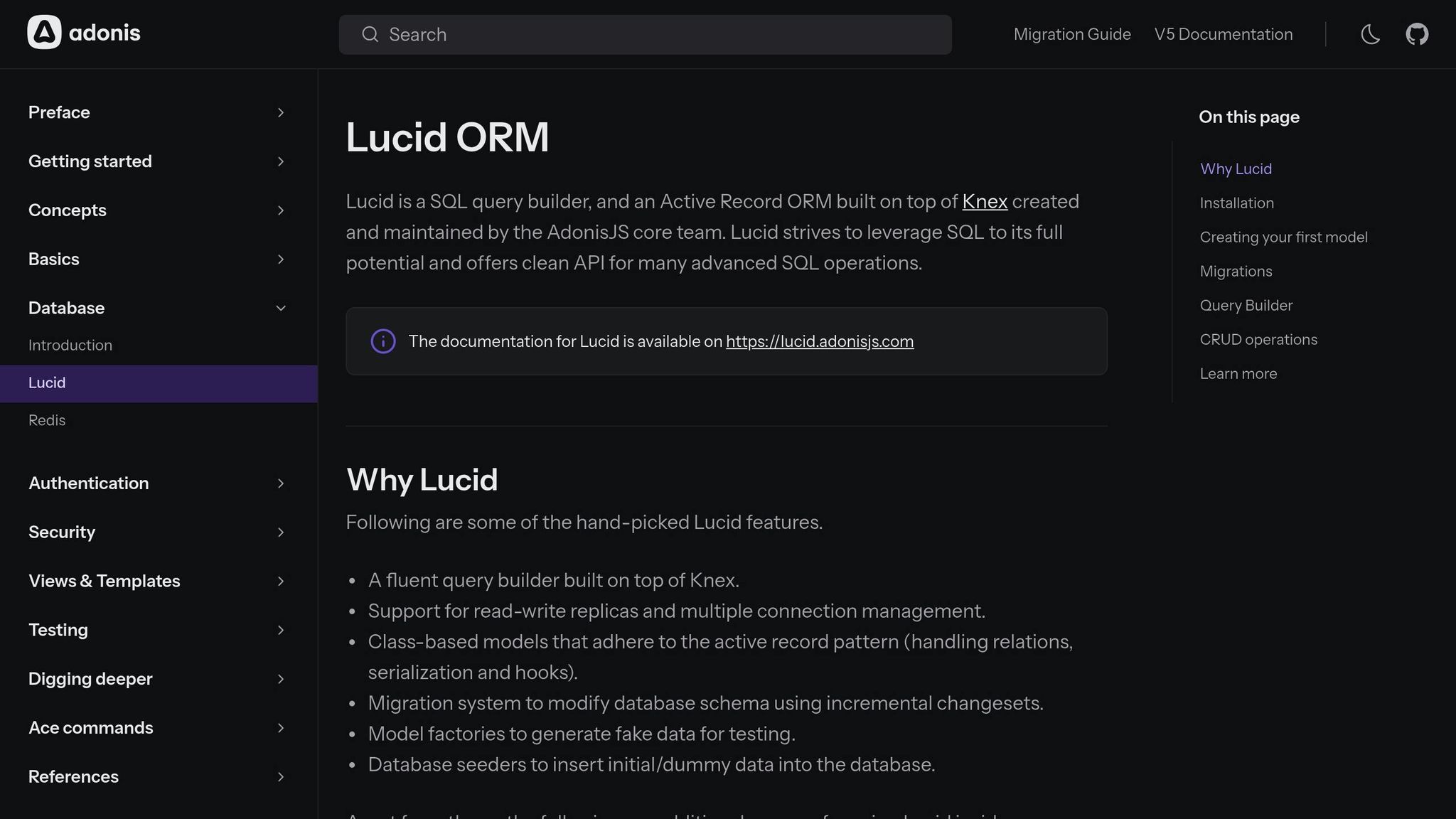
Lucid ORM fits perfectly into a modular setup, allowing each module to manage its data while maintaining overall database integrity. Models and migrations work together to keep your database organized.
Model organization follows the same modular principles. Use the -m flag to create models within specific modules. For example:
node ace make:model User -m=authcreates aUsermodel within theauthmodule.node ace make:model Product -m=ecommercecreates aProductmodel in theecommercemodule.
Lucid ORM also supports relationships across modules. A User model in the auth module can establish relationships with an Order model in the ecommerce module. These relationships are seamless, ensuring your modular organization doesn’t limit functionality.
Migrations, however, remain centralized in the database/migrations directory. This global approach ensures that all schema changes are tracked in one place, making it easier to manage database versioning and deployment. Migration files include timestamps, so they execute in the correct order, regardless of the module they belong to.
For better TypeScript integration, create declaration files in the contracts directory. These files provide type information for your module’s components, ensuring IoC aliases like @ioc:App/Models/User work properly with type checking.
Lucid ORM’s query builder and relationship loading also work seamlessly across modules. You can:
- Eager load relationships from other modules.
- Apply scopes defined in different modules.
- Use global query constraints that span multiple modules.
This flexibility ensures that your modular design doesn’t compromise how you access and manage data.
Customizing AdonisJS for Business Requirements
AdonisJS, with its modular design, offers plenty of room for tailoring the framework to meet specific business needs. While the default features are robust, many businesses require additional capabilities to address unique challenges. AdonisJS makes it possible to extend and customize its functionality without compromising on code clarity or scalability. Here’s a closer look at how you can adapt AdonisJS to align with your business goals.
Best Practices for Extending AdonisJS
AdonisJS provides several tools and patterns to help developers extend its core functionality effectively:
- Macros and Getters: These allow you to add methods or define deferred properties for existing classes like
Request,Response,HttpContext, and more. Keeping these extensions in dedicated files ensures your code remains organized. For instance, you might create astart/extend.tsfile to house such customizations:import { Request } from '@adonisjs/core/http' Request.macro('getClientIP', function () { return this.ip() || this.header('x-forwarded-for') || 'unknown' }) Request.getter('isApiRequest', function () { return this.header('accept')?.includes('application/json') || false }) - Service Providers: Use these for more complex extensions or configurations. With lifecycle hooks like
register,boot, andshutdown, you can ensure services or third-party packages are initialized properly and at the right time. - Database Hooks: Lucid ORM supports hooks that let you implement business rules, data validation, or audit trails directly within your models. These hooks trigger automatically during database operations, ensuring consistent behavior throughout your app.
- Service Layer Patterns: By creating service classes to handle intricate business logic, you can keep your controllers focused and your models clean. This separation improves modularity and simplifies testing.
- TypeScript Declaration Merging: When extending AdonisJS, maintaining type safety is crucial. Use the contracts directory to declare new methods or properties, ensuring seamless IDE support and fewer type-related errors.
- IoC Container: The Inversion of Control (IoC) container streamlines dependency management. You can register services, repositories, or utilities in the container and inject them wherever needed, promoting loose coupling and maintainability.
Managing Extensions for Large Teams
When working in larger teams, organizing and managing customizations becomes even more important. Here are some strategies to ensure smooth collaboration and maintain code quality:
- File Organization: Structure your customizations clearly. For example:
- Use
app/extensionsfor macros and getters. - Use
providersfor service providers. - Use
app/servicesfor business logic.
- Use
- Naming Conventions: Avoid naming conflicts by prefixing methods with the module name. For instance, instead of
getDiscount(), opt forgetEcommerceDiscount(). - Documentation: Internal documentation is a must when multiple developers are involved. Include clear explanations, usage instructions, and code examples for each customization. This helps new team members get up to speed quickly.
- Version Control: Use feature branches for new customizations and enforce code reviews before merging. This not only ensures quality but also helps spread knowledge across the team.
- Testing: Treat customizations like any other part of your application. Write unit tests for service classes, integration tests for service providers, and functional tests for macros. Automated testing helps catch issues early and ensures reliability.
- Centralized Configuration: Manage settings for extensions using AdonisJS’s built-in configuration system. This makes it easy to adjust behavior across environments without modifying the code.
- Team Communication: Establish clear processes for proposing, reviewing, and deprecating extensions. Regular discussions about architectural decisions help maintain consistency and avoid redundant work.
sbb-itb-058cafb
Benefits and Challenges of AdonisJS Modular Development
AdonisJS brings both opportunities and obstacles when it comes to modular backend architecture. Choosing this framework involves trade-offs that can shape your development process and the success of your project in the long run. Let’s break down the benefits and challenges to help you make an informed choice.
Benefits of AdonisJS
AdonisJS is designed to make modular backend architecture more efficient, offering several advantages along the way.
Scalability and productivity are standout features. Thanks to its modular design, AdonisJS allows you to develop, test, and deploy components independently. This makes it easier for your application to adapt and grow as your business evolves.
Native TypeScript support sets AdonisJS apart. With built-in TypeScript, developers benefit from features like compile-time error checking and smoother refactoring, which can significantly improve both reliability and development speed.
A built-in testing framework ensures quality control. AdonisJS provides tools for thorough module testing, which becomes increasingly important as your application’s complexity grows.
Developer-friendly features save time. Automatic code reloading, clear error messages, and an intuitive CLI contribute to a smoother development experience, reducing friction during the project lifecycle.
Security is baked into the framework. AdonisJS offers built-in defenses against common vulnerabilities like SQL injection, cross-site scripting (XSS), and cross-site request forgery (CSRF), making it a solid choice for projects handling sensitive data.
While these benefits are compelling, there are practical challenges you’ll need to navigate.
Challenges to Consider
Despite its strengths, modular development with AdonisJS comes with its own set of hurdles.
The learning curve can be steep. Developers who are new to modular architecture or transitioning from simpler frameworks may need time to fully grasp how to structure modules, manage dependencies, and make the most of AdonisJS’s features.
Over-engineering is a real risk. It’s easy to go overboard by creating separate modules for minor features, which can lead to unnecessary complexity. Striking the right balance requires careful planning and experience.
Documentation isn’t always exhaustive. While the core documentation is solid, it doesn’t always cover advanced modular patterns or edge cases, which can slow down development.
A smaller community means fewer resources. Compared to more established frameworks, AdonisJS has fewer third-party packages and less community-generated content, which might lead to longer wait times for support.
Performance overhead may be a concern. The framework’s rich feature set and modular architecture can introduce slight performance costs, which might not be ideal for projects with tight performance requirements.
Pros and Cons Comparison
| Advantages | Challenges |
|---|---|
| Native TypeScript support with great IDE integration | Steep learning curve for those new to modular systems |
| Modular design allows independent development and testing | Risk of over-engineering for simpler projects |
| Strong security features built directly into the framework | Smaller community with limited third-party resources |
| Developer-friendly tools like CLI and auto-reloading | Documentation gaps for advanced scenarios |
| Integrated testing framework tailored for modular setups | Performance overhead due to added abstraction layers |
| Supports team scalability with clear module separation | Managing complexity requires architectural expertise |
| Built-in ORM (Lucid) with migrations and seeding | Framework lock-in can limit future flexibility |
| IoC container for clean dependency management | Longer initial setup compared to simpler frameworks |
If you’re building a complex application with a team of developers, the benefits of AdonisJS often outweigh the challenges. However, it’s essential to evaluate your project’s specific needs, your team’s expertise, and your long-term goals before committing to this framework.
Summary and Key Points
AdonisJS stands out as a strong option for businesses aiming to build scalable and modular backend systems that can adapt to their growth. This guide has highlighted how this Node.js framework tackles modern web development challenges with its well-thought-out modular architecture.
Why AdonisJS Stands Out
The modular design of AdonisJS is its standout feature, allowing developers to create independent, testable components that integrate smoothly. This makes handling complex backend requirements easier, enabling businesses to scale without compromising code quality or maintainability.
With built-in TypeScript support, AdonisJS helps catch errors during compile time, leading to more reliable code and fewer runtime issues – an essential factor for businesses that depend on robust systems.
The framework’s MVC (Model-View-Controller) pattern ensures a clear separation of concerns. Controllers handle incoming requests, models manage data, and views present information, creating a well-organized structure.
Security is baked into the framework, offering protection against threats like SQL injection, XSS attacks, and CSRF vulnerabilities. This proactive approach strengthens data security without requiring additional tools.
Lucid ORM simplifies database operations, providing flexibility while allowing developers to focus on business logic rather than complex SQL queries.
Developer-friendly tools like the CLI, automatic code reloading, and detailed error messages streamline the development process, boosting productivity and reducing friction.
These features collectively enable businesses to improve their backend systems strategically and effectively.
Practical Steps for Businesses
For businesses considering AdonisJS, taking actionable steps can help ensure a smooth transition and maximize its potential. Here are some key recommendations:
- Start Small: Test AdonisJS with a pilot project. Choose a smaller application or a new feature where the framework’s modular architecture can shine without risking existing systems.
- Invest in Training: If your team is new to TypeScript or modular patterns, invest in training. While there’s a learning curve, this effort results in higher code quality and faster development in the long run.
- Plan Your Architecture: Before diving into development, map out how different modules will interact and where flexibility might be needed in the future. This preparation avoids costly architectural issues down the road.
- Use Testing Tools Early: Take advantage of AdonisJS’s integrated testing tools from the start. These tools make it easier to maintain quality as your application grows, which is critical for businesses relying on digital systems for daily operations.
For businesses partnering with solution providers, AdonisJS offers a reliable foundation for custom applications, CRM integrations, and enterprise systems that need to adapt to evolving demands. Its modular design makes it particularly suitable for organizations planning for growth or frequent updates.
Ultimately, adopting AdonisJS requires weighing its powerful features against the complexity it introduces. For those ready to invest in scalable and maintainable backend architecture, AdonisJS provides the structure and tools to build systems that keep pace with business success.
At AorBorC Technologies, we specialize in using modern frameworks like AdonisJS to craft custom backend solutions tailored to meet your business’s evolving needs. Let’s build the systems that drive your growth.
FAQs
How does AdonisJS’s modular architecture help small and medium businesses scale and maintain their backend systems?
AdonisJS’s Modular Architecture: A Boost for SMBs
AdonisJS offers a modular setup that’s perfect for small and medium businesses (SMBs) aiming to grow while keeping their backend systems simple and efficient. Its design makes it easy for developers to add, update, or remove features without causing disruptions to the rest of the system. This flexibility ensures businesses can adapt quickly as their needs change.
By keeping the code well-structured and easy to manage, AdonisJS reduces complexity and allows for faster updates. For SMBs, this translates to less downtime, quicker feature launches, and the ability to stay competitive – all while keeping maintenance costs in check and leaving room for growth.
What challenges might developers face when using AdonisJS for modular backend development, and how can they address them?
Developers diving into AdonisJS might encounter a few hurdles. For starters, its opinionated structure means you’ll need to get comfortable with its specific conventions, which can be a shift if you’re used to more flexible frameworks. Plus, AdonisJS’s TypeScript-first approach might feel a bit foreign if you’re coming from a plain JavaScript background. Another challenge? The smaller community compared to other big-name backend frameworks, which can make finding support a bit trickier.
That said, there are plenty of ways to navigate these challenges. The official documentation is a great place to start – it offers in-depth guidance on modular design and best practices. You can also tap into community forums, join discussions, and keep up with updates like AdonisJS 7 to stay in the loop. If you’re just starting out, hands-on tutorials and building small projects are excellent ways to ease into the framework and build confidence.
How does using TypeScript with AdonisJS improve development and code quality?
Integrating TypeScript with AdonisJS can make a noticeable difference in your development workflow. One of the biggest advantages is strong typing, which helps catch potential errors early in the development phase. This means fewer bugs and a codebase that’s easier to maintain over time.
TypeScript also brings intelligent code suggestions and autocompletion to the table, making the coding experience smoother and more efficient. These features not only speed up the process but also make it more intuitive for developers.
Another key benefit is how TypeScript supports scalability in larger projects. By enforcing a clear structure and consistent practices, it helps maintain order as your codebase grows. Together, AdonisJS and TypeScript create a solid foundation for building reliable and modular backend systems.